




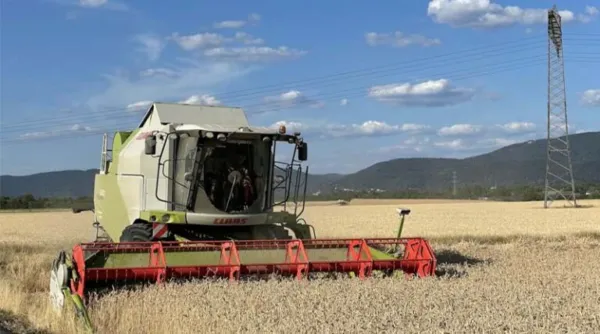

21 May 2026, New Delhi: The fields of tomorrow look nothing like those of a decade ago. Walk across a modern farm today and you might see a drone fleet scanning canopies for early signs of fungal disease, a tractor navigating row after row without a human hand on the wheel, or seedlings growing under calibrated LED arrays in an urban warehouse.
Agriculture - humanity's oldest occupation - is being reimagined from the soil up.
The pressure behind this transformation is existential. The Food and Agriculture Organization (FAO) estimates that humanity must produce roughly 70% more food than today to feed a projected 9.7 billion people by 2050 - yet arable land and fresh water are becoming scarcer with every passing season. Climate change is already depressing yields across key growing regions. Technology is no longer optional for forward-thinking farmers; it has become the backbone of global food security.
This report, grounded in the latest market research and field data from leading institutions, identifies the ten most transformative technologies currently reshaping modern farming - and explains why each one matters for producers, investors, policymakers, and consumers around the world.
If there is a single technology that has done more to alter the act of farming than any other in recent memory, it is precision agriculture - the data-driven approach that treats every square metre of a field as its own distinct growing environment. Enabled by the Internet of Things, precision farming connects a web of soil sensors, moisture probes, weather stations, drones, and AI-powered analytics into one coherent intelligence layer across the farm.
The global precision farming market was valued at $11.38 billion in 2025 and is projected to reach $21.45 billion by 2032, growing at a CAGR of 9.5%, according to MarketsandMarkets (2025). Asia Pacific is forecast as the fastest-growing region, driven by rapid modernisation in China, India, and Indonesia where hundreds of millions of smallholders face acute pressure to raise yields on smaller and smaller parcels of land.
Variable-rate application systems can now adjust fertiliser and pesticide doses row by row, while soil moisture probes update field-condition data every few minutes. The result is a farm that applies inputs only where and when they are needed - eliminating the blanket-application approach that has characterised conventional farming for generations, dramatically cutting both costs and environmental impact.
What makes precision agriculture so compelling is that it is not a single tool but an architecture - the enabling layer on which every other technology in this list operates. A CRISPR-edited seed's potential cannot be fully realised without the soil intelligence to plant it optimally. An autonomous tractor is far more valuable navigating real-time field-health maps than a static GPS waypoint. Precision agriculture is the nervous system of the modern farm.
Artificial intelligence has crossed the threshold from pilot program to routine farm infrastructure. In 2024, approximately 58% of large-scale commercial farms globally reported using AI for crop management - up from 49% just one year earlier, according to Market Growth Reports (2025). That adoption rate is accelerating sharply.
Machine learning commanded 48.19% of AI agricultural spending in 2025, anchoring applications from yield forecasting to disease detection and autonomous weed removal, according to Mordor Intelligence. John Deere's See & Spray system uses convolutional neural networks to differentiate crops from weeds at 20 frames per second, cutting herbicide use by up to 90%.
AI-powered predictive weather modelling is now in use across an estimated 15 million farms globally, enabling better harvest planning and loss mitigation in the face of increasingly erratic climate patterns. Precision spraying via AI-enabled drones saw a 34% adoption increase in a single year, helping farmers reduce chemical usage by 27%. AI-based pest detection systems reduced crop damage by 18% in recent field trials, and computer vision tools are now used in over 30% of fruit harvesting operations to assess ripeness.
The AI in agriculture market stood at $5.9 billion in 2025 and is projected to reach $61.3 billion by 2035 - a compound annual growth rate of 26.3%, the fastest of any agricultural technology sector, according to Future Market Insights (2026).
- Yield prediction using historic and real-time satellite, soil, and weather datasets
- Disease and pest identification with accuracy rates exceeding 91% in field trials
- Automated irrigation systems that reduce water usage by 30-40% compared to conventional scheduling
- AI-powered supply chain logistics that reduce post-harvest losses and improve market timing
- Computer vision tools used in over 30% of fruit harvesting operations to assess ripeness
IBM, Microsoft, and Syngenta are among the major technology and seed companies pouring resources into machine learning platforms. In February 2025, IBM's Watson Decision Platform for Agriculture expanded its integration of AI, weather data, IoT, and blockchain tools to serve farms across multiple continents. The AI revolution in agriculture is not coming - it is already planted and growing fast.
The autonomous tractor was once science fiction. In 2026, it is a line item on procurement budgets across North America, Europe, and increasingly Asia. The global autonomous farm equipment market was valued at $70.9 billion in 2025, according to Global Market Insights, and is projected to nearly double to $144.7 billion by 2035 at a compound annual growth rate of 7.6%.
Modern autonomous agricultural robots combine GPS, LiDAR, computer vision, and machine learning to navigate complex field environments with sub-centimetre accuracy. John Deere's fleet of autonomous AI-powered tractors has already covered over 3 million acres across North America. Selective harvesting robots for berries, grapes, and tree fruits - crops that have historically resisted mechanisation - are now commercially available. Robotic weed control systems powered by machine learning reduced manual labour needs by 40% in soybean and corn operations in 2024.
For smallholders, the barriers are falling too. Affordable AI-as-a-Service pricing is removing capital constraints for agricultural cooperatives in Latin America and Sub-Saharan Africa, while 5G connectivity is giving autonomous sprayers and weeding robots the real-time positional accuracy they need without expensive infrastructure. The tractor that once required a skilled operator for sixteen-hour days is giving way to a machine that works through the night, guided by stars and satellites.
Today's agricultural drones carry multispectral cameras capable of detecting crop stress at resolutions invisible to the naked eye, thermal sensors for irrigation mapping, and precision-spray systems that apply inputs with surgical accuracy. The global agricultural drone market surpassed $6.5 billion by 2026, according to Farmonaut, cementing UAVs as one of the most rapidly adopted tools in modern agronomy.
Drone adoption for crop monitoring has seen a 25% annual increase, according to Technavio's precision agriculture research. Platforms from companies such as Taranis capture sub-millimetre imagery that can identify early fungal lesions on leaves, enabling fungicide applications 30-40% more targeted than conventional schedules. Some of the most sophisticated drone swarms can cover vast areas in a single pass, providing farmers with real-time field intelligence that previously required week-long scouting missions on foot.
Looking ahead, the integration of drones with broader farm data systems is accelerating. Some platforms now feed real-time drone-captured data directly into blockchain-based supply chains. The use case that once seemed futuristic - a fleet of autonomous drones conducting nightly patrols of a 5,000-hectare estate, flagging anomalies before they become crises - is the present-day reality for progressive farm managers from California to Karnataka.
Somewhere in Newark, Tokyo, or Dubai, lettuce is growing sixty trays high in a climate-controlled warehouse - without rain, without pesticides, using 95% less water than an open field. Vertical farming has evolved from expensive novelty into a commercially serious industry with a global market valued at $9.62 billion in 2025, projected to reach $39.20 billion by 2033 at a CAGR of 19.3%, according to Grand View Research.
The technology stack powering modern vertical farms is formidable: advanced LED lighting systems calibrated to specific spectral signatures for each crop stage, automated nutrient-delivery networks running hydroponic or aeroponic systems, IoT climate controls managing temperature, humidity, and CO₂ levels in real time, and robotic systems handling everything from seeding to harvest. In May 2025, OnePointOne launched Opollo Farm - a fully robotic vertical facility that can produce harvest-ready leafy greens in as little as 15 days.
The economic arithmetic is maturing. Repeated droughts cut California lettuce yields by 18% in 2024 and drove wholesale prices up by 22%, according to Mordor Intelligence - a situation vertical farms are structurally insulated from. 80 Acres Farms incorporated on-site solar at its Ohio operations, reducing grid electricity costs by 40% and labour costs per kilogram by 25%. For food-insecure urban regions and import-dependent nations, vertical farming is not merely a business opportunity - it represents a path to genuine food sovereignty.
No technology in modern agriculture carries more transformative promise - or more regulatory complexity - than CRISPR-Cas9 gene editing. Unlike the first generation of GMOs, which involved inserting foreign DNA from other species, CRISPR enables scientists to make precise edits to a plant's own existing genetic code, accelerating what traditional breeding achieves over decades into a matter of months.
Over 60% of new crop varieties developed in 2025 utilised some form of gene editing to improve yield, pest resistance, climate resilience, or nutrient content, according to Farmonaut's 2025 AgriTech Guide. Applications span drought-resistant wheat for semi-arid regions, biofortified crops with elevated vitamins and minerals for nutrition-deficient populations, extended shelf-life produce that reduces post-harvest losses, and disease-resistant bananas protecting production in regions devastated by Panama disease.
- Drought-resistant wheat and maize varieties adapted to semi-arid growing regions
- Biofortified crops with elevated levels of vitamins, iron, and zinc for nutrition-deficient populations
- Extended shelf-life produce that reduces food waste across the cold chain
- Disease-resistant bananas protecting production in regions devastated by Panama disease
- Reduced-allergen varieties addressing consumer health concerns at scale
In January 2025, Syngenta Crop Protection and AI biotech company TraitSeq announced a pioneering collaboration to accelerate next-generation biostimulant development using genomic data. The convergence of AI and CRISPR - machines identifying optimal traits, gene editing inserting them - is setting the pace of crop improvement at a rate previously unimaginable. How regulatory frameworks evolve across geographies will determine how quickly these varieties reach farmers' fields globally.
Every time a food safety scandal breaks - contaminated salad greens, adulterated olive oil, mislabelled fish - the same question echoes through supply chains: where exactly did this come from? Blockchain technology offers a credible and scalable answer. By creating an immutable, time-stamped ledger of every transaction and movement from seed to shelf, it transforms the food supply chain from a tangle of paper records into a verifiable digital audit trail.
Over 75% of agri-food companies are projected to use blockchain-powered IoT systems for traceability, with global investment in agricultural blockchain technologies surpassing $1 billion annually ahead of 2026, according to Farmonaut's 2026 Blockchain & IoT Report. Industry projections suggest blockchain could track over $300 billion worth of global food supply chains annually.
Smart contracts built on blockchain platforms are enabling automatic payments between farmers, processors, and buyers the moment shipment conditions are verified - eliminating weeks-long payment delays that strain smallholder cash flows in developing markets. Carbon credit systems are using blockchain to provide transparent, auditable records of sequestration claims. As consumer demand for food transparency intensifies, the ability to trace a mango to a specific farm in Maharashtra or a piece of salmon to a specific Norwegian fjord is becoming a competitive differentiator for premium food brands worldwide.
There are now more Earth observation satellites in orbit than at any point in history, and agriculture is one of the primary beneficiaries. Modern agricultural satellite systems can monitor vegetation health, soil moisture, evapotranspiration rates, and crop growth stages across millions of hectares simultaneously - providing farm managers with an intelligence capability once exclusive to government agencies and large agribusinesses.
The CNH Industrial-Starlink partnership announced in May 2025 is particularly significant for rural connectivity. By harnessing a network of over 7,000 satellites for real-time data and cloud operations, the collaboration extends the benefits of autonomous tractors and AI-driven weed detection to farm operations in the most remote growing regions - precisely the areas that have historically been left out of the digital agriculture revolution.
Platforms combining satellite imagery with machine learning can identify crop stress days or weeks before visible symptoms appear. Early warning systems for locust swarms, flood risk modelling for low-lying paddy fields, and carbon footprint monitoring for regulatory compliance are all being delivered via satellite-as-a-service platforms accessible from a smartphone - bringing enterprise-grade intelligence within reach of a smallholder in Kenya or a cooperative in Vietnam.
Agriculture accounts for approximately 70% of global freshwater withdrawals. In a world where aquifers are depleting, glaciers are retreating, and drought frequency is rising, the ability to grow more food with less water is not merely a commercial efficiency - it is a civilisational necessity. Smart irrigation technology, using sensors, AI, and real-time data to deliver water precisely where and when needed, is at the forefront of this challenge.
Precision irrigation and water management held a 22.7% revenue share of the AI precision farming technology market in 2025, according to ResearchIntelo, and is forecast to grow at a 14.1% CAGR - one of the highest in the sector - as regulatory pressures on water use intensify globally. CropOne Holdings' IoT-driven climate control systems have documented water consumption reductions of up to 95% versus conventional field agriculture. Even in traditional open-field settings, smart drip systems with AI-assisted scheduling are routinely achieving 30-50% water savings without yield penalties.
- Soil moisture sensor networks that trigger irrigation only when soil reaches specific tension thresholds
- AI models integrating weather forecasts, crop growth stages, and evapotranspiration data for predictive scheduling
- Subsurface drip systems that deliver water directly to root zones, eliminating surface evaporation losses
- Solar-powered pump systems extending smart irrigation access to off-grid farming communities
- Digital VRT (Variable Rate Technology) for applying water at different rates across field zones in a single pass
In water-stressed regions from the Indus Valley to the Murray-Darling Basin, this technology is not optional - it is existential.
The most ancient technology on this list is also, in a sense, the most cutting-edge. Biological inputs - microbial inoculants, biofertilisers, biocontrols, and biostimulants derived from living organisms - are experiencing a dramatic renaissance powered by advances in genomics, fermentation science, and our deepening understanding of the soil microbiome. According to ICL Group's 2026 AgTech Innovation Report, biologicals are no longer the "next big thing" in AgTech - they are becoming a core part of modern crop management.
PitchBook's Q1 2025 data showed ag biotech leading venture capital concentration in AgTech, with $1.6 billion deployed in a single quarter - reflecting sustained investor conviction that biologicals represent a durable solution to agriculture's twin pressures: environmental regulation and input cost volatility. A microbial inoculant that fixes atmospheric nitrogen into plant-available form can reduce synthetic fertiliser applications by 20-40%, lowering costs and dramatically cutting the nitrous oxide emissions that make conventional nitrogen fertilisation one of agriculture's largest contributions to climate change.
Microbiome engineering - the deliberate manipulation of soil microbial communities - is enabling growers to suppress pathogens, enhance nutrient uptake, and boost stress tolerance without chemical inputs. In January 2025, Syngenta and TraitSeq launched a collaboration leveraging AI and genomic sequencing to design next-generation biostimulants with unprecedented precision. The marriage of digital intelligence and biological science is producing tools that work with natural systems rather than against them - a philosophical as much as a practical shift in how global agriculture approaches the challenge of feeding the world sustainably.
Considered in isolation, each of these technologies is impressive. Considered together - as interdependent layers of a single integrated system - they represent something genuinely extraordinary: the emergence of a new kind of agriculture that is simultaneously more productive, more resource-efficient, more transparent, and more resilient than anything that has existed in the history of human food production.
The farm of 2035 will be a living data platform, where satellite observations feed AI models directing autonomous machines working soil enriched by engineered microbiomes, producing crops whose genetics have been precisely tuned for local conditions. That produce will travel through a blockchain-verified supply chain to a consumer who can trace its journey with a phone scan. The water that grew it will have been applied in precise, sensor-guided doses.
The challenge is ensuring this transformation is equitable - that the smallholder farmer in Sub-Saharan Africa or Southeast Asia has access to the same intelligence and tools as the large agribusiness in North America or Europe. The technologies exist. The question now is one of access, policy, investment, and will. The fields of tomorrow are being planted today.
Sources: Future Market Insights · Mordor Intelligence · Grand View Research · MarketsandMarkets · ICL Group · PitchBook · Global Market Insights · ResearchIntelo · Farmonaut · Market Growth Reports · Technavio · Precedence Research
Insecticides (India) Limited Launches New Paddy Insecticide 'Granuvia'
Global Agriculture is an independent international media platform covering agri-business, policy, technology, and sustainability. For editorial collaborations, thought leadership, and strategic communications, write
21 May 2026, Wendell: KIOTI Tractor, a division of Daedong-USA, Inc., today introduced the new CK40 Series compact tractors, marking a major
21 May 2026, New Delhi: The fields of tomorrow look nothing like those of a decade ago. Walk across a modern farm
29 April 2026, New Delhi: The National Bank for Agriculture and Rural Development (NABARD) has acquired equity stake in 24×7 Moneyworks