
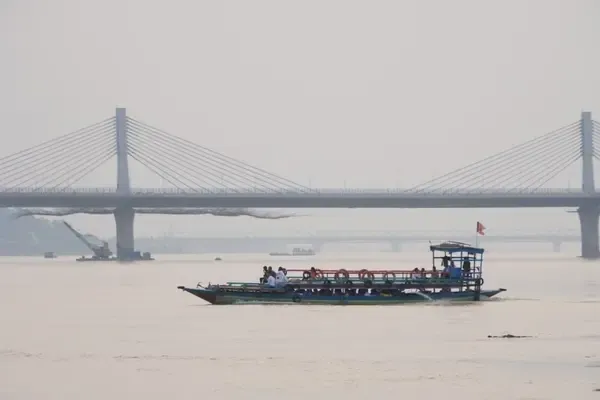

The new bridge redraws routes, and possibly the future for many who once relied on the river
For years, Mahesh Das began his mornings with the familiar rhythm of the ferry crossing the Brahmaputra, watching the sun rise over the waters as he made his way to North Guwahati.
The boat was more than transport, it was routine, reflection, and a quiet bond with the river. But with the opening of the new Kumar Bhaskar Barma Setu, Mahesh no longer waits at the riverbank. Like many others, he has traded the slow drift of the ferry for the swift certainty of the bridge, marking the end of an era and the beginning of a faster, changing Guwahati.
₹850-cr Maharaj Prithu Flyover Faces Scrutiny Weeks After Launch Over Rotary Chaos
The inauguration of the Kumar Bhaskar Varma Setu over the mighty Brahmaputra River has not only transformed road connectivity between Guwahati and North Guwahati, but has also triggered a profound shift in the region’s long-standing ferry transport system, once the lifeline for thousands of daily commuters.
For decades, ferries operating between the two banks of the Brahmaputra served as the most accessible and affordable mode of transport. Students, office-goers, traders, and daily wage earners depended on these boats to cross the river, often navigating unpredictable schedules and harsh weather conditions. However, with the opening of the six-lane bridge on March8, 2026, the dynamics of mobility across the river are rapidly evolving.
The bridge, stretching over 1.2 kilometres and forming part of a larger connectivity corridor, has drastically reduced travel time between Guwahati and North Guwahati from nearly an hour via road or ferry to just 7–10 minutes. This dramatic improvement has made road transport faster, more reliable, and largely weather-independent, posing a significant challenge to traditional ferry services.
Even before the bridge became operational, ferry operators had begun experiencing a steady decline in two-wheeler passenger numbers. A recent trip indicates a drop in ridership across key routes such as Guwahati–North Guwahati, Guwahati–Madhyamkhanda, and Guwahati–Rajaduar. The anticipation of the bridge’s opening further intensified concerns among operators, many of whom fear a drastic reduction in demand.
With the bridge now functional, these fears are beginning to materialise. Commuters who once relied on ferries for their daily commute are increasingly opting for the quicker and more convenient road route. Two-wheeler owners, in particular, have shifted to using the bridge, avoiding the wait times and uncertainties associated with ferry schedules.
A ferry operator at the Machghat noted that while ferries once ran at near-full capacity during peak hours, the number of passengers has visibly thinned in recent weeks. “People prefer certainty,” he said. “If they can cross the river in 10 minutes on a bridge, why would they wait for a ferry that may be delayed?”
A commuter who has used the ferry services since many years said, “I have relied on ferry services since a long time. They are economical and saved a lot of our time in the earlier days. But, now since the bridge has been built, it just takes five minutes to reach North-Guwahati area. However, I still prefer the ferry services if I have to go to Doul Gobindo temple side. It takes lesser time then the bridge.”
The decline in ferry usage cannot be attributed solely to the bridge. Ferry services in Guwahati have long struggled with operational challenges, including fluctuating river levels, seasonal disruptions due to floods or fog, and a shortage of trained manpower. These issues have often made ferry travel unreliable, pushing commuters to seek alternative modes even before the bridge was conceived.
Moreover, safety concerns have historically plagued inland water transport in Assam. Incidents of overcrowding and occasional accidents have raised questions about regulatory oversight and infrastructure readiness. While ferries remain an economical option, these persistent challenges have eroded public confidence over time.
The most immediate impact of the bridge is being felt by ferry operators, both government-run and private. Many operators who depended on daily passenger traffic now face an uncertain future. Reduced footfall translates directly into lower revenues, threatening livelihoods tied to the river economy.
Independent operators, in particular, are worried about their inclusion in the evolving transport ecosystem. Some have expressed hope that government initiatives, such as the development of modern river terminals, could provide new opportunities or stabilise demand.
However, the transition is unlikely to be smooth. Ferry services have traditionally operated with minimal margins, and a sustained drop in ridership could force operators to cut trips or shut down certain routes altogether.
Despite the challenges, ferry services are not expected to disappear entirely. Instead, their role is likely to evolve. Experts suggest that ferries may increasingly cater to niche segments such as tourism, leisure travel, and specific routes where road connectivity remains limited.
For instance, routes like Guwahati–Umananda have seen an increase in footfall, driven largely by tourism and religious visits. The scenic appeal of the Brahmaputra and the cultural significance of river islands offer opportunities to reposition ferry services as experiential journeys rather than mere transport.
Additionally, ferries may continue to serve communities in areas where road infrastructure is still underdeveloped or where accessing the bridge is less convenient.
The transformation of river transport in Guwahati must also be viewed in the context of broader infrastructural developments. The city has already seen the introduction of the Guwahati Ropeway, which provides another alternative for crossing the river in about 7–8 minutes.
With the addition of the new bridge, Guwahati now boasts multiple modes of connectivity: road, water, and aerial, each catering to different needs. This multimodal network has the potential to enhance overall mobility but also intensifies competition for ferry services.
Urban planners view the bridge as a “game changer” that will reshape travel patterns and urban expansion. By bringing North Guwahati closer to the city’s core, the bridge is expected to spur development on the northern bank, including administrative and institutional infrastructure.
As more people begin to live and work across both banks, the demand for quick and efficient transport will continue to grow. In this context, ferries may need to reinvent themselves, either by improving service quality or by aligning with emerging mobility trends.
The story of Guwahati’s changing river crossings is, at its heart, a reflection of how progress reshapes everyday life. The opening of the Kumar Bhaskar Varma Setu has undeniably brought speed, efficiency, and reliability to thousands of commuters, redefining what it means to travel between the two banks of the Brahmaputra River. For many like Mahesh Das, the shift from ferry to bridge represents convenience, but also the quiet loss of a long-cherished routine.
Yet, this transition is not merely about one mode of transport replacing another. It signals a broader evolution in urban mobility, where infrastructure development prioritises time and predictability. In doing so, it challenges traditional systems to adapt or risk fading into memory. Ferry services, once indispensable, now stand at a crossroads compelled to redefine their purpose in a rapidly modernising city.
Even as their role diminishes in daily commuting, ferries still carry cultural, economic, and experiential value that cannot be easily replicated by concrete and steel. Their future may lie not in competition, but in complementing the city’s expanding transport network.
As Guwahati moves forward, the true measure of progress will be its ability to balance innovation with inclusion, ensuring that while the city races ahead, it does not leave behind the livelihoods, traditions, and rhythms that once defined it.