
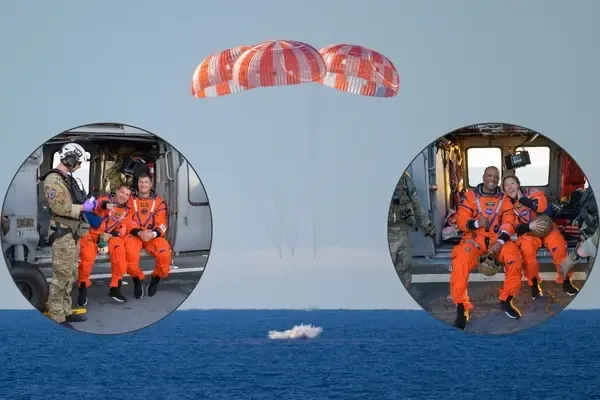

GUWAHATI: In a landmark achievement for space exploration, NASA successfully concluded its Artemis II mission as the Orion spacecraft carrying four astronauts splashed down safely in the Pacific Ocean on Saturday, April 11.
Delegations from US, Iran Arrive in Islamabad for Peace Talks Amid Fragile Ceasefire
The splashdown occurred at 8:07 pm EDT (5:37 am IST on April 11) off the coast of San Diego. The spacecraft re-entered Earth’s atmosphere at a blistering speed of 25,000 mph (40,000 km/h) before deploying parachutes for a controlled descent.
Recovery teams from NASA and the US Navy promptly secured the capsule and assisted the crew, who emerged smiling after completing their high-stakes journey.
Launched on April 2, Artemis II marked a major milestone, becoming the first crewed mission to travel beyond low Earth orbit since Apollo 17. The four-member crew- Reid Wiseman, Victor Glover, Christina Koch, and Jeremy Hansen- undertook a lunar flyby mission without landing on the Moon.
During the mission, the astronauts travelled farther into space than any humans before, reaching a distance of 406,771 kilometres on the far side of the Moon. This surpasses the previous record of 400,171 kilometres set during Apollo 13. The crew spent several hours observing and documenting views of the Moon, capturing images as they looped around it before beginning their return journey.
Artemis II also served as the first crewed test of NASA’s Space Launch System (SLS) rocket and the Orion spacecraft. Throughout the 10-day mission, astronauts evaluated critical systems, including life support, navigation, and deep-space operations, which are essential for future missions.
The mission even offered a rare experience, with the crew witnessing a total solar eclipse from space during their journey.
Artemis II builds upon the success of Artemis I, which validated key systems without a crew. The data gathered from this mission is expected to play a crucial role in planning upcoming missions, particularly Artemis III, which aims to return humans to the lunar surface for the first time in over five decades, and Artemis IV, targeted for further lunar exploration.
Widely seen as a defining moment in modern space exploration, Artemis II signals a renewed human presence in deep space. The mission lays the groundwork not only for sustained lunar exploration but also for future ambitions of sending humans to Mars and beyond.