
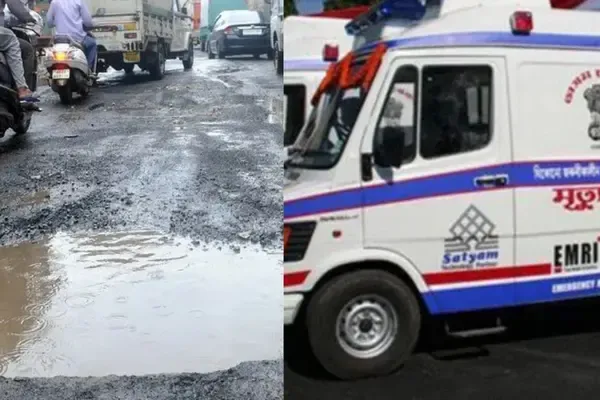

GUWAHATI: Potholes are universally cursed, but one of these is said to have saved a woman's life. The woman, Vineeta Shukla, a 50-year-old resident of Pilibhit in Uttar Pradesh, who had been declared brain-dead by doctors reportedly regained consciousness after the ambulance transporting her body hit a pothole on a highway.
Two Class 12 Exams Postponed in Meghalaya's West Garo Hills After Clashes, Curfew Imposed
The incident, which occurred on the Bareilly–Haridwar stretch of National Highway 74, transformed what was meant to be her final journey home into a moment of unexpected relief for her family.
Vineeta had collapsed at her home on February 22 while carrying out routine household work, according to reports. Her relatives rushed her to a hospital in Bareilly, where doctors evaluated her condition. Medical assessments indicated no brainstem reflexes, dilated pupils and a Glasgow Coma Scale score of 3 — the lowest possible score and typically associated with severe neurological damage.
Based on these clinical findings, doctors informed the family that Vineeta had suffered brain death and that chances of survival were negligible. Devastated by the diagnosis, her husband Kuldeep Kumar Shukla began preparing for her last rites. Two days later, on February 24, the family placed her in an ambulance to transport her body back to their hometown of Pilibhit for funeral arrangements.
However, during the journey the ambulance hit a pothole on VIP Road, causing a sudden jolt. Moments later, family members noticed signs of life, prompting them to immediately divert the vehicle to a hospital in Pilibhit.
Kuldeep later said that his wife had stopped breathing and her pulse appeared to be fading during the journey, but the sudden impact seemed to trigger a response.
Doctors at the Pilibhit hospital conducted fresh tests and found high levels of neurotoxins in Vineeta’s bloodstream and lymphatic system. She was admitted to the intensive care unit, where she remained under close observation for nearly two weeks.
With continued treatment, her condition gradually improved and doctors were eventually able to stabilise her. Rakesh Singh, a neurosurgeon at Neurocity Hospital, said a review of her earlier medical records suggested that her condition at the Bareilly facility had met the clinical indicators associated with brain death.
However, her subsequent recovery has raised questions about the initial assessment and whether the neurotoxins may have temporarily suppressed her neurological activity. Vineeta, who works as a senior assistant in the copy section of the judicial courts in Pilibhit, has since returned home. She is now able to speak and interact with her family, marking what many have described as a remarkable and unexpected recovery.