
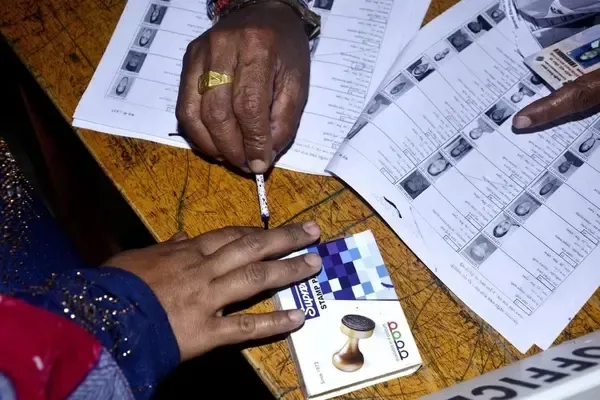

Delimitation may have redrawn Guwahati's political map, but for many voters, it has also blurred a basic question, where exactly do they vote?
As Assam heads towards the 2026 Legislative Assembly elections, an unexpected concern has surfaced among voters in Guwahati, confusion over constituencies and lack of awareness about candidates. Despite repeated awareness drives by election authorities, several residents in Kamrup (Metro) admit they are still unsure about which constituency they belong to.
AIUDF’s Political Space Narrows Ahead of 2026 Polls
Kamrup (Metro), which comprises five Assembly constituencies: Dispur, Dimoria (ST), New Guwahati, Guwahati Central and Jalukbari has a total electorate of over 10 lakh voters. As per official data, Dispur alone accounts for 2,43,176 voters, followed by Dimoria (2,16,949), Jalukbari (2,06,314), Guwahati Central (1,91,758) and New Guwahati (1,91,447). In total, the district has 10,49,644 voters, including 5,05,429 male, 5,44,183 female and 32 third gender electors.
Yet, behind these numbers lies a deeper issue. Several voters say they are unaware not only of their constituency boundaries but also of the candidates contesting from their areas. This confusion has been largely attributed to the delimitation exercise carried out in Assam, which significantly altered constituency boundaries and names.
The delimitation process, undertaken to redraw electoral boundaries based on population changes, led to the restructuring of several constituencies in Guwahati. Older names such as Gauhati East and Gauhati West were replaced or reorganised, and multiple localities were shifted from one constituency to another. While the exercise aimed to ensure fair representation, it appears to have left many voters disoriented.
A resident from Hatigaon, requesting anonymity, said, “Earlier we knew we were under Dispur, but now some areas nearby have been shifted. People in our locality are still confused. Even during discussions, many are not sure which candidate they should approach.”
Another voter from Sixmile echoed similar concerns, stating that the lack of clarity has affected political engagement. “We see candidates campaigning, but we are not even sure if they belong to our constituency.
There should have been more awareness. Voting is our right, but how do we exercise it properly if we don’t have basic information?” he asked.
In areas like Noonmati and Chandmari, which now fall under different constituencies compared to earlier arrangements, residents said that the changes were not adequately communicated. “Earlier we were under Gauhati East. Now it has changed, but no one clearly explained the new boundaries. Many elderly voters are completely unaware,” said a local resident.
The confusion is not limited to constituency names alone. Several voters admitted that they are unfamiliar with the candidates contesting from their constituencies. With political parties focusing heavily on rallies and campaigns, some residents feel that basic voter education has taken a back seat.
A first-time voter from Panjabari said, “This is my first election, and I was excited to vote. But when I tried to find out about my constituency and candidates, it became confusing. There is information online, but not everyone knows how to access it. There should be more ground-level awareness.”
Residents also pointed out that while booth-level officers (BLOs) had visited some areas for voter verification, the information provided was often limited to voter lists and did not extend to explaining constituency changes in detail.
Responding to the concerns, an official from the Kamrup Metro election office told GPlus that efforts have been made to inform voters. “We have deployed BLOs to verify electoral rolls and spread awareness at the grassroots level. Political parties also have booth-level agents (BLAs) who are responsible for disseminating such information,” the official said.
However, on the ground, many voters feel that these measures have not been sufficient. Some believe that awareness campaigns should have been more intensive, especially in urban areas where population movement and new settlements have further complicated the situation.
A resident from Gandhibasti remarked, “People move houses frequently in Guwahati. Many tenants don’t even know which constituency they fall under. Unless there is a proper campaign through local media, schools or community groups, this confusion will continue.”
The issue also raises questions about voter participation and informed decision-making. Political analysts note that a lack of clarity about constituencies and candidates can impact voter turnout and engagement. When voters are unsure about their electoral identity, it may lead to apathy or uninformed choices.
For many residents, the confusion also reflects a larger disconnect between administrative processes and public awareness. While delimitation is a necessary exercise for democratic representation, its success depends on how effectively it is communicated to the electorate.
An elderly voter from Uzan Bazar summed up the sentiment, saying, “We have been voting for decades, but this time thing feel different. Earlier, we knew our constituency and our MLA. Now, even that basic connection feels lost.”
As the election date approaches, there is a growing demand for clearer communication from both the Election Commission and political parties. Voters say that beyond rallies and promises, there should be a concerted effort to educate people about where they stand in the electoral map.
With over 10 lakh voters in Kamrup (Metro) alone, ensuring that each individual is aware of their constituency and candidates is crucial for a fair and participatory election. The question that remains, however, is whether this gap in awareness will be addressed in time or whether many voters will head to the polling booths still unsure of where they belong.