
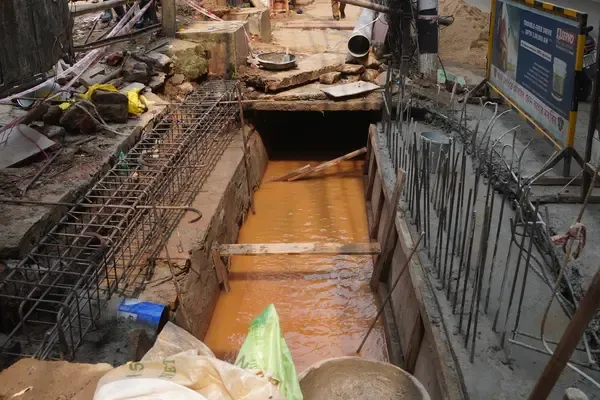

Flooded street hides killer drain in Maligaon
What should have been an ordinary walk home turned fatal for 30-year-old Payal Nath on Sunday April 19. On a rain-lashed evening in Maligaon, one mis-step into what appeared to be a flooded street ended her life, swallowed by an open drain hidden beneath murky water.
Why Even Moderate Rainfall Now Triggers Crisis in Guwahati
Her death is not an isolated tragedy. It is a warning, one that residents of Guwahati say has gone unheeded for years.
Payal Nath was returning home from work when heavy rainfall triggered severe waterlogging across Maligaon. Streets quickly turned into streams, blurring the line between road and drain. In the chaos, Nath slipped and fell into an uncovered drain, reportedly being swept away by strong currents created by artificial flooding.
Her body was later recovered about a hundred metres away, underscoring the force of the water flow beneath the city’s surface.
Various reports confirm that such flooding had submerged open drains entirely, making them invisible hazards for unsuspecting pedestrians.
For locals, the horror lies not just in the incident, but in its predictability.
Residents of Maligaon describe a grim familiarity with waterlogging and exposed drains. Every monsoon, they say, roads transform into dangerous channels, with open drains lurking beneath.
“This is not new,” said a shopkeeper near the Maligaon flyover. “Every year we complain. Every year nothing changes.”
The Maligaon–Adabari stretch has long been prone to flooding during heavy rainfall, often disrupting traffic and daily life. Past incidents have seen vehicles stranded and commuters struggling through waist-deep water.
An eyewitness of the Payal Nath case say, “The drains in the area have been open since a long time. We knew beforehand something bad might happen, but the authorities took no action.”
However, beyond inconvenience, the deeper issue is safety. Open drains, often uncovered, poorly marked, or damaged turn into deadly traps when submerged.
Residents across several localities say that drains remain open or have broken slabs that go unnoticed during flash floods. At many places blockages caused by garbage and silt reduce water flow.
A frequent commuter of Athgaon Aalu Godam area Niraj Jain said, “Drains are being cleaned, but the authorities do not take the silt and garbage along with them. Once it rains the silt and garbage again accumulates in the drains, thereby clogging them which results in artificial floods.”
“Moreover, in many places increased construction has outpaced infrastructure upgrades throughout the city. Rainwater accumulates quickly, overwhelming drains,” adds Niraj.
When heavy rain hits, these weaknesses converge. Roads flood, drains overflow, and the city’s underground water channels become invisible threats.
In such conditions, even a familiar street turns deadly within minutes.
The tragedy of Payal Nath echoes similar incidents reported in other localities like that of death of Avinash Sarkar of Jyotinagar in July 2024, where an open drain claimed the life of the 8-year-old. Several other incidents of open drain deaths have been reported out of which one was reported in September 2025. Three-year-old Sumit Kumar Sahu died after falling into an uncovered drain at a flyover construction site in Kalapahar, Guwahati.
However, what makes Maligaon particularly vulnerable is its geography and traffic density, combined with aging infrastructure.
Despite major development projects in the area such as the construction of the Nilachal Flyover to ease congestion, basic civic issues like drainage safety persist.
Residents argue that infrastructure development has been uneven: while flyovers rise above, the ground below remains neglected.
Following the death of Payal Nath residents across various localities have expressed concerns regarding open drains. When asked, a senior official from the Guwahati Municipal Corporation (GMC) said,
“Wherever there is an open drain, we try to close them at the earliest. Also, we urge residents to inform us beforehand about any open drains so that we can close them at the earliest to avoid any unforeseen incidents.”
Behind the statistics and infrastructure debates lies a personal loss that cannot be repaired. Payal Nath was not just another victim of civic failure, she was a daughter, a worker, a member of the community.
Her death has sparked outrage on social media and among civil society groups, many of whom are demanding accountability and urgent reforms.
Yet, for many families in Guwahati, fear persists: the next heavy rain could bring another tragedy.
Guwahati is often described as the gateway to Northeast India, a rapidly growing urban centre with ambitions of modernisation and economic expansion. Yet beneath this progress lies a troubling reality. The recurring issue of “killer drains” highlights a dangerous gap between visible development and the essential infrastructure needed to keep citizens safe.
Open, poorly maintained drains become especially hazardous during the monsoon, when heavy rainfall quickly floods streets and obscures these threats from view. For residents, this turns everyday movement into a serious risk. Experts have repeatedly warned that without immediate and sustained intervention such as proper drainage planning, regular maintenance, and stronger accountability, such incidents will continue to claim lives.
The monsoon is not an unpredictable disaster; it is an annual certainty that cities must prepare for. What remains uncertain, however, is whether Guwahati will take decisive action in time to prevent another avoidable tragedy.
As the waters slowly recede in Guwahati’s Maligaon, a troubling question continues to echo through the community: could Payal Nath’s death have been prevented? For many residents, the answer feels painfully obvious, yes.
What happened was not merely an unfortunate accident, but a reflection of deeper systemic failures that have long been ignored. Poorly maintained drainage systems, inadequate safety measures, and a lack of accountability have turned essential urban infrastructure into hidden dangers. During heavy rains, these drains become invisible traps, especially in flooded areas where visibility is low and warnings are absent.
Unless meaningful and sustained changes are made, ranging from better urban planning to stricter safety protocols, the risk will persist. Guwahati’s drains will remain more than just channels for water; they will continue to pose a silent, ever-present threat beneath the city’s streets, waiting for the next unsuspecting victim.