
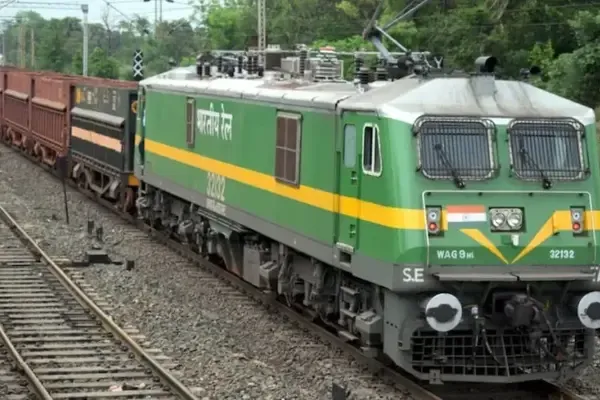

On a humid afternoon at the sprawling New Guwahati railway yard, long lines of freight wagons stand motionless, stretching into the horizon.
Loaded with essentials ranging from food grains to fuel, these trains are the lifeline of Assam and the wider Northeast. But increasingly, they are running late, and the consequences are rippling through the region’s economy.
Guwahati’s Delivery App Boom Brings Convenience, But Hidden Fees, Menu Markups Spark Fairness Debate
Railway officials and logistics experts say that delays in freight train movement across India have become more frequent in recent years, driven by congestion, infrastructure constraints, and operational challenges. For Guwahati, the gateway to the Northeast, the impact is particularly acute.
Guwahati occupies a strategic position in India’s railway map. Nearly all goods entering the Northeast pass through the city, making it one of the busiest freight corridors in the region. The New Guwahati yard itself functions as a major hub for goods trains, handling locomotives and freight movement rather than passenger traffic.
However, this strategic importance has also made the city vulnerable to systemic inefficiencies. Across India, a handful of high-density rail corridors carry a disproportionate share of traffic about 41% of total movement on just 16% of the network. When these corridors become congested, freight trains are often the first to be slowed or halted to allow passenger trains to pass.
“It is not that freight trains don’t get priority in mixed-use corridors,” said a senior railway official in the Northeast Frontier Railway (NFR), speaking on condition of anonymity. “Whenever a freight train operates from across any corner of the state and country, security and safety of the goods is our utmost priority.”
The consequences of these delays are far-reaching. In Guwahati’s wholesale markets, traders report irregular supply schedules, particularly for perishable goods.
“Earlier, consignments would arrive within a predictable window,” said a trader at Fancy Bazaar. “Now, delays of 12 to 24 hours are common. It affects pricing and availability.”
The problem is not limited to commercial goods. Fuel supplies, construction materials, and even essential commodities are affected when freight trains are delayed enroute due to several technical and non-technical reasons.
Recent incidents highlight the fragility of the system. In one case last year, a technical snag in a freight train in Maharashtra delayed multiple passenger services by up to three hours, demonstrating how disruptions in goods movement can paralyze the broader rail network.
Closer to home, derailments and accidents have also contributed to disruptions. A recent goods train derailment in Assam’s Kamrup district temporarily affected rail traffic, requiring restoration work and rerouting. Meanwhile, unusual events such as wildlife collisions have also halted train movement in the region, underscoring the unique challenges of operating in the Northeast.
Logistic partners across different parts of the city cite uncertainty of timing of freight trains result in losses. A transport service provider at Chabipool said, “Larger consignments generally arrive and go through trains. Most of them arrive by freight trains and the rest by passenger trains. Passenger trains have fixed arrival and departure time so we can ascertain when the goods will arrive, but freight trains do not have a proper timeframe. So we cannot say how many days will it take for a consignment to reach.”
Indian Railways has acknowledged the growing strain on its infrastructure and has initiated several projects aimed at easing congestion. These include track doubling, electrification, and the expansion of dedicated freight corridors.
In the Northeast, projects such as the doubling of railway lines between key junctions are expected to improve capacity and reduce delays. Additionally, the broader push to expand railway connectivity including new lines linking remote regions has increased the volume of both passenger and freight traffic.
Yet, these developments are a double-edged sword. While new routes enhance connectivity, they also add pressure to already stretched sections of the network.
Railway “blocks” for maintenance and upgrades further complicate scheduling. Across the country, periodic shutdowns for track repairs, bridge work, and station upgrades often disrupt train movement, leading to cascading delays.
The city itself is undergoing an ambitious railway transformation, with plans to upgrade stations and improve passenger amenities by 2026. However, questions remain about whether these upgrades will address the deeper issue of freight congestion.
Observers note that while station modernisation focuses on passenger experience, freight handling infrastructure such as yards, sidings, and signalling systems requires equal attention.
“There is a visible push for high-speed and premium trains,” said an analyst based in Guwahati. “But freight efficiency is what sustains the economy. Without fixing that, delays will persist.”
For small businesses and industries in Assam and neighbouring states, delayed freight translates into higher costs. Transporters often pass on the cost of delays to clients, while manufacturers face production slowdowns due to late arrival of raw materials.
In rural areas, the impact is even more pronounced. Agricultural produce transported by rail can lose value if delayed, particularly in the case of fruits and vegetables.
Passengers, too, are indirectly affected. Freight congestion can spill over into passenger services, causing delays and overcrowding. During periods of high demand, such as festivals or disruptions in air travel, the railway network struggles to cope, prompting emergency measures like additional coaches and special trains.
The mounting delays in freight movement through Guwahati are more than a logistical inconvenience, they are a stark reflection of the structural pressures facing India’s railway network, particularly in regions where geography and dependence converge. As the Northeast’s primary gateway, Guwahati sits at the intersection of ambition and limitation, where rising demand for connectivity collides with aging infrastructure and operational bottlenecks. What unfolds in its rail yards is not an isolated issue, but a microcosm of a broader national challenge.
While Indian Railways has initiated critical upgrades ranging from track doubling to electrification and new freight corridors, the pace of expansion has struggled to keep up with the surge in both passenger and freight traffic. In the Northeast, where alternative transport options remain limited, the consequences of this imbalance are amplified. Delayed freight disrupts supply chains, inflates costs, and places an added burden on businesses, farmers, and consumers alike. Over time, such inefficiencies risk dampening economic momentum in a region that is otherwise poised for growth.
Equally concerning is the imbalance in priorities. The visible push toward modernised stations and faster passenger services, though important, must be matched by investments in freight infrastructure: yards, signalling systems, and dedicated corridors that can ensure smoother, more predictable movement of goods. Without this, the system will continue to operate in a reactive mode, where every disruption triggers a cascade of delays across the network.
Ultimately, resolving Guwahati’s freight gridlock will require more than incremental fixes. It calls for a coordinated, long-term strategy that recognises freight as the backbone of regional development. Only by addressing these systemic challenges can the railways restore reliability, sustain economic activity, and truly serve as the lifeline the Northeast depends on.