
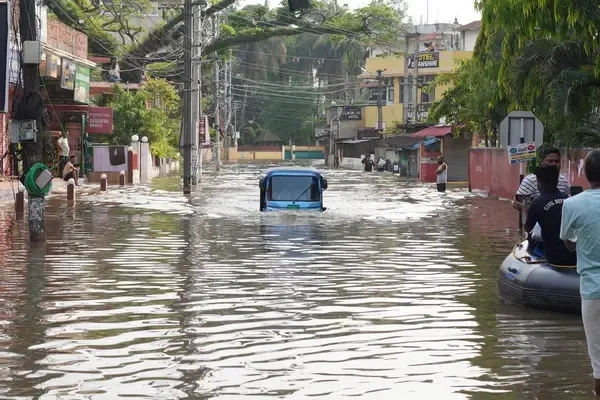

How bureaucratic disconnect among GMC, GMDA and PWD keeps Guwahati drowning
A few minutes of rainfall on the evening of April 19 was all it took for large parts of Guwahati to sink, yet again, into a familiar cycle of waterlogging, traffic paralysis, and public frustration.
From arterial roads to residential pockets, the city’s fragile drainage system collapsed under pressure, exposing a crisis that has persisted for over two decades. At the heart of this recurring disaster lies not just poor infrastructure, but a deeper, systemic failure, the lack of coordination among three key agencies: the Guwahati Municipal Corporation (GMC), the Guwahati Metropolitan Development Authority (GMDA), and the Public Works Department (PWD-Roads).
Freight Train Delays at New Guwahati Yard Disrupt Northeast Supplies
Urban flooding in Guwahati is no longer an aberration; it is an annual certainty. Despite crores of rupees being spent on development projects under various schemes, including the “smart city” initiative, the absence of a comprehensive and coordinated drainage master plan continues to render these investments ineffective. The April 19 rainfall once again served as a stark reminder that without a robust storm water drainage system and underground sewage network, Guwahati’s aspirations of becoming a modern urban centre remain fundamentally flawed.
Assam Pradesh Mahila Congress President Mira Borthakur Goswami has sharply criticised the authorities, pointing directly at the fragmented functioning of GMC, GMDA, and PWD as the root cause of the problem. According to her, the absence of coordination has led to the haphazard construction of drains across the city. “Some drains are elevated, others are too low, and their widths vary drastically. This inconsistency disrupts the natural flow of water, leading to severe waterlogging even during moderate rainfall,” she said.
Her observations echo what residents have long experienced, a city where infrastructure development happens in silos. Roads are constructed or widened by PWD, drains are built alongside them without a unified design, and maintenance responsibilities are either unclear or poorly executed. Meanwhile, GMDA, which is expected to conceptualise and implement large-scale infrastructure like storm water drainage and sewerage systems, has yet to deliver a comprehensive master plan.
The consequences of this fragmented approach are visible across Guwahati. Natural water channels, once crucial for draining excess rainwater, have been neglected, encroached upon, or poorly maintained. Wetlands that historically acted as natural reservoirs are shrinking, while hill cutting has increased runoff into the plains. Together, these factors have intensified the city’s vulnerability to flooding.
Social activist and Padma Shri awardee Ajoy Kumar Dutta, a former legislator from Guwahati, describes the situation as a long-standing failure of planning and political will. “Crores of rupees have been spent in the name of making Guwahati a smart city. But without a proper storm water drainage system and underground sewage network, this is meaningless,” he said.
Dutta’s recollection of events from five decades ago adds a historical dimension to the crisis. He points out that as early as 1974, when the Guwahati Municipal Corporation was first constituted, the need for a scientific drainage system was clearly recognised. “It was 50 years back that people of Guwahati felt the necessity of a proper drainage system,” he said.
According to Dutta, efforts were even made at the highest level to secure international funding. Then President Fakhruddin Ali Ahmed reportedly facilitated discussions with the World Bank, which agreed to provide ₹78 crore in two phases for the development of a drainage system. An initial amount was sanctioned for preliminary work, with the state required to contribute only a small share.
However, what followed, Dutta alleges, was a mix of political interference and administrative resistance. “The state government at the time did not support the GMC council because it was a non-Congress body. There was a fear that if such a project succeeded under them, it would strengthen their political position,” he claimed. Eventually, the project was derailed and shifted to Hyderabad, a city that went on to develop far more robust urban infrastructure.
“Guwahati was better than Hyderabad in those days,” Dutta remarked, “but today we are still struggling with the basics.”
Over the years, multiple studies and proposals have attempted to address the issue. Dutta notes that apart from the initial plans, at least two major studies, one by an Israeli organisation and another by the Tahal Group in 2008, offered detailed recommendations. Yet, none have been fully implemented.
“This is the biggest problem,” he said. “We keep studying the issue but fail to act on the findings. Whatever work is being done now is largely a waste of money because there is no integrated planning.”
Officials within the system also acknowledge the gaps. A senior PWD official involved in current de-siltation and drainage construction work admitted that the absence of a master plan is a critical issue. “When we construct roads, we build drains alongside them to allow water to flow out. These drains are designed with gradients that lead to larger drains or wetlands,” he explained.
However, he conceded that errors often occur during execution. “Sometimes due to contractor or labour mistakes, the gradient is not maintained. This creates long-term problems,” he said. More importantly, he highlighted that most existing drains are not designed as storm water drainage systems.
“In many cases, sewage water is also discharged into these drains,” he added. “There has to be a clear construction plan and maintenance plan, but that is missing in Guwahati.”
The issue of overlapping responsibilities further complicates the situation. Traditionally, GMC was responsible for de-silting drains, but in recent years, PWD has taken over much of this work, particularly after a de-siltation scam in 2022 led to the arrest of several officials. “Now, some roads and drains are constructed by GMC, others by PWD. It becomes confusing at times,” the official admitted.
This confusion is symptomatic of a larger institutional problem, the absence of a standard operating procedure (SOP) that clearly defines roles and responsibilities. Without such a framework, coordination between departments remains ad hoc, leading to inefficiencies and duplication of efforts.
On its part, GMC maintains that it is actively working to address the issue. A senior official claimed that all drains in the city are “natural storm water drains” connected to rivulets and wetlands. He pointed to the operation of pumping stations at Bharalu and ongoing de-siltation efforts as evidence of the corporation’s commitment.
“Every year, we de-silt around 143 drains at a cost of ₹9 crore. Including tributaries and other channels, the total expenditure goes up to around ₹40 crore,” he said.
Yet, these efforts have not translated into lasting relief for residents. The lack of a drainage map or master plan means that de-siltation is often reactive rather than strategic. Without understanding how different drains connect and function as a system, such exercises offer only temporary respite.
Sources within GMDA reveal that the agency, which was expected to prepare a comprehensive drainage master plan, has yet to finalise it. This delay has left a critical gap in the city’s urban planning framework. Without a blueprint to guide construction and maintenance, individual projects undertaken by different departments fail to integrate into a cohesive system.
For residents, the impact of this administrative disconnect is immediate and severe. Waterlogged streets disrupt daily life, damage property, and pose health risks. Traffic congestion during rains brings the city to a standstill, affecting businesses and emergency services alike.
Goswami has questioned how long citizens will have to endure this situation. “Who will take responsibility for the losses suffered by the people?” she asked, calling for urgent government intervention.
Her demand for accountability resonates widely. Despite repeated assurances and annual de-siltation drives, the core issues remain unaddressed. The absence of coordination among GMC, GMDA, and PWD continues to undermine any meaningful progress.
Experts argue that solving Guwahati’s flood problem requires more than piecemeal interventions. It demands a unified approach, beginning with the preparation of a comprehensive drainage master plan. Such a plan must map existing infrastructure, identify gaps, and provide clear guidelines for construction, maintenance, and inter-departmental coordination.
Equally important is the need to protect and restore natural drainage channels and wetlands. Urban expansion must be aligned with environmental considerations to ensure that the city’s natural defenses against flooding are not compromised.
As Guwahati grapples with yet another season of floods, the message is clear: the problem is not a lack of resources or technical knowledge, but a failure of governance. Until GMC, GMDA, and PWD work in tandem, guided by a shared vision and clear accountability, the city will continue to drown, not just in rainwater, but in its own administrative shortcomings.