




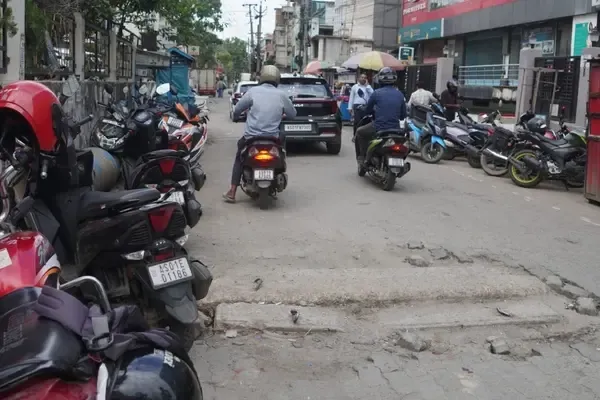

Divider gaps and U turns packed along Beltola Tiniali to Last Gate are breaking traffic flow as sudden lane cuts and braking shift bottlenecks onto the main road every peak hour
A stretch of around two kilometres between Beltola Tiniali and Last Gate in Guwahati has more than 20 U-turns and divider openings or junctions, leading to frequent disruptions in traffic flow.
Guwahati’s Land Boom Is Leaving the Middle Class Behind
While some openings serve essential connectivity routes such as the Survey–Hatigaon link, Rangamancha Path, and the Wireless–Hatigaon bylane, a large number appear to serve limited or unclear purpose.
Commuters have often reported that the dense placement of such openings affects smooth vehicular movement, causing delays and congestion along the corridor during peak traffic hours in the area as observed in routine movement patterns across the stretch regularly seen.
Instead of ensuring smoother movement, the high density of divider gaps is contributing to congestion and frequent braking, making daily commutes slower and more stressful for commuters.
When openings are spaced barely 30 to 40 metres apart, the continuity of traffic flow is significantly affected. Motorists, including two-wheelers, e-rickshaws and cars, are often seen making sudden turns across lanes, forcing vehicles in the main carriageway to slow down or stop abruptly.
The situation is particularly concerning near busy transit points, where pedestrian movement is high.
“These unbarricaded dividers risk the lives of both pedestrians and commuters,” said a commuter near the Survey bus stop. “It gets incredibly frustrating because you always have people moving across or bikes and e-rickshaws suddenly cutting in. Reducing these openings is everyone for everyone’s safety and traffic hygiene.”
A local ward councillor told GPlus that the issue, as per his understanding, falls under the traffic department and assured that he would look into it.
“As you have raised this matter before me, I will try to have a look at it once,” the councillor said.
He also said that completely removing divider openings is not a solution. “Some of these openings are needed for two-wheelers to enter or exit into or from the bylanes,” he said.
Even where authorities have installed temporary iron barricades, such as near the Survey bus stop, gaps remain in execution. Pedestrians are often seen squeezing through narrow spaces, risking movement alongside fast traffic.
A local traffic police personnel said they had not received any formal complaints regarding the issue and defended the existing layout, stating that multiple openings are required to facilitate vehicles moving in and out of adjoining bylanes.
However, ground observations indicate that instead of easing congestion, the frequent openings are shifting bottlenecks from side lanes onto the main road.
The issue is not isolated to this corridor. Similar concerns are visible elsewhere in Guwahati, including near the newly constructed Zoo Road flyover.
As commuters approach the flyover from the Ganeshguri side, a poorly placed U-turn often slows traffic significantly, affecting the otherwise smooth movement along the corridor up to Commerce College Point.
Instances of effective intervention, however, do exist. About 50 metres before Last Gate near the Naharani Path junction, a previously problematic divider opening was permanently closed with concrete a few years ago, resulting in improved traffic flow in that stretch.
Commuters say the solution lies in better planning rather than more openings, with calls for closure of unnecessary gaps while retaining only essential junctions to improve safety and ease congestion across the city.