




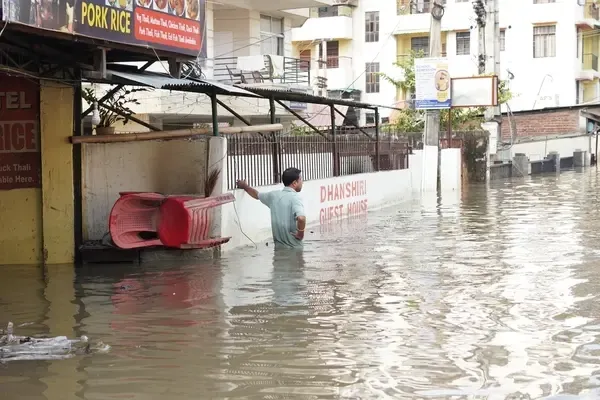

Families suffer repeated flood losses, but compensation remains absent
For thousands of residents in Guwahati, the arrival of the monsoon is no longer associated with relief from heat but with anxiety, uncertainty, and recurring loss.
Year after year, flood-prone areas of the city slip into the same pattern; roads submerge, homes are damaged, livelihoods are disrupted, and citizens are left to bear the cost. Despite repeated assurances from authorities to address urban flooding, the situation on the ground continues to reflect a cycle that remains largely unchanged.
Every Monsoon, Guwahati’s Open Drains Turn into Death Traps
Several localities such as Rukminigaon, Hatigaon, Anil Nagar, Nabin Nagar, and parts of Beltola and Chandmari, Maligaon have long been identified as vulnerable zones. During every spell of heavy rain, these areas face waterlogging that often lasts for hours or even days. The consequences go beyond inconvenience. Furniture, electrical appliances, vehicles, and essential household items are frequently damaged. For many families, especially those from middle and lower income groups, such losses are difficult to recover from.
Over the past few years, the scale of property damage in Guwahati during the monsoon has been significant, though often underreported in formal data. According to assessments made by local agencies and disaster management authorities, urban flooding in Guwahati has repeatedly affected thousands of households annually. In some years, particularly during intense rainfall events, more than 10,000 homes have reported varying degrees of water ingress. The financial loss per household may range from a few thousand rupees to several lakhs, depending on the severity of flooding and the assets affected.
In 2022, heavy rainfall over a short duration led to severe waterlogging across multiple parts of the city, with official reports indicating that several thousand families were impacted. Similar conditions were observed in 2023 and 2024, where repeated rainfall events caused damage not only to private property but also to public infrastructure. Roads caved in, drains overflowed, and construction debris further blocked already strained drainage systems. Despite these recurring incidents, there has been little structural change in how the problem is addressed.
One of the key issues remains the lack of a comprehensive compensation mechanism for property damage. While ex gratia relief of ₹4 lakh is provided to the families of those who lose their lives in disasters, there is no clear policy to support those who suffer financial losses due to damage to homes and belongings. This gap has left residents feeling unsupported, especially when they are forced to rebuild or repair their homes using personal savings or loans.
A source from the district administration acknowledged the absence of such provisions. “As of now, there are no specific initiatives to compensate property damage. Discussions have been taking place at higher levels, but nothing concrete has been finalised,” the source said. For residents who have faced repeated losses, this uncertainty adds to their frustration.
The problem in Guwahati is not isolated but part of a broader pattern seen in several urban centres across India. However, when compared with cities like Mumbai or Chennai, the response mechanisms differ significantly. Mumbai, for instance, while frequently affected by flooding, has developed certain compensation frameworks through the Brihanmumbai Municipal Corporation for structural damage in extreme cases. Chennai, after the devastating floods of 2015, introduced relief packages for affected households, including compensation for damaged homes and essential goods.
In contrast, Guwahati’s approach has largely remained reactive rather than preventive. While relief measures are occasionally announced during major disasters, there is no consistent or institutionalised system to address recurring property damage. This disparity becomes more evident when considering the scale of economic impact. Urban flooding in Indian cities has been estimated to cause losses worth thousands of crores annually, and while Guwahati’s share may be smaller in absolute terms, the relative impact on households is severe.
Experts point to multiple factors contributing to the city’s vulnerability. Rapid urbanisation without adequate planning has led to the encroachment of natural water bodies and drainage channels. Wetlands that once acted as natural buffers have been reduced significantly. At the same time, the existing drainage infrastructure has not kept pace with the city’s growth. Clogged drains, unregulated construction, and ongoing infrastructure projects further aggravate the problem.
The burden of these systemic failures is borne by residents. A shopkeeper in Hatigaon described the recurring losses he faces every year. “Every monsoon, water enters my shop. I have to move goods, repair damages, and sometimes even close for days. There is no support from anywhere. We just manage on our own,” he said.
For homeowners, the situation is equally challenging. Many families invest their life savings into building a house, only to see it damaged repeatedly by floodwaters. The cost of repairs, replacement of appliances, and preventive measures such as raising floor levels or installing pumps adds up over time. Without any form of financial assistance, these expenses can push households into debt.
The psychological impact is another aspect that often goes unnoticed. Living in constant fear of flooding affects the quality of life and sense of security among residents. Parents worry about the safety of their children, especially in areas where open drains pose additional risks. The memory of past incidents, including fatalities due to slipping into drains during heavy rain, continues to haunt communities.
Despite these challenges, the pace of improvement has been slow. Various initiatives have been announced over the years, including projects aimed at improving drainage systems and reducing waterlogging.
However, delays in execution, lack of coordination between agencies, and inadequate maintenance have limited their effectiveness.
The situation is further complicated by ongoing construction activities across the city. Road widening, flyover construction, and other infrastructure projects often disrupt existing drainage patterns. In many cases, temporary arrangements are not sufficient to handle heavy rainfall, leading to water accumulation in nearby areas. Residents argue that while development is necessary, it should not come at the cost of basic safety and functionality.
Comparisons with other states also highlight the need for a more structured approach. States like Kerala, which face regular flooding due to heavy rainfall, have developed detailed disaster management plans that include both immediate relief and long-term rehabilitation. Insurance schemes and community-based initiatives also play a role in reducing the financial burden on individuals.
In Guwahati, however, such mechanisms are either limited or absent. The reliance on ad hoc measures and post-disaster responses has not been enough to address a problem that is both predictable and recurring. As climate patterns become more unpredictable, the intensity and frequency of rainfall events are likely to increase, making the need for proactive planning even more urgent.
For now, residents continue to adapt as best as they can. Some have raised the plinth levels of their homes, others have installed water pumps, and many have simply learned to live with the inconvenience. But these individual efforts cannot replace the need for systemic solutions.
The growing gap between promises and reality has led to a sense of disillusionment among citizens. While announcements and reviews continue, the conditions on the ground remain largely unchanged. The absence of compensation for property damage only adds to the feeling that the burden is being unfairly shifted onto residents.
As the monsoon approaches once again, the question remains whether Guwahati will see any meaningful change or continue to repeat the same cycle. For those living in flood-prone areas, the stakes are high. Each season brings not just rain, but the possibility of loss: financial, physical, and emotional.
Until there is a clear and consistent policy to address both prevention and compensation, the plight of these residents is unlikely to improve. The city’s growth and aspirations must be matched by its ability to protect its people. Otherwise, the cost of inaction will continue to be paid by those who can least afford it.