
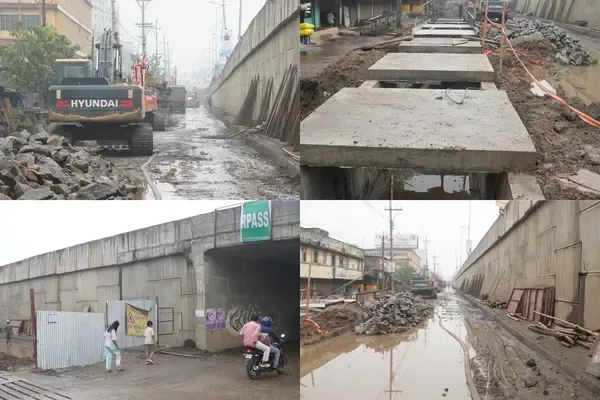

For nearly a year, the service lane opposite Tripura Road in the Balughat area, towards Basistha has remained incomplete, with little visible effort to address its deteriorating condition
As the monsoon season approaches, Guwahati finds itself once again confronting a familiar and unresolved crisis; flooded roads, unsafe infrastructure, and a growing sense of vulnerability among residents. Despite repeated warnings, past tragedies, and ongoing complaints, several stretches of the city continue to remain in a neglected condition, raising serious concerns about preparedness and accountability.
Who Controls Guwahati’s Streets as Vending Zones Remain Delayed
Over the past few days, the city has already experienced spells of heavy rainfall, bringing back memories of waterlogged streets and disrupted daily life. Areas such as Rukminigaon, Wireless, Hatigaon, Anil Nagar, and Nabin Nagar have long been associated with flooding. However, the problem is no longer limited to these localities. The National Highway stretch passing through Guwahati, particularly along the Khanapara to Jalukbari corridor, is increasingly emerging as another vulnerable zone.
One of the most concerning examples is the service lane opposite Tripura Road in the Balughat area, towards Basistha. For nearly a year, this stretch has remained incomplete, with little visible effort to address its deteriorating condition. What was expected to be a functional road has instead turned into a hazardous path, affecting not just traffic movement but also the livelihoods and safety of people in the area.
Residents and commuters say the road has become a daily challenge. During dry days, it remains dusty and uneven, while even light rainfall turns it into a muddy stretch filled with water and sludge. The absence of proper drainage and unfinished construction work has made the situation worse. With the monsoon yet to fully arrive, fears are already mounting about how dangerous the stretch could become in the coming weeks.
Local businesses have also been hit hard. Shop owners in the area report a decline in customers, as people avoid the stretch due to its poor condition. Deliveries are often delayed, and in some cases, transport vehicles refuse to enter the area altogether. For many small traders, this has meant a steady loss of income with no clear timeline for improvement.
A commuter who regularly travels through the stretch said the situation has become unbearable. “Every day we take a risk while passing through this road. There are potholes, mud, and waterlogging. It is not just inconvenient; it is dangerous.
We do not know when this will be fixed,” he said.
When contacted, an official from the District Road Safety Committee (DRSC) acknowledged the issue but pointed to jurisdictional limitations. “We have been informed about the problem. This particular stretch falls under the National Highways
Authority of India as part of the Khanapara to Jalukbari corridor. We hope that the concerned authority will take action soon,” the official said.
Attempts to reach the Project Director of the National Highways Authority of India for comments were unsuccessful, as no response was received. The lack of communication has further added to public frustration, as residents feel that their concerns are not being addressed with urgency.
The situation becomes even more worrying when viewed in the context of recent incidents linked to rainfall in the city. On April 19 evening, heavy rain led to widespread waterlogging across several parts of Guwahati. During this period, a 30-year-old woman, Payal Nath from Maligaon, lost her life after reportedly slipping into an open drain. The incident once again exposed the risks posed by inadequate urban infrastructure. In addition, three more bodies were found floating across Guwahati allegedly linked to floods and open drains.
Such incidents are not isolated. In July 2024, an eight-year-old boy, Abhinash Sarkar, died after falling into an open drain in the Jyotinagar area during flash floods. Over the years, multiple cases of injuries and fatalities have been reported during heavy rainfall, highlighting a pattern that remains largely unaddressed.
The recurring nature of these tragedies has led to growing concern among citizens, who question why basic safety measures are still lacking despite repeated warnings. The presence of open drains, clogged culverts, and incomplete roadwork continues to pose a threat, especially during the monsoon season.
Adding to the situation, the District Disaster Management Authority of Kamrup Metropolitan had earlier issued a show-cause notice to the authorised representative of Dinesh Chandra Kamakhya Highway Concessions Pvt. Ltd. for alleged negligence leading to severe waterlogging along the same National Highway stretch.
The notice followed reports of persistent flooding in areas such as Excelcare Hospital, Tetelia, and Gotanagar. Field inspections conducted by the administration revealed that cross-culverts along the highway were heavily clogged with silt and debris, preventing the natural flow of water and causing accumulation during rainfall.
Officials stated that instructions had been issued multiple times under “Mission Flood Free” initiatives to clear these culverts before the onset of the monsoon. However, the failure to act on these directives has resulted in continued waterlogging and disruption.
While the administration has taken steps to hold certain agencies accountable, residents point out a contradiction. Completed or operational stretches are being scrutinised and show-caused, while incomplete and more hazardous sections, such as the Balughat service lane, remain unattended. This selective attention has raised questions about priorities and the effectiveness of monitoring systems.
A local resident expressed frustration over the lack of consistency. “If action is being taken, it should be across all problematic areas. The incomplete roads are even more dangerous because they have no proper structure at all. Why are they being ignored?” he asked.
The ongoing issues reflect a broader challenge in urban management, where multiple agencies share responsibility but coordination often falls short. For citizens, however, these administrative boundaries offer little comfort. Their primary concern remains safety, which continues to be compromised.
As Guwahati prepares to enter the monsoon season, the current state of infrastructure does not inspire confidence. The combination of unfinished projects, clogged drainage systems, and delayed responses creates a situation where even moderate rainfall can lead to disruption and risk.
For many residents, the fear is not just about inconvenience but about survival. Each year, the monsoon brings with it the possibility of accidents, injuries, and loss of life. Despite this, the pace of improvement has been slow, and in some cases, almost invisible.
The condition of the Balughat service lane stands as a clear example of this gap between planning and execution. A year-long delay in completing a critical stretch of road reflects not just inefficiency but also a lack of urgency in addressing public concerns.
Until these issues are resolved in a comprehensive and timely manner, Guwahati is likely to remain vulnerable to the same cycle of flooding and disruption. For a city aspiring to modernise and improve its infrastructure, the persistence of such basic problems continues to raise serious questions about governance and accountability.
As the clouds gather once again, residents are left hoping that this year will not repeat the same pattern. But given the current state of affairs, that hope appears increasingly uncertain.