




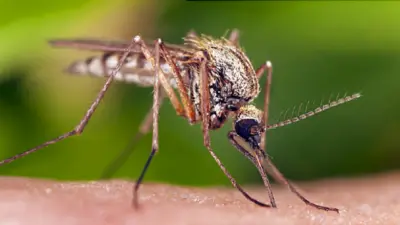

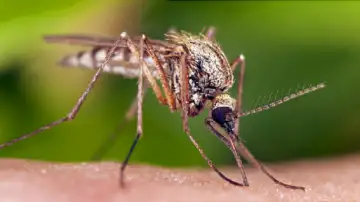
A sudden panic seems to have gripped Guwahati residents, as the rising tide of mosquitoes are increasing by the day with warmer months approaching Assam. Locals from across the city have complained about an increase in mosquito infestation levels. Many claim that even after extermination measures such as fogging and cleaning of open drains, the issue remains and is getting scarier.
Angita Mahanta, a long-time resident of Ganeshguri speaks about similar experiences. She said, "My family has lived here for decades and the increase in mosquitoes has been felt by everyone.
Public health implications of diseases transmitted by vectors (any agent which carries and transmits an infectious pathogen) such as mosquitoes cannot be overemphasized. Some come vector-borne diseases are Malaria, Dengue, Japanese Encephalitis (JE), Chikungunya, Kala Azar, and Filaria. According to the World Health Organization (WHO), more than 80% of the global population, approximately 5.5 billion people are threatened by at least one major Vector-Borne Disease (VBD), and more than half are at risk for two or more such diseases.
Interestingly, the present government has introduced measures for effective mosquito control. The enactment, however, of the existing Public Health Act against the violations of mosquitogenic conditions is essential as suggested by the National Vector Borne Disease Control Programme's 2020 report.
The report adds that legislative support is vital for the success of dengue control programs and it should ideally cover all aspects of environmental sanitation to effectively contribute to the prevention of all transmissible diseases. The Epidemic Disease Act 1897, under Part B, has provisions for taking legislative actions against the defaulters. This act has been amended subsequently by various states according to their requirement. Legislation is needed to contemplate intersectoral coordination among the ministries involved to prevent isolated implementation of individual programs and harmful environmental changes that could create potentially hazardous public health conditions.
It is imperative to mention that the peak transmission season for various vector-borne diseases including JE, Malaria, and Dengue begins in April and goes up to November.
Busy areas of the city like Paltan Bazar for instance provide for the making of potential hotspots for malaria with mosquito breeding grounds scattered all over.
"Living normally in this locality has become difficult. In the building I live in, fogging was last done on March 14 but we haven't experienced a decrease in the numbers of them. They are huge in size and mosquito repellants just do not seem to work against them," a resident of Bijuli Mill Lane in Paltan Bazaar told G Plus.
"In recent years, there has been a significant increase in VBDs, as observed in the intensified transmission in endemic areas, re-emergence after a gap of several decades, and spread to newer areas. The high incidence of VBDs is an indicator for deficient health and well-being of the community as well as leading to personal and national economic loss due to disease burden associated with morbidity and mortality. The direct costs of VBDs include a combination of personal and public expenditures on both prevention and treatment." as stated in the report by NVBDCP. The indirect costs include productivity or income loss due to illness or premature death.
Mandatory health impact assessment of various development projects and building construction activities is the need of the hour. In the Building Construction Regulation Act where building by-laws should be framed for appropriate construction of mosquito-proof overhead/underground tanks, mosquito-proof buildings, designs of sunshades and porticos, etc to prevent stagnation of water which causes excessive breeding of mosquitoes.
In Assam, low rainfall situations and drying groundwater levels are the main challenges in the urban as well as rural areas, forcing people to store water for household use. Many states are making efforts for rainwater harvesting in urban areas considering the increase in population and burden on water supply. A utilitarian rainwater harvesting system needs to be designed in such a way that it does not allow the breeding of Aedes mosquitoes. It is important to mention that currently there is no regulatory mechanism in this regard.
G Plus spoke to Ganesh Saikia, Joint Director, Health, Kamrup to take stock of the current situation in Guwahati. He mentioned that fogging will be undertaken only when cases of Malaria and Dengue are reported. As for the reports that say the numbers of mosquitoes have risen, he said, "We have not received reports as of yet of an increasing number of cases of malaria/dengue or mosquitoes. In fact, Assam's case numbers are comparatively better than the rest of the country as we have improved on our efforts to contain vector-borne diseases. All of last year was spent on dealing with COVID and its repercussions, this year we have to renew our initiatives. As for fogging localities, we will only do it when VBDs are reported from the same."
Surbhi Agarwal, 23, a resident of Fatasil said, "The mosquito infestation in our area has taken over our lives. We can't sit outside even for a minute, let alone open our windows past dusk. There is an open drain in the lane I live in, and the number of mosquitoes seems to have risen over the years. In recent memory, no fogging has been done in our locality."
Meanwhile, various municipalities in the country like the Mumbai Municipal Corporation, New Mumbai Municipal Corporation, Municipal Corporations of Delhi, Chandigarh, Goa, and a few other municipalities have adopted legislation for the prevention of "nuisance mosquitoes". However, they lack proper implementation at the ground level, according to a report by the National Vector Borne Disease Control Programme.
It is to be mentioned that in 2019, Assam recorded a total of 2307 cases of Malaria. Further, the state saw 167 cases of Dengue, 2652 positive cases for acute encephalitis syndrome, and 642 cases for JE in 2019, as per the National Vector Borne Disease Control Programme. In 2020, the numbers don't look too bad for Assam specifically as 484 cases of Malaria were registered, 32 cases of Dengue, 595 cases of Japanese Encephalitis, and 96 deaths were caused because of it.
- News
- City
- Guwahati Mosquito Menace
- Guwahati
- Assam
- Assam Elections 2021
- Assam Elections
- Guwahati News
- Assam News
- Guwahati Municipal Corporation
- GMC
- GMDA
- Guwahati Plus News
- Guwahati Plus
- G Plus News