

Rethinking Iran's Role in India's Maritime Strategy
Is it time for Indians to stop labeling Iran as part of the "Middle East"?
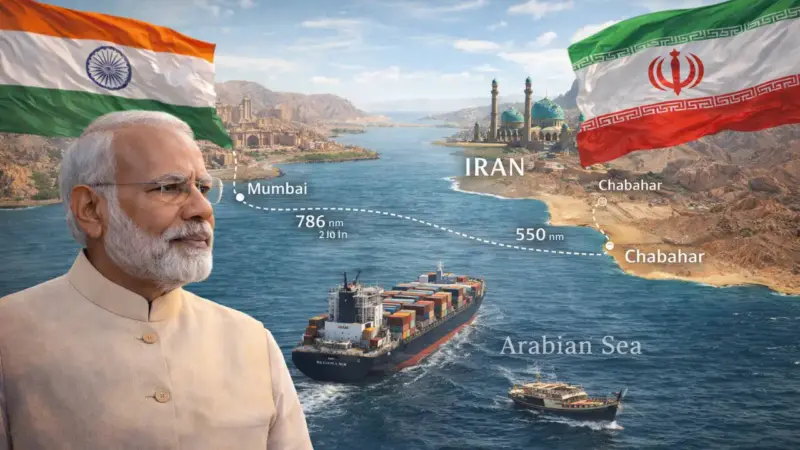
This designation is not only geographically inaccurate but also strategically detrimental. Iran is not a remote West Asian nation embroiled in conflicts that do not concern India; rather, it is a maritime neighbor. The southern coastline of Iran is situated directly across the Arabian Sea from India's western coast, with a mere 550 nautical miles separating Kandla Port in Gujarat from Chabahar. From Mumbai, the distance extends to 786 nautical miles. Historically, this route served as a trade corridor, fostering connections between two civilizations rather than a crisis zone.
The recent conflict involving Iran and the combined forces of the US and Israel has drastically altered this perspective. Following the US and Israel's military actions against Iran on February 28, India felt the repercussions almost immediately-oil prices surged past $100, LNG supplies from Qatar dwindled, and an Iranian warship that had participated in India's MILAN-2026 naval exercise was sunk near Sri Lanka. Regardless of one's stance on the conflict, the impact on India was both swift and undeniable.
India Iran Maritime Neighbour
">For a nation sharing a maritime border with a country at war, it is crucial to recognize that this conflict is not merely someone else's issue. The energy crisis hit India hard and quickly. On March 2, QatarEnergy halted LNG production after Iranian drone strikes damaged its facilities, a fact confirmed on social media the same day. Just two days later, Petronet LNG, India's largest LNG importer, notified the BSE of force majeure notices to QatarEnergy and its downstream partners-GAIL, IOCL, and BPCL. By March 5, GAIL disclosed that its gas allocation had been reduced to zero, effective immediately. Subsequently, on March 7, oil marketing companies increased LPG prices-Rs 60 for household cylinders and Rs 115 for commercial ones-prompted by the Indian Oil Corporation's updated rates that morning. The underlying issue is a single chokepoint: government sources indicated that 40-50% of India's crude imports and 85-90% of its LPG shipments from Gulf nations transit through the Strait of Hormuz, which is currently closed.
This is not merely a West Asian issue; it is a regional crisis.
India's neglect of Iran's significance has been a long-standing issue, developing over the past decade. Following the reimposition of US sanctions on Iranian oil in 2019, India ceased its imports entirely-a move initially viewed as prudent statecraft. However, the consequences of this decision have become clearer over time. Geostrategist Brahma Chellaney, Professor Emeritus of Strategic Studies at the Centre for Policy Research in New Delhi, has consistently warned against this strategic self-sabotage. He pointed out that India's withdrawal from Iranian oil left China as the primary buyer of what remained the world's most affordable crude, sold at significant discounts to the Brent benchmark-thus enhancing Beijing's energy security at India's expense. Essentially, India has been paying more to allow China to pay less. Meanwhile, the US has notably refrained from penalizing Beijing for actions that India was pressured to halt.
The situation at Chabahar port appears to be following a similar trajectory. In May 2024, India and Iran entered into a significant 10-year agreement for India to develop and manage the Shahid Beheshti terminal. Chabahar Port represents India's sole viable route to Afghanistan and Central Asia that circumvents the problematic neighbor, Pakistan. Any deviation from this agreement with Iran could create an opportunity for China to step in. Notably, the 2026-27 Union Budget did not allocate new funds for Chabahar, with a looming US sanctions waiver deadline of April 26. Chellaney described this as "a tactical freeze rather than a strategic retreat," cautioning that any Indian withdrawal would likely create a vacuum for China to exploit. The ongoing conflict has not altered the strategic landscape; it has merely highlighted the extent of ground India has already conceded.
Understanding Iran's Significance for India
By removing the "Middle East" label, the strategic relationship with Tehran becomes clearer. Iran stands as the closest major supplier of oil and LNG for India. It also serves as the entry point to the International North-South Transport Corridor (INSTC)-a 7,200-km multi-modal route linking India to Afghanistan, Central Asia, Russia, and Europe. According to a report in The Diplomat, the INSTC is projected to reduce transit times by approximately 40% and logistics costs by around 30% compared to the Suez Canal route.
Geopolitically, Iran occupies a pivotal position at the intersection of regions crucial to India's strategic interests-Afghanistan to the east, Central Asia to the north, and Pakistan to the southeast. Should Chinese firms dominate future development projects in Iran, it could severely undermine India's broader geoeconomic objectives-not only concerning Chabahar port but also regarding the INSTC as a whole. In 2021, Iran and China reportedly signed a 25-year cooperation agreement, with Chinese investment commitments amounting to $400 billion in Iran's economy. With each passing year, as India retreats, China advances.
The IRIS Dena Incident and Its Implications
The sinking of the Iranian frigate IRIS Dena has brought the conflict directly into India's strategic sphere. The warship had recently docked at Visakhapatnam for India's MILAN-2026 naval exercise. Iran's Foreign Minister Araghchi stated on social media that the vessel, which was unarmed and carried nearly 130 sailors, was struck in international waters without warning. Iran's ambassador confirmed its unarmed status. Former Navy chief Admiral Arun Prakash remarked that a US nuclear submarine had operated in Indian waters for several days without notifying New Delhi, which Chellaney described as a strategic embarrassment. New Delhi did not issue an official statement regarding the incident.
External Affairs Minister S. Jaishankar addressed the presence of Iranian naval vessels in Indian ports, clarifying that they were initially there for a fleet review but found themselves caught in the conflict. He explained that one Iranian ship had reported difficulties and requested entry, which India granted on March 1. The vessels had originally intended to participate in a fleet review before the situation escalated.
Labeling Iran as "Middle Eastern," as Chellaney rightly pointed out, is not merely a geographical oversight. It has allowed New Delhi to treat one of its most significant neighbors as a distant issue for a decade-impacting energy, connectivity, and strategic positioning. Chellaney, writing for a prominent publication at the end of 2025, cautioned that India's historically valued independent stance in global affairs has revealed its structural vulnerabilities, with a series of external shocks leading to a diminished strategic maneuverability. The ongoing conflict in Iran represents the latest and most significant of these shocks.