
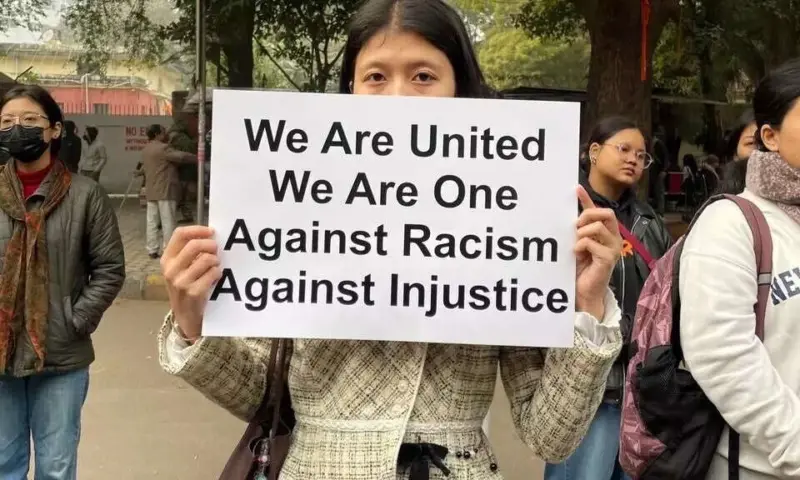

Ongoing Struggles with Prejudice
For many individuals from the Northeast residing in major cities, the realities of subtle bias and blatant racism are distressingly common.
As the youth from this region increasingly migrate to urban centers like New Delhi for better educational and job prospects, they frequently encounter stereotypes, discrimination, and at times, outright aggression.
The recent alleged assault of a woman from Manipur and a third-gender individual from Assam near Saket Court in New Delhi on March 8 has reignited discussions about the safety and dignity of Northeastern residents in the capital.
This incident has led to significant public outrage and raised alarms regarding the treatment of people from the region.
Political figures from the Northeast swiftly condemned the attack, with Meghalaya's Chief Minister Conrad K. Sangma labeling it 'sickening' and asserting that racial bullying should not be normalized.
Former Chief Minister of Manipur, N. Biren Singh, also denounced the incident, emphasizing that such acts are unacceptable in society.
What is particularly alarming is the frequency of these occurrences in the capital. The assault near Saket follows closely on the heels of an incident on February 20, where a couple was arrested for directing racial slurs at three women from Arunachal Pradesh.
These events have reignited a long-standing debate about racism in India. Despite years of dialogue and calls for reform, discrimination against Northeastern individuals continues to emerge, prompting serious questions about identity, belonging, and acceptance within the nation's social framework.
Everyday Discrimination Persists
A woman from Manipur was allegedly assaulted in Delhi on March 8
Everyday bias still lingers
Numerous individuals from the Northeastern community assert that while discussions at the policy level continue, the day-to-day experiences of discrimination remain unresolved.
"Sometimes it's the jokes, or people inquiring if we hail from China or Nepal. It highlights how little awareness exists about us," remarked Debajani Sonowal, a Guwahati resident who previously worked in Delhi.
Another young professional from Assam recounted similar experiences during his time in the capital.
"I was often called 'chinky' or 'Chinese'; this was around 2015-16. Even during routine outings, slurs were hurled at us. This contributed to my decision to leave Delhi," shared Nirupam Basumatary.
For the thousands of students and professionals migrating to cities like Delhi annually, the aspiration extends beyond seeking justice after such incidents; they yearn for a societal transformation where respect and inclusion are the norms.
Addressing Racism in India
A Delhi couple was arrested for hurling racial slurs at three women from Arunachal Pradesh on February 20. (Photo:'X')
'Racism exists in India'
The ongoing nature of these incidents raises questions about whether sufficient measures have been implemented at the institutional level to combat discrimination against Northeastern individuals.
Pradyot Bikram Manikya Debbarma, leader of the Tipra Motha Party, noted that while the issue is widely acknowledged, it is seldom addressed openly.
"Everyone is aware of these occurrences. It stems from ignorance and the belief that some communities are superior to others. Racism is present in India. We are the world's largest producer of Fair & Lovely. Whether we acknowledge it or not, racism exists," he stated.
Debbarma further explained that the issue is closely tied to the lack of awareness about the Northeast in mainstream Indian discussions.
"The Bezbaruah Committee produced a report that has yet to be adequately addressed by the Government of India. Established in 2014 after the murder of Nido Tania, a student from Arunachal Pradesh in Delhi, the committee was tasked with investigating racial discrimination and safety issues faced by Northeastern individuals in other parts of India, particularly in urban areas, and proposed several legislative and policing reforms.
Debbarma emphasized the need for broader societal initiatives to tackle stereotyping and discrimination, asserting that implementing the committee's recommendations could be a significant step forward.
"The committee's report discusses issues related to accommodation, awareness, sensitivity, and education. People across India should be educated about our region. There are numerous recommendations in the report that could help address these concerns," he added.
For many from the Northeast, the hope persists that discussions ignited by such incidents will eventually lead to substantial change, ensuring that every Indian, regardless of their origin, feels safe, respected, and accepted throughout the country.