
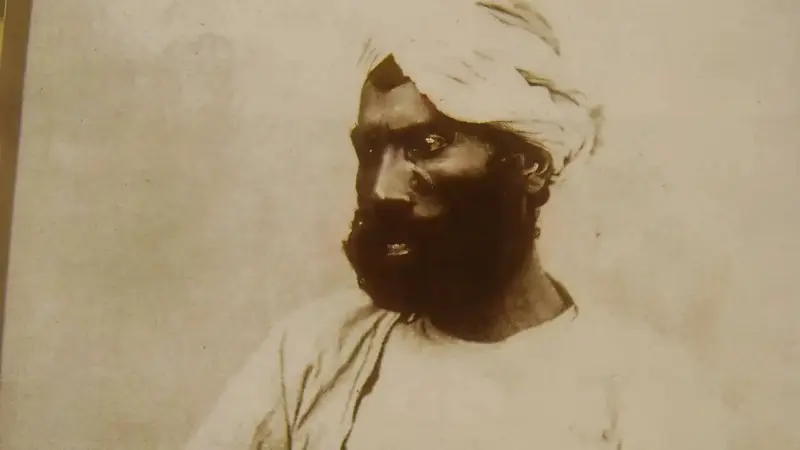

The Legacy of Mangal Pandey
Mangal Pandey is a name familiar to every Indian student. Known for his act of defiance against British authority on March 29, 1857, when he shot at a British officer, his story is often simplified.
However, the deeper narrative involves a Dalit worker named Matadin Bhangi, whose plea for water ignited a significant historical moment.
A Thirsty Plea
A Glass of Water
Matadin, a Valmiki employed at the ammunition factory in Barrackpore, faced the harsh realities of caste discrimination. One day, parched from his labor, he approached Mangal Pandey, a Brahmin soldier, for a drink. Pandey's refusal was rooted in the caste system, which deemed it unacceptable for him to share anything with a low-caste individual.
Matadin Was Denied Water By Mangal Pandey Amid Caste Hierarchy At Barrackpore (AI Generated)
">Matadin's response was powerful and resonated through history: he confronted Pandey, highlighting the hypocrisy of a Brahmin soldier consuming cartridges greased with cow and pig fat, substances that violated their religious beliefs. This confrontation exposed the contradictions within the military ranks.
The Spark of Rebellion
The Fire Spreads
Matadin's words ignited a fire among the soldiers. On March 29, 1857, Pandey took a stand against the British, accusing them of disrespecting Indian soldiers' religious beliefs, leading to his court-martial and execution on April 8. The disbandment of the 34th Bengal Native Infantry followed.
Mangal Pandey Broke Parade Line and Opened Fire In 1857 (AI Generated)
">By May 10, the revolt had erupted in Meerut, quickly spreading across northern India, marking the largest uprising against British colonial rule prior to the 20th century. Matadin, however, was also charged and executed for his role in this uprising.
The Forgotten Hero
The Erasure
While Mangal Pandey has been commemorated with a postage stamp and a Bollywood film, Matadin Bhangi remains largely unrecognized in mainstream history. His contributions are preserved only in Dalit oral traditions and the works of historians like Badri Narayan Tiwari and D. C. Dinkar. Tiwari emphasized that Matadin's words were not just insults but a profound awakening of consciousness among the soldiers.
The events of 1857 intertwine the narratives of caste and colonialism. The true instigator of the rebellion was not merely the soldier who fired the gun but the Dalit who dared to speak the truth about the injustices he witnessed. Matadin Bhangi's refusal to remain silent sparked a rebellion that would change the course of history.