
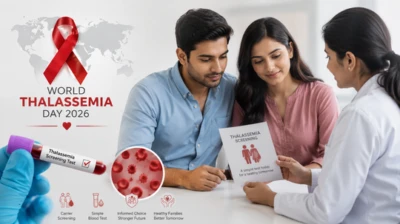

World Thalassemia Day is observed every year on May 8 to raise awareness about the inherited blood disorder caused by faulty genes.The day was initiated in 1994 by the Thalassaemia International Federation in memory of George Englezos, the son of the federation's founder, who succumbed to the disease.
This year's theme, "Together for Better Care and Equal Access," highlights the need for universal screening, safe blood availability, and advanced therapies.
The disorder, which often requires blood transfusions every fortnight, affects approximately 1.3 million people living with severe forms of thalassemia worldwide. About 1.5 percent of the global population is carriers, and the disease claims nearly 11,000 lives annually.
More than 40,000 infants are born each year with severe thalassemia, predominantly in low- and middle-income countries. Although mortality rates have declined, they remain high in developing regions, particularly in Southeast Asia.
What Is Thalassemia?
Thalassemia is an inherited hemoglobin disorder caused by defective synthesis of alpha or beta globin chains.
In β-thalassemia major, reduced or absent beta-chain production leads to ineffective erythropoiesis, severe anemia, bone marrow expansion, splenomegaly, growth retardation, and iron overload due to repeated blood transfusions.
Patients often present in early childhood with pallor, jaundice, recurrent infections, and characteristic facial bone deformities.
Thalassemia Screening
With 10,000-15,000 babies born with Thalassemia Major every single year in India, the country remains one of the global hotspots for the blood transfusion-dependent disease.
HealthandMe spoke to doctors who emphasized that carrier screening, premarital counseling, and antenatal diagnosis remain crucial preventive strategies in India, often referred to as the "thalassemia capital of the world", as nearly one in every eight thalassemia patients globally lives in the country.
Experts stressed that normalizing conversations around screening is key to reducing the disease burden.
Dr. Ajay Sharma, Director and Head of Hematology and Hemat-Oncology at Paras Health Panchkula, said thalassemia is a preventable genetic disorder, but continues to go undetected until it is too late.
This is because "thalassemia screening, which is one of the simplest yet most overlooked preventive steps in India," said Dr. Vishnu Hari, Associate Director and Head of Haematology & BMT at Sarvodaya Hospital, Faridabad.
"Every couple, especially those planning marriage or pregnancy, should undergo basic carrier screening. The challenge is not the availability of tests, but the lack of awareness and social hesitation around genetic conditions," Dr. Hari said.
Also read: Reused Syringes Infect Over 330 Children in Pakistan With HIV: Report
When To Get Screened?
Screening should ideally be done early, as early detection helps informed decision-making and prevents severe health complications in children. Experts recommend screening:
- At the premarital stage
- At the start of pregnancy
What Will the Screening Find?
Carrier detection is possible with a complete blood count and a test called High Performance Liquid Chromatography (HPLC). Indicators include:
- Low haemoglobin (~9 g/dL)
- Low MCV (Mean Corpuscular Volume, ~65)
- HbA2 levels above 3.5%
Dr. Sharma said early screening through a simple blood test, such as Hb electrophoresis, can identify carrier status in couples.
"If both partners are carriers, timely genetic counselling during the antenatal phase becomes critical," he said.
While cultural stigma and low prioritization of preventive healthcare often delay this step, the integration of routine thalassemia screening into premarital check-ups and early pregnancy care can help significantly reduce the number of affected births in India.
What Could Be Done To Manage Thalassemia?
Dr Parveen Yograj, a General Surgeon from Jammu, in a post on the social media platform X, shared that treatment for thalassemia has evolved remarkably over recent decades.
"Regular blood transfusions combined with iron chelation therapy using agents like Deferasirox and Deferiprone have significantly improved survival. Curative therapy through bone marrow transplantation is now increasingly successful, especially in children with matched donors.
"Recent breakthroughs in gene therapy and CRISPR-based genome editing offer new hope for a long-term cure by correcting defective globin gene expression," he said.
Read more news like this on www.healthandme.com