




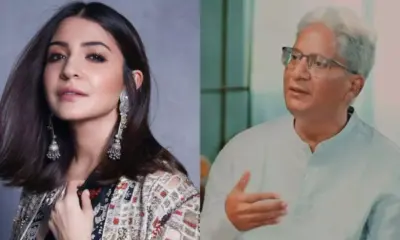

Bollywood actress and entrepreneur Anushka Sharma is no stranger to public attention but her latest social media story has sparked a conversation that goes well beyond celebrity gossip.
A short video she shared on her Instagram has divided the internet sharply, reigniting one of the oldest and most heated debates in modern medicine does homeopathy actually work or is it simply a placebo?
Anushka shared a clip from a conversation between Dr. Rajan Sankaran, a well-known homeopathic physician and Namita Thapar the Executive Director of Emcure Pharmaceuticals and a familiar face from Shark Tank India. Alongside the video, Anushka wrote, "Homeopathy played an important role in my life and Dr. Rajan Sankaran has been a key part of that journey. I deeply value his insights on health and mindful living."
For her followers, it was a personal and heartfelt share. For the scientific community and a vocal section of the internet, it was something else entirely an endorsement of a system of medicine that mainstream science has repeatedly and consistently failed to validate.
One particularly sharp response read, "Virat Kohli's wife, Anushka Sharma is recommending homeopathy to Indians. Fraud babas are not enough, she is now promoting unscientific fraud medicine to Indians. Give them enough money and they might one day tell people, just visit Premanand Maharaj to cure all your diseases." The comment, while harsh in tone, reflects a frustration that many in India's scientific and medical community have expressed for years that celebrity influence, when pointed in the wrong direction, can do real harm.
So what exactly is homeopathy, and why does it remain so controversial?
In India, however, the picture is far more complicated. Homeopathy has deep cultural roots in the country and enjoys a level of institutional legitimacy that it does not have in many Western nations. It is officially recognised by the Indian government, taught in dedicated medical colleges, and practised by hundreds of thousands of registered practitioners across the country. For millions of Indians particularly in smaller towns and rural areas where access to conventional healthcare is limited homeopathic practitioners are often the first and sometimes only point of medical contact. The emotional and cultural attachment to homeopathy in India runs very deep, and dismissing it entirely often feels, to many people, like a dismissal of their lived experiences.
That is precisely what makes Anushka's post so layered and so difficult to simply laugh off or applaud.
On one side of this debate are people who have personally experienced what they believe to be genuine relief and healing through homeopathic treatment including, apparently, Anushka herself.
On the other side are doctors, scientists, and public health advocates who worry about something very specific that when a celebrity with tens of millions of followers publicly endorses an unproven medical system, some of those followers may choose homeopathy over evidence-based treatment for conditions that are serious, progressive, or life-threatening.
This is not a hypothetical concern. It has happened before, in India and across the world, with consequences that have sometimes been devastating.
What Anushka's post ultimately reflects is a tension that Indian society has not yet fully resolved between the instinct to respect personal choice and lived experience on one hand, and the responsibility that comes with having a massive public platform on the other. Celebrities are not doctors. They are not required to be. But when they speak about health, millions of people listen and that comes with a weight that cannot simply be waved away as a personal opinion.
The debate rages on. And it will continue to, long after this particular post disappears from people's feeds.