




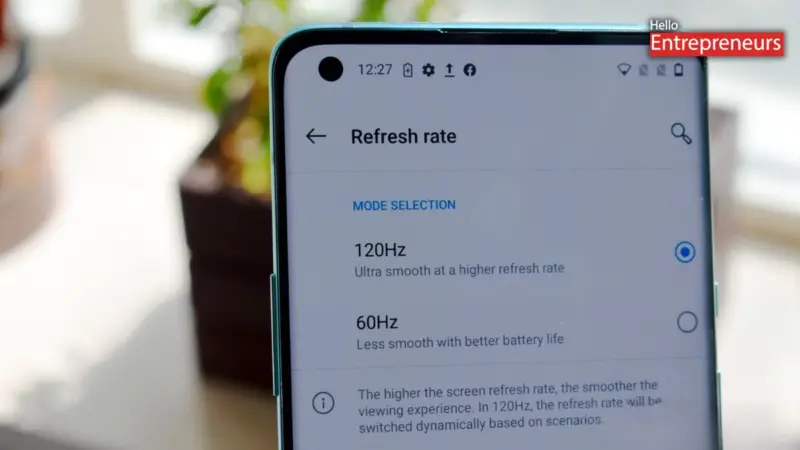

New Delhi: As we all know, many smartphone brands have started to offer high refresh rates in their phones, but one main question still remains: do users actually need high refresh rates in their devices or not? Smartphone brands are now steadily pushing higher refresh rate displays by moving beyond 120Hz to 144Hz and even 165Hz.
But on paper, these updates have appeared significantly and are often highlighted as key features. Are they changing the day-to-day usage of the users?
A 60Hz display refreshes 60 times per second, . a 120Hz display does it for 120 times, whereas 144Hz and 165Hz panels go higher.
In simple terms, to understand this, via a flip-book animation. The faster the pages flip, the smoother the motion appears.
Which is mostly similar to the higher refresh rate should lead to smoother animations, fluid scrolling, and better motion clarity.
The jump from 60Hz to 120Hz is clearly highlighted. However, moving beyond 120Hz does not deliver the same visible improvement.
A 144Hz or 165Hz display should feel smoother than a 120Hz panel. One major reason is that the system interface itself is often capped at 120Hz. Application optimization also plays a crucial role. However, most of the applications are not specially designed to take advantage of refresh rates beyond 120Hz.
Even if the smartphone supports 165Hz, it now operates at 120Hz or lower most of the time. In terms of gaming, where higher refresh rates could matter. Most of the mobile games run at 60FPS or 90FPS. Some also support 120FPS, but very few go beyond 120FPS. This actually means higher refresh rate panels rarely operate at their full potential.
Higher refresh rates come at the cost of the increased power consumption. By running a display at 144Hz or 165Hz it will requires more energy than 120Hz or lower. However, manufacturers use adaptive refresh rate systems that lower the refresh rate when high smoothness is not needed.
While reading or watching videos, the display might drop to 60Hz. Higher refresh rate modes are typically labeled as providing smoother performance, but the higher battery usage, while the lower mode prioritizes efficiency.
However, for everyday tasks such as social media scrolling, messaging, and browsing, 120Hz is already smooth. Video content also does not benefit, as most media is produced at 24FPS, 30FPS, or 60FPS. Factors such as brightness, color accuracy, and overall display quality have a greater impact on the user experience than the refresh rate alone.
It now delivers a smooth and responsive experience across typical use cases. Rather than aiming only for the higher refresh rate numbers, it is more practical to consider overall display quality, consistency, and brightness. A 144Hz and 165Hz display is a more specification-driven update than one for daily use. It may add value on paper, but it is expected to be the deciding factor for most users when choosing a device.