
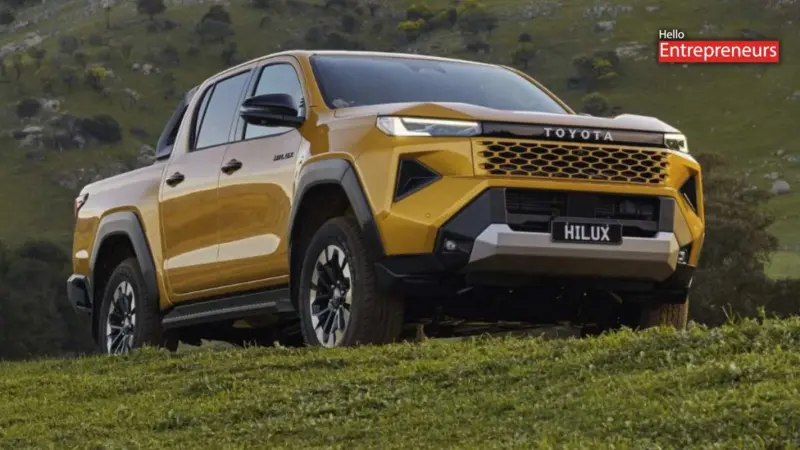

New Delhi: Toyota has introduced its ninth-generation Hilux, marking a significant transformation for the legendary pickup as it enters the era of electrified mobility. The latest Hilux brings a host of firsts, including the battery electric and hydrogen fuel cell versions alongside 48V hybrid, diesel, and petrol powertrains embodying Toyota’s multi-path strategy to meet diverse customer and market needs. This latest generation Hilux has been developed under Toyota’s philosophy that different regions and customer requirements demand multiple powertrain options rather than a single solution.
The lineup now includes a fully electric Hilux BEV, a Hybrid 48V variant, and continued internal combustion choices for select markets, making it the most versatile Hilux ever produced.
The 2026 Hilux adopts a latest Tough and Agile design theme, the front fascia gets a bold latest look with the slimmer headlamps, a horizontal bar carrying the TOYOTA name, and the redesigned bumper. The electric version features a closed-off front grille for aerodynamic efficiency and unique alloy wheels. A latest rear deck step and reprofiled side steps enhance practically, while Hilux now comes exclusively in the Double Cab body style based on customer preference. Inside, the cabin has been redesigned for greater comfort and modern appeal, drawing inspiration from the latest Toyota Land Cruiser. The dashboard features a 12.3-inch customizable driver display and a 12.3-inch infotainment touchscreen, with grouped off-road controls and a latest shift-by-wire selector in the BEV variant.
Connectivity features include wireless smartphone charging, rear USB ports, and remote vehicle access via the MyToyota application, which offers fleet managers the ability to track multiple vehicles, monitor charging and fuel levels, and access driving analytics. The Hilux adopts electric power steering, providing more precision and ease of manoeuvrability. The Toyota T-Mate suite of safety and driver assistance technologies has also been upgraded, now offering features such as Proactive Driving Assist, Low Speed Acceleration Suppression, and Emergency Driving Stop System. Additional features include Blind Spot Monitor, Safe Exit Assist, and Driver Monitor Camera. Over-the-air software updates will keep the system current throughout the vehicle’s lifespan.
The latest Hilux BEV marks historic shifts for the pickup, powered by the 59.2 kWh lithium-ion battery and dual e-axles. The electric Hilux delivers permanent all-wheel drive with 205 Nm of torque at the front and 268.6 Nm at the rear. Preliminary figures suggest a payload capacity of 715 kg, a towing capacity of 1600 kg, and an estimated driving range of 240 km. Toyota claims best-in-class charging performance, while off-road capability remains uncompromised thanks to body-on-frame construction, battery protection measures, and the same wading depth as the diesel model. A Multi-Terrain Select system optimises traction across different surfaces, simulating low-range torque distribution similar to conventional 4x4.
Toyota’s 48V hybrid system, already introduced in 2025, will become the core powertrain option for the latest generation. Production is scheduled to begin in spring 2026. The setup combines a 2.8-litre diesel engine with the 48V lithium-ion battery, electric motor-generator, and DC-DC converter, delivering smoother, quieter operation and improved fuel economy. The system also retains Hilux’s renowned capability, including the 1-tonne payload and 3.5-tonne capacity, while maintaining its 700 mm wading depth. The off-road performance is enhanced with the Multi-Terrain Select, Multi-Terrain Monitor, and Panoramic View Monitor for improved control in rough conditions. Toyota will continue offering the 2.8-litre diesel and 2.7-litre petrol versions for Eastern European markets, ensuring the model remains accessible to customers in regions where the diesel remains a necessity.
India is likely to get these engine options at the time of launch, sometime next year. Toyota has also confirmed that the Hydrogen Fuel Cell Electric Vehicle version of Hilux will go into production by 2028. This upcoming variant will combine zero-emission performance with the long range and rapid refuelling capabilities, furthering Toyota’s hydrogen ecosystem development across Europe.