
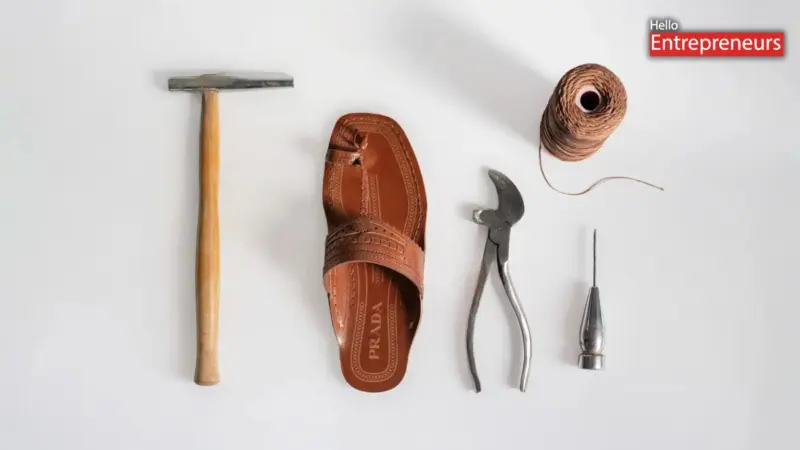

New Delhi: What started as a cultural appropriation debate has nowadays become a rather unlikely partnership- introducing the traditional Kolhapuri chappals of India to the world of luxury. The narrative began earlier this year at the Spring/Summer 2026 presentation of Prada in Milan Fashion Week. One of the expensive pairs of outfits that were noticed was a pair of leather sandals. The design was immediately recognisable to many Indians seeing it online. The open-toe braided leather style was quite akin to Kolhapuri chappals, an ancient handicraft form of footwear, whose origin was Maharashtra and Karnataka.
When photos of the runway leaked into social media, the backlash did not take long to manifest itself. Prada was accused of borrowing a traditional craft by Indian users, designers and politicians. It was not only a matter of inspiration, but of recognition and justice.
Kolhapuri chappals are not a simple footwear, it is also a culture. They are crafted by local artisans and made by frequently generations-old methods; also they have a Geographical Indication (GI) tag in India. Although they are of cultural significance, they are usually sold at relatively cheap prices in the local markets. Prada, on the other hand, was to be sold at much more expensive prices, with the support of a global luxury brand. This contrast elicited resentment, and it was claimed by many that international brands were making money off classic designs without giving back to the first designers.
The scandal did not stay within the social media. The artisan groups and industry bodies were also concerned about intellectual property rights and held them accountable. Legal discourse on the protection of traditional knowledge also started to pick up. Prada, at first, did not say anything, which only added to the criticism. However, as the controversy became more and more vocal, the company released an announcement that stated that its sandals were actually based on Kolhapuri chappals. Prada made it clear that they had no intention of offending Indian culture. More to the point, it indicated a desire to have dealings with Indian stakeholders. This was the first change in the story- denial to dialogue.
In the background, a dialogue started between the brand and Indian artisan communities, as well as trade bodies representing the Kolhapuri craft industry. The next thing that came in was a twist. Prada chose to go in a different direction rather than merely protecting its design. The company also declared to release a limited series of Kolhapuri-inspired sandals manufactured in India. The distinction was apparent this time around: the products would not just recognize their inspiration, but the Indian artisans would be directly involved in the production process.
The partnership was to bring together traditional artisanship and the world of design and marketing. The Maharashtra and Karnataka artisans became part of the production chain and had an access to the international markets, which were previously inaccessible to them. Production was not the end of what Prada did in response. The company also unveiled a three year training and skill development programme of Indian artisans.
This project will help to develop craftsmanship, better production methods, and exposure to the world fashion standard. It is also possible that the selected artisans are offered a chance to be trained in Italy, a cultural exchange between the old Indian artisans and the luxury European design. This was a big change to many of the observers. What started as an alleged cultural appropriation situation, turned out to be a prototype of collaboration and investment.
The same design that a few years ago caused outrage is being marketed today, as a Made in India luxury product. The path to controversy-collaboration has been short, yet it poses some key questions. To Indian craftsmen, it is certainly a welcome move. It can expose them to new heights and international exposure of their work, all due to the fact that they are affiliated with a global brand such as Prada.
However, concerns remain. Researchers and advocates still debate the authenticity of such partnerships in terms of providing fair amounts and long-term rewards to craftsmen. The broader questions involve the way global brands ought to interact with traditional knowledge in the future as well. The episode of Kolhapuri-Prada shows an emerging tension in the fashion industry of the world. The boundary between appreciation and appropriation is ever more significant as brands seek to be inspired by different cultures.
The influence of the population in this instance was also important. This backlash could not have come up, and the story could have turned out very differently. Rather, it has been a demonstration of how criticism can bring companies into more responsible action. What began as a controversial instance on an international runway has now come round in a completely different way. Kolhapuri chappals that used to pass unnoticed in the global fashion discourse are being brought into the limelight to be talked about and displayed all over the world.
It is not the most ideal of stories, yet it is an indicator of a change. Traditional crafts are ceasing to be merely inspirational sources, they are taking part in the world discourse, and their origins are finally receiving the much-needed attention. And this time India is very much a part of the story.