





New Delhi, 01 June (H.S.):
In a major step towards strengthening water resource management, drinking water security, and water conservation in the country, the Central Government has launched the Mission for Advancement of High-Impact Areas for Water (MAHA on Water) programme.
Under this ambitious initiative, the Ministry of Jal Shakti and the Anusandhan National Research Foundation will jointly invest ₹200 crore to accelerate research and innovation in the water sector.
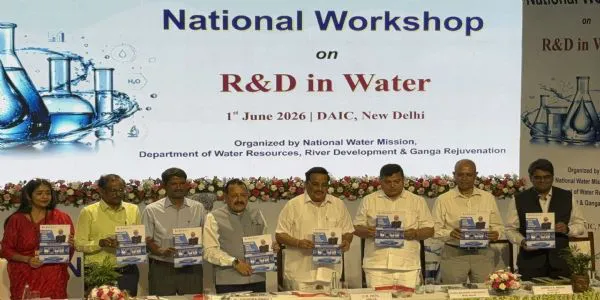
The Ministry of Jal Shakti on Monday organized a National Workshop on Research and Development in the Water Sector at the Dr. Ambedkar International Centre in New Delhi. The workshop was jointly inaugurated by Union Jal Shakti Minister C. R. Patil and Minister of State (Independent Charge) for Science and Technology Jitendra Singh. Ministers of State for Jal Shakti, Raj Bhushan Choudhary and V. Somanna, were also present on the occasion.
As part of the workshop, companies, startups, and Micro, Small and Medium Enterprises (MSMEs) were invited to participate in product and prototype development aimed at promoting innovation in the water sector. A significant Memorandum of Understanding (MoU) was also signed between the Ministry of Jal Shakti and Indian Space Research Organisation for satellite-based water research, water quality monitoring, river flow analysis, and the development of water conservation technologies.
The highlight of the event was the launch of MAHA on Water, a joint initiative of the Ministry of Jal Shakti and ANRF. The programme aims to promote cutting-edge research in priority areas such as water resource management, drinking water, climate adaptation, and water-use efficiency. An open call for research proposals was also announced under the initiative.
Addressing the gathering, C. R. Patil described water as the cornerstone of India's civilization and said that the Jal Jeevan Mission remains a crucial pillar of the country's development journey. He noted that more than 300 research units across the country are being supported under the National Water Mission, with over 100 receiving special assistance.
Highlighting the achievements of the **Jal Sanchay** water conservation campaign, Patil said that although the campaign, launched in June 2025, initially targeted the creation of one million water conservation structures in its first year, public participation helped raise the number to more than 2.7 million. He added that the subsequent target of 10 million structures had already been achieved ahead of schedule, prompting the government to raise the target to 20 million structures.
He urged citizens to transform water conservation into a mass movement and informed that water conservation work is currently being carried out through 20 different design models across the country.
Speaking at the workshop, Dr. Jitendra Singh said that research and development in the water sector is not solely the responsibility of the government but a shared national mission in which the private sector also has a significant role to play. He noted that India's space economy is expanding rapidly and is expected to witness multifold growth in the coming years.
The minister said that satellite technology is increasingly being used in public welfare programmes and that ISRO's expertise is proving valuable for several ministries. He added that a new agreement would soon be signed with the Ministry of Earth Sciences to address drinking water challenges in coastal states, while joint projects involving biotechnology and the Council of Scientific and Industrial Research are already being undertaken in the field of water purification.
During the technical sessions, the Research and Development Division presented findings from 113 completed studies. Participants reviewed the National Hydrology Programme and discussed scientific research on topics including leachate transport modelling for the Ghazipur landfill site, reservoir management, and water use in agriculture. Detailed deliberations were also held on farmer-centric studies and advanced water management technologies.
---------------
Hindusthan Samachar / Jun Sarkar