




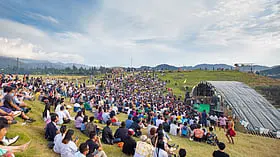

Hosted by the Apatani community in Arunachal Pradesh, the Ziro Festival of Music brings independent artists and travelers to Lower Subansiri each September.
Featuring handmade bamboo stages, regional dishes, and community-led practices, the four-day gathering balances indie music culture with local heritage and environmental care.
In the lower ranges of Arunachal Pradesh, the Ziro Valley sits encircled by pine trees, terraced paddy fields, and blue hills. Every September, this agricultural landscape hosts a gathering that brings independent musicians, folk artists, and travelers into the heart of the state. Running from September 25 to September 28, the Ziro Festival of Music has carved out a distinct presence within India's independent performance landscape since its debut in 2012.
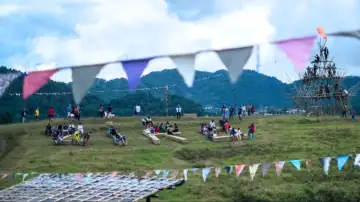
The event takes place on the traditional lands of the Apatani community. The Apatani people are widely recognised for their sustainable agricultural practices and distinct cultural heritage, including intricate irrigation systems that allow fish farming alongside rice cultivation in flooded paddies. Rather than constructing standard metal and plastic stages, festival organisers work alongside local craftspeople to build the festival infrastructure using locally sourced bamboo and cane. The main stages, seating areas, stalls, and arches are assembled using traditional tribal joinery methods, allowing the festival structures to sit comfortably within the surrounding valley.
Performances take place across two primary stages built across open pastures. Day acts assemble on the main acoustic stage, where singer-songwriters, traditional folk troupes, and regional acoustic acts play to crowds sitting on the embankments. As daylight fades, activity moves toward the electric stage, which hosts indie rock bands, electronic producers, and international experimental acts. Over four days, the lineup features a mix of indie performers from across India along with international artists from Northeast Asia, Europe, and neighbouring South Asian countries. Past editions have featured artists such as Lee Ranaldo, Indus Creed, Lou Majaw, and regional folk ensembles from across Nagaland, Manipur, and Mizoram.
Beyond the music performance spaces, community engagement shapes the daily flow of the gathering. Apatani elders and youth participate and volunteer in running festival operations, from guiding guests to hosting cultural demonstrations. Food stalls set up around the perimeter serve traditional regional dishes alongside rice beer brewed in local homes. Attendees taste dishes cooked in bamboo hollows, fresh seasonal greens, smoked pork, and local herbs sourced directly from valley gardens.
Camping forms a central part of the visitor experience. A dedicated campsite sits a short walk from the performance grounds, where travelers set up tents among pine groves. Mornings at the festival grounds begin with community workshops, yoga sessions, guided village walks, and discussions centered on regional environmental preservation. Local guides lead walk-throughs of nearby Apatani villages like Hong and Hari, where visitors learn about traditional house construction, local animist traditions, and community-led conservation efforts.
Environmental responsibility sits at the core of the festival's operational strategy. Organisers enforce strict waste management protocols across the site. Disposable plastics are restricted, and vendors use biodegradable utensils, leaf plates, and bamboo cups. Drinking water stations are placed throughout the venue, encouraging attendees to carry reusable bottles. Scraps and organic materials from food stalls are collected for local composting, keeping the impact on the pasture land minimal.
 Inside The Ziro Music Festival Experience
Reaching the Ziro Valley involves a journey through the terrain of Northeast India. Travelers typically arrive via Guwahati or Assam's Lakhimpur district before taking road transport up mountain roads into Lower Subansiri district. Indian nationals require an Inner Line Permit to enter Arunachal Pradesh, while foreign nationals need a Protected Area Permit, process steps that reinforce the regulated approach to tourism within the state.
The timing of the gathering coincides with the post-monsoon period, when the rice paddies turn yellow and green before harvest. The daytime weather stays mild, while evenings bring cooler mountain breezes that require warm layers. Throughout the four days, the focus remains squarely on artistic` collaboration, cultural exchange, and direct interaction between visitors and local hosts. By maintaining a scale tied directly to its physical surroundings, the Ziro Festival of Music continues to demonstrate how creative events can operate in close balance with regional traditions and natural ecosystems.
Beyond the formal schedule of performances, the atmosphere across the valley during these four days reflects a wilful cadence. Visitors wander through the fields between daytime sets, stopping at small wooden tea shops operated by local families along the edges of the venue. The absence of commercial branding billboards and heavy corporate sponsorships across the festival grounds keeps the focus on the surrounding environment and the music being shared on stage.
Music lovers and travelers often share meals around open fires at night, swapping stories about their journeys to reach the state. The festival acts as a bridge between independent artists from urban centers and regional musicians who carry forward long-standing oral traditions. By bringing these distinct musical traditions together on hand-built stages, the gathering creates space for unexpected collaborations, spontaneous jam sessions, and ongoing dialogue among performers from different backgrounds.
As the final sets wrap up on the fourth night, the village grounds return to their regular agricultural function. Local volunteers work alongside cleanup crews to dismantle the bamboo stages, leaving the pastures clear for livestock and upcoming harvest activities. The event leaves behind minimal physical traces on the land, reinforcing a model of cultural gathering that honours the community, the music, and the landscape that hosts it.
If you enjoyed reading this, here's more from Homegrown:
Manali Is Getting A Village Of Art, Open-Air Cinema & 3 Days Of Stories With HIFAF 2026
Manotsava 2026 Brings Listening & Sharing Circles To Bengaluru And Delhi