
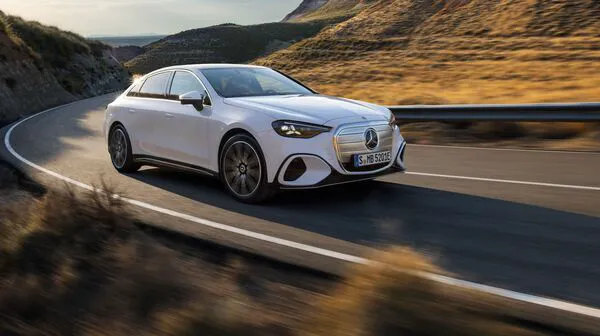

Mercedes-Benz has officially unveiled its next-generation C-Class, and for the first time in the model's history, it arrives without a combustion engine.
The new electric C-Class marks a significant shift for one of Mercedes' best-selling nameplates, retaining the model's premium character on a ground-up electric architecture. The launch begins in the United States, with a broader global rollout, including India, expected to follow, subject to local regulations. Pricing for India has not yet been announced.
2026 Mercedes-Benz C-Class: Performance and powertrain
The launch model is the top-spec C 400 4MATIC electric, producing 360 kW (roughly 483 bhp) through a dual-motor all-wheel-drive setup. It covers zero to 100 km/h in 4.0 seconds, making it the quickest C-Class ever built.
Unlike most EVs, the rear axle gets a two-speed transmission. A shorter first gear (11:1) handles city driving and towing, while second gear (5:1) optimises motorway efficiency. On all-wheel-drive variants, the front motor disconnects almost instantly under light loads, cutting front axle energy losses by up to 90 per cent. Battery-to-wheel efficiency is rated at 93 per cent.
2026 Mercedes-Benz C-Class: Design
The front grille features 1,050 illuminated dots behind a smoked glass mesh, with light animations playing on locking, unlocking, and charging. Headlights adopt a star-shaped daytime running light signature, with an optional 'DIGITAL LIGHT' micro-LED system that extends the illumination range by 40 per cent while consuming half the power of the previous generation.
At the rear, four round red taillights in a star arrangement create a distinct identity. The optional 'SKY CONTROL' panoramic roof splits its glass into nine independently dimmable segments and projects 162 illuminated stars that sync with the cabin's ambient lighting.
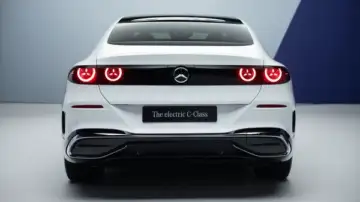 The rear end of the new electric C-Class appears rather handsome with its star-pattern taillights and a blacked-out connected panel.
 2026 Mercedes-Benz C-Class: Range and charging
The 94 kWh usable battery is rated at up to 762 km (WLTP), aided by a low drag coefficient starting from 0.22, a multi-source heat pump, and a recuperation system that recovers up to 300 kW during braking. Using an 800-volt architecture with DC fast-charging support up to 330 kW, the car can recover around 325 km of range in just 10 minutes. For older 400-volt infrastructure, an optional DC converter is available.
Mercedes also confirms bidirectional charging support, letting the car feed energy back to the grid or external devices. A rear-wheel-drive variant targeting approximately 800 km of range is expected next year.