




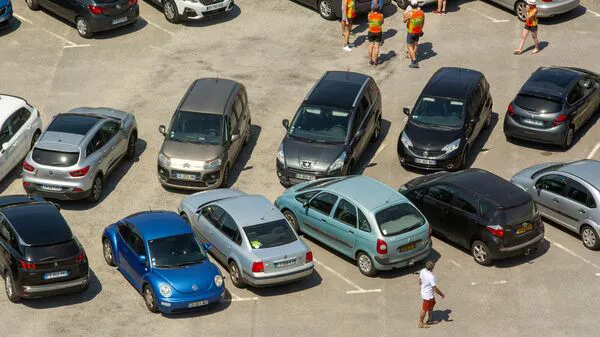

Parking your car comes with its own risk. There are numerous instances where owners have returned to their vehicle only to find it damaged due to the carelessness of other drivers, bicycles trying to navigate through tight spaces, or objects such as stray trolleys, and so on.
What typically ensues is a lengthy process of heated arguments on who did what, reviewing dash cam footage, filing insurance paperwork and keeping your fingers crossed for what feels like an eternity.
But what if your car could detect the oncoming threat and move out of the way itself? This is a question that US automaker Ford attempted to answer with a new patent that was published on May 5, three years after the original filing. The idea is quite simple: a parked vehicle could detect that another vehicle or object is about to hit it and then automatically move itself out of the way.
How does it work?
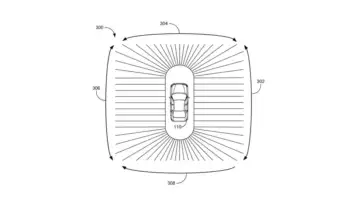 The system uses sensors fitted all around the car to build a live image of its surroundings and detect imminent threats
 To do so, the parked car needs to constantly monitor its surroundings via sensors that can detect if another vehicle is approaching on a collision path. The patent drawings describe multiple sensors fitted around a car, likely including camera, radar, LiDAR-based, and ultrasonic parking sensors. These aid in building a live image of the car's surroundings and assign threat levels to moving objects, based on their speed, location and trajectory.
Notably, Ford's system does not merely detect movement but aims to predict the path of the incoming object and calculate all possible responses instead of reacting at the very last second. If the system believes that a collision is imminent, it can prompt the vehicle to steer, roll forwards, and/or reverse to avoid the impact. This, however, depends on the surroundings, as a vehicle cannot simply drive off randomly. If moving forward would mean hitting a wall or a pedestrian, the car may stay put. If there is a free gap nearby, it may shift into it.
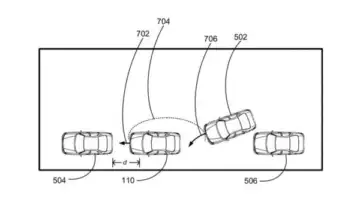 On detection, the system would assign threat levels to the incoming danger, and if it calculates that a collision is imminent, it would prompt the parked car to move out of the way
 Before making a move, the parked car would warn the approaching driver with flashing lights and the horn. If a collision is imminent, the system would prompt the car to move out of the way. However, if the impact could not be avoided, it would automatically record and log the incident to help in identifying the problem at a later time.