




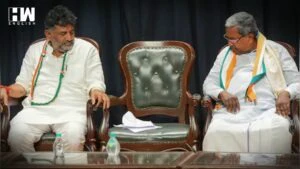

By deferring the leadership question in Karnataka, Congress risks signalling to its own regional leaders that hard work and delivery are applauded, but not rewarded or trusted with power
On January 6, Siddaramaiah entered Karnataka's political record books, equalling D. Devaraj Urs as the state's longest-serving Chief Minister with a cumulative tenure of seven years and 239 days. No small achievement, considering longevity in Karnataka politics is often elusive. Stability in power is not the state's best-known quality.
Siddaramaiah's continuity in power places him among the state's consequential leaders and underlines his remarkable ability to survive, adapt, and outlast rivals in a political ecosystem defined by churn. Siddaramaiah marked the milestone with apparent modesty. Records, he said to reporters, are meant to be broken. His own rise from local politics to the Chief Minister's chair was something he never anticipated. Thirteen elections contested. Nine won. Good going.
But while Siddaramaiah was looking back, the Congress party was nervously looking sideways - towards its Deputy Chief Minister, D.K. Shivakumar, and the question it refuses to answer: can Siddaramaiah take the credit for it all by himself?
Publicly, Shivakumar congratulated the Chief Minister and dismissed leadership chatter with discipline. Privately, the chatter has only grown louder, particularly in the party's state unit. The government has already crossed the halfway mark of its term. And yet, the leadership question refuses to go away. The Congress high command in Delhi insists everything is stable and settled. The state is under control. The leadership is clear. Nothing to see here.
Sending conflicting signals
And yet, the party's own behaviour suggests precisely the opposite. How? Let me explain.
In recent weeks, the Congress has adopted - or should I say developed - a rather curious coping mechanism. When in doubt, praise D.K. Shivakumar. Lavishly and relentlessly. Official party social media handles have transformed into tribute pages, portraying Shivakumar as the man who single-handedly revived the organisation in the state, raised funds when the coffers were nearly empty, held the party together when it was fraying at the edges, and delivered electoral victory (in 2023) when the party swung between hope and despair. He is cast as organiser-in-chief, crisis manager, political firefighter. He is praised like the general who wins wars but never gets the crown.
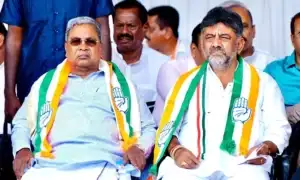 Karnataka Chief Minister Siddaramaiah (left) with Deputy CM DK Shivakumar (right)
What do we make of the party's lavish praise of DKS? Even a political novice would say that without D.K. Shivakumar's organisational muscle and ground-level management, the Congress's return to power in Karnataka would have been far from assured. The irony is that the more the party acknowledges this, the more glaring the contradiction becomes. Recognition, in the Congress ecosystem, appears to have a glass ceiling. Praise flows freely. Rewards are hard to come by.
This raises a question the party can no longer dodge with empty praises. If D.K. Shivakumar is truly the Congress's political general in Karnataka, why does validation stop at applause? Why is his contribution celebrated through tweets, short videos, and glowing adjectives but not institutionalised through power-sharing or leadership clarity? Most pointedly, what happened to the reported understanding of 2023 that Shivakumar would take over as Chief Minister after two and a half years?
Leaders and key supporters of Shivakumar say they were there when the promise was made, barely after the victory celebrations following the 2023 election. In fact, during the celebrations at his house, his supporters thought it was a given that the Chief Minister's post would go to him. They were shocked when he did not get it.
The Congress has tried to manage this contradiction the way it always does: through strategic ambiguity. Siddaramaiah is projected as the face of governance; Shivakumar as the engine of organisation. A neat division of labour, on paper. In practice, politics does not work like a corporation. By endlessly deferring the leadership question while glorifying Shivakumar's indispensability, the Congress risks eroding moral credibility and signalling to its own regional leaders that hard work and delivery are applauded, but not rewarded or trusted with power.
A personality clash? Not really
Neutrals in the party suggest it's a case of personality clash. But could it not be a case of broken promises? It is indeed a test of institutional integrity. Can a party that claims to value merit afford to repeatedly reward its most effective leaders with admiration instead of responsibility? What message does this send to the wider cadre, especially younger leaders watching closely to see whether performance actually translates into authority? Political capital that is acknowledged but never redeemed does not breed loyalty; it breeds cynicism.
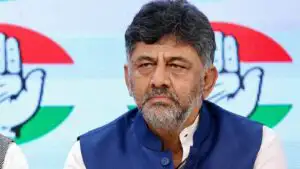 If D.K. Shivakumar is truly the Congress's political general in Karnataka, why does validation stop at applause?
I remember the Congress's handling of Rajasthan after the 2018 election victory. Then, Sachin Pilot had criss-crossed the state relentlessly for five years, taking the Congress to the last mile, energising the cadre, and reconnecting the party with voters after years in the wilderness. When I met him soon after the results were declared, he was upbeat and quietly confident, leaving the clear impression that the Chief Ministership was all but settled in his favour.
What followed, however, was a familiar party high-command-induced confusion and crisis. Despite Pilot's heavy lifting, the party opted for seniority and numbers over momentum, installing Ashok Gehlot as Chief Minister on the grounds that he enjoyed the backing of a majority of newly elected MLAs. Pilot was asked to wait, accommodate. He was told to trust the process. It was a situation that would later explode into open rebellion and cause long-term damage to the party in the state.
The parallel with Karnataka cannot be missed. It leaps to the eye that the lesson from Rajasthan was not learnt.
Caution has logic, but…
Granted that Siddaramaiah's record-setting moment reinforces a sense of permanence at the top. It's also true that continuity may reassure voters, but you cannot ignore the fact that it amplifies anxieties within the party. For Shivakumar and his supporters, each new milestone feels less like stability and more like a door quietly, methodically closing. The longer the Congress postpones a clear decision, the more it risks turning a manageable leadership issue into a festering fault line.
To be fair, caution has its logic. Leadership changes can unsettle governments and provoke factional backlash. Siddaramaiah remains a formidable political force with a loyal base and proven governance credentials. But prudence cannot become paralysis. A promise made cannot simply be allowed to dissolve into silence. In politics, deferred decisions are still decisions; they merely push the cost into the future, don't they?
The Congress high command now faces a stark choice: translate faith in D.K. Shivakumar into formal leadership responsibility, honouring the spirit of the reported 2023 understanding; or recalibrate expectations honestly, explaining why continuity outweighs commitment. What it cannot afford is prolonged ambiguity.
In the end, this is about more than who occupies the Chief Minister's chair. It is about whether the Congress can convince its own ranks that performance is rewarded with power, not just applause. Some analysts have showcased Karnataka as a model of Congress revival. How the party resolves the D.K. Shivakumar paradox will determine whether that revival is durable or merely decorative.
The views expressed by the author are strictly personal.