
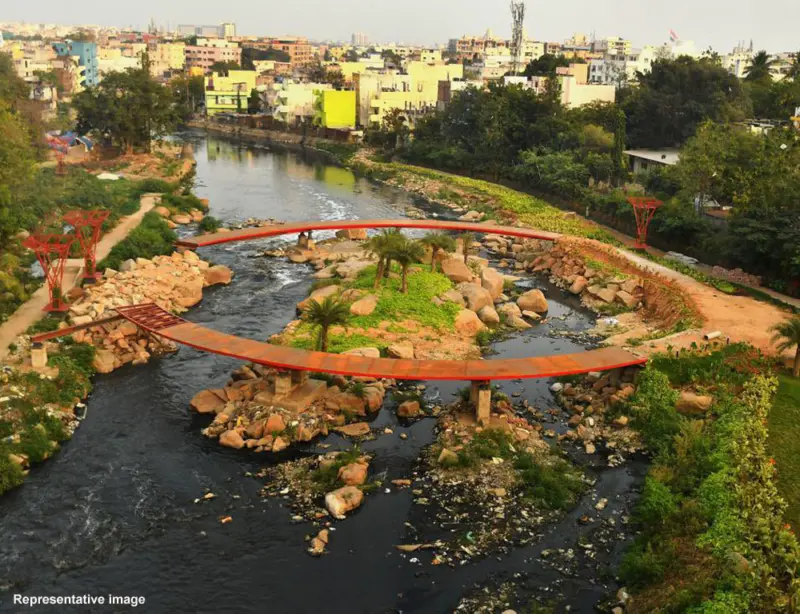

HYDERABAD: The Telangana unit of the Bharatiya Janata Party (BJP) on March 22, 2026, organised a discussion on the rejuvenation of the Musi river, raising concerns over displacement and what it termed gaps in the state government's approach.
The event, held at Hotel Katriya, focused on ecological, infrastructural and social aspects of restoring the river system. Speakers said any rejuvenation effort must consider the entire river basin, from its origin to its confluence.
BJP alleges focus on real estate over river restoration
N Ramchander Rao, former MLC and BJP Telangana president, said the party supports the idea of rejuvenation but opposed the current implementation model. He said people were being displaced "for no reason" and alleged that the government was prioritising real estate development along the river.
Hyderabad: 478 caught for harassment during Bonalu and Moharram, says SHE Teams
He added that the BJP would stand by those affected by displacement without valid justification.
Expert outlines scientific framework for river rejuvenation
Sriram Vedire, adviser on water policy and management to the Maharashtra Chief Minister, presented a framework distinguishing river rejuvenation from riverfront development.
He said rejuvenation involves restoring a river as a "living system" by ensuring ecological balance, water quality, biodiversity, and sustainable flows. Riverfront development, he said, is only supportive and cannot replace ecological restoration.
Vedire emphasised that "rejuvenation first, development next" should be the guiding principle.
Three stretches identified; gaps flagged in government plan
The presentation divided the Musi into three stretches - upper catchment near Ananthagiri Hills, the urban Hyderabad stretch, and the downstream segment up to the Krishna river confluence at Wadapally.
For the upper stretch, measures such as forest protection, desilting of Osman Sagar and Himayat Sagar, and groundwater recharge were recommended. In the urban stretch, removal of encroachments, floodplain zoning and preventing sewage inflow were highlighted.
For the downstream stretch, suggestions included wetland construction, tank desilting, livelihood support for farmers and fishers, and provision of safe drinking water.
However, the BJP said the government had not planned interventions in the upper and lower stretches and that there was "no clarity" in the urban segment.
Call for unified authority and real-time monitoring
The discussion also called for a single river basin authority covering multiple districts to ensure coordinated action. It proposed real-time water quality monitoring and legally enforceable basin plans.
Speakers stressed that upstream intervention is more effective and cost-efficient than downstream remediation, warning that neglect could lead to long-term ecological damage and higher recovery costs.