




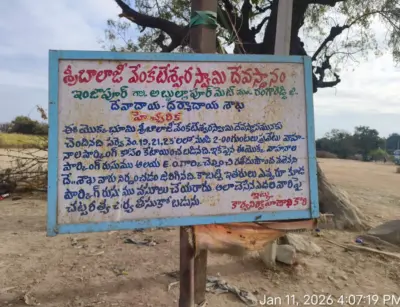

HYDERABAD: For more than five years, residents of Injapur village have struggled with severe cement dust and the loss of their temple's sacred land.
Private parties have encroached on land belonging to Sri Balaji Venkateshwara Swamy Devasthanam and the irrigation sluice canal connecting Masab Cheruvu (Turkayamjal Village) to Bathula Cheruvu (Hayathnagar), both within Injapur Village.
Explaining the issue, social activist Bokka Vamshidhar Reddy told HyderabadMail that encroachers built several cement godowns and residential buildings on temple land. They turned 21 guntas of temple property into godown sites and converted nearly 5 acres of Devasthanam land into a parking yard for cement lorries. All of this happened without permission or authorisation.
The Endowment Tahsildar (LPC) investigated and submitted a report to the Commissioner of Endowments in February 2025. The report confirmed that about 50 acres of Devasthanam land are still under agricultural use but found illegal godowns on temple property. It recommended stopping all further activities on these lands. The Mandal Revenue Officer, Abdullapurmet, also reported encroachments to the Revenue Divisional Officer, Ibrahimpatnam, and submitted a separate report to the Lokayukta in 2024. Despite these reports, the encroachments have continued.
According to Reddy, authorities intervened in 2020, during initial construction. Officials from the Municipality, Revenue, and Irrigation Departments tried to stop the illegal work. The encroachers argued with and obstructed the officials, leading to a criminal complaint and FIR at Vanasthalipuram Police Station under Sections 430 and 186 of the IPC. These charges were for encroaching on the irrigation canal and obstructing public servants. In September 2021, the Hayathnagar Court found the accused guilty, fined them Rs 3,500 each, and ordered three months' simple imprisonment if the fine was not paid.
Despite the criminal conviction, the encroachers kept operating. Hundreds of cement-laden lorries continued to park on Devasthanam land. The Endowments Department filed eviction petitions in the Endowments Tribunal, but those cases are still pending. In September 2025, Endowments officials filed another complaint at Vanasthalipuram Police Station, which led to a new FIR. Still, illegal parking and godown activities continue.
Most importantly, villagers raised their concerns with the District Collector, not just about encroachments but also about official conduct. They discovered that Endowments Department officials had collected user and occupation charges for parking cement lorries on temple land. This allowed illegal use of the land for godown activities. Even after criminal cases were filed, a board was put up claiming the land was allotted for lorry parking, while eviction petitions were still pending. Villagers called this irregular and legally untenable.
Additionally, villagers pointed out another contradiction. The same Devasthanam land had been leased to a local farmer for agriculture, but was also being used to park cement lorries for illegal godowns. Complainants say this shows major administrative failure and conflicting official actions. Encroachers have also sub-leased parts of Devasthanam commercial land to private individuals, including a puncture shop, without authorisation. No criminal case has been registered for this either.
Turning to the public health impact, the consequences have been severe. Villagers, devotees, school children, and emergency workers all suffer. Air pollution from cement activities has spread across Injapur and nearby colonies, even reaching the temple. Residents report daily respiratory issues, asthma, eye irritation, skin allergies, and trouble breathing. Cement dust, heavy vehicle movement, and soil contamination have damaged crops on temple land and harmed temple property. The main road to the village and temple is badly damaged by constant truck traffic, creating hardship and safety risks for residents and emergency services.
In terms of water management, encroachment of the irrigation sluice canal, which connects Masab Cheruvu to Bathula Cheruvu, is another public safety concern. The canal is vital for irrigation, drainage, and flood management for 50 acres of Endowment land leased to farmers. Villagers allege that some Irrigation Department officials claim no agricultural activity depends on the canal. Villagers say this contradicts historical records and is an excuse for inaction.
Expanding the scope of the problem, the issue goes beyond just cement godowns. Agricultural land in Injapur Village now hosts several illegal industrial and manufacturing units. None of these businesses have licenses or permits from the GHMC, Revenue Department, Industries and Commerce Department, Telangana State Pollution Control Board (TSPCB), HMDA, or other authorities. The cement godowns operate without Consent for Establishment (CFE) or Consent for Operation (CFO) from TSPCB and lack required air-pollution controls. This violates the Air (Prevention and Control of Pollution) Act, 1981. Running industries on agricultural land without NALA conversion or HMDA zoning approval adds to the legal violations.
All these illegal godowns and industrial units are located along the Injapur-Hayathnagar main road, which links to the Vijayawada National Highway and the Nagarjuna Sagar Road Highway. Heavy truck traffic in this busy corridor, residents say, raises the risk of accidents, congestion, and safety threats for commuters, residents, and temple visitors.
Social activist Bokka Vamshidhar Reddy called for an immediate joint inspection by GHMC, TGSPCB, Endowments, Irrigation, Revenue, HMDA, Industries & Commerce, and Police. He asked for closure, sealing, and demolition of all illegal godowns, removal of cement lorries from temple and canal land, restoration of the sluice canal, road repair and crop loss assessment with costs recovered from violators, a vigilance inquiry into officials who enabled the encroachments, and enforcement under the Air and Water Pollution Acts.
Reddy said, "Continued failure to protect these lands and enforce the law is causing serious and growing problems for the public. These include threats to safety, health, and the environment. Illegal godowns and industries are a grave danger to the public."