
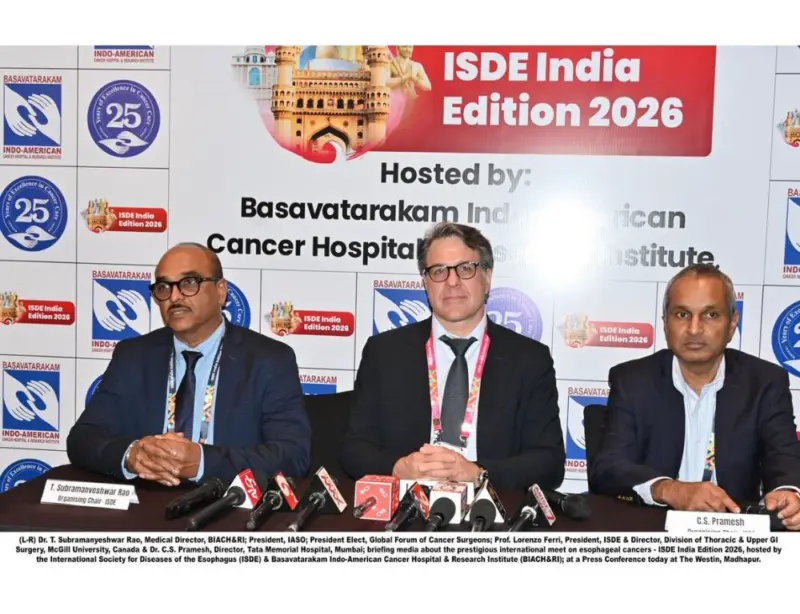

HYDERABAD: The two-day ISDE India Edition 2026 conference concluded in Hyderabad, highlighting growing evidence that consumption of very hot beverages and smoked meat increases the risk of esophageal cancer.
Hosted for the first time in India by the International Society for Diseases of the Esophagus (ISDE) in association with Basavatarakam Indo-American Cancer Hospital & Research Institute (BIACH&RI), the event brought together over 150 oncologists from India and abroad.
Experts from Canada, Singapore, Japan, Australia and the United States participated alongside Indian clinicians, marking the silver jubilee of BIACH&RI.
Esophageal cancer, arising from the lining of the esophagus, remains one of the most aggressive and underdiagnosed cancers globally. In India, risk factors include tobacco use, alcohol consumption, gastroesophageal reflux disease (GERD), obesity, infections, and poor diet. Doctors said additional risks such as consuming very hot beverages and malnutrition further increase vulnerability.
The disease ranks among the top ten cancers worldwide, with rising incidence in Andhra Pradesh and Telangana. Higher prevalence has been reported in the North-East and Kashmir. Late diagnosis continues to affect outcomes, with symptoms often impacting swallowing and nutrition.
India emerging as key contributor to global cancer research
Prof. Lorenzo Ferri, President of ISDE and Director of the Upper GI Cancer Program at McGill University, said, "Esophageal cancer is a highly aggressive disease where precision is critical there is little room for error, yet immense scope for improvement."
He added that India has demonstrated strong clinical expertise, and global collaboration can help standardise and improve treatment outcomes.
Dr. T. Subramanyeswara Rao, Medical Director and Chief Surgical Oncologist at BIACH&RI, said advances in technology and specialised care have improved survival rates. "Historically, nearly nine out of ten patients succumbed to the disease. Today, outcomes have improved, but there is scope for further refinement," he said.
He added that a 500-bed Basavatarakam Cancer Hospital will be established in Amaravati, Andhra Pradesh, and is scheduled for inauguration on June 22, 2028, to address growing demand for cancer care.
Access, affordability and research gaps highlighted
Dr. C.S. Pramesh, Director of Tata Memorial Hospital, said that only 13% of the hospital's 75,000 patients are from Mumbai, while 87% travel from across India. Nearly 40% discontinue treatment midway due to high living costs.
He said a nationwide network of over 400 cancer centres now treats more than 8.6 lakh new patients annually, supported by the Ayushman Bharat scheme.
"Research must be contextual to the region it serves," Dr. Pramesh said. "Findings from high-income countries are not always directly applicable here."
He announced the launch of an Esophageal Cancer Study Group under the national grid to strengthen India-specific research.
According to him, the national incidence of esophageal cancer stands at about 6.5 per 1,00,000 population. The rate is higher among men at 8-9 per 1,00,000 compared to 3-4 per 1,00,000 among women. In Kashmir and the North-East, incidence is six to seven times higher than the national average.
Experts said factors such as tobacco and alcohol use, consumption of very hot tea, and long-term intake of smoked and preserved meat contribute to higher rates in these regions.
The conference also showcased advancements such as minimally invasive and robotic surgery, endoscopic submucosal dissection (ESD), and multimodal therapies aimed at improving survival and quality of life.