





New Delhi, May 30:
Prime Minister's Message: The Bicentenary of Hindi Journalism is a Celebration of India's Consciousness, Thought, and Public Awakening
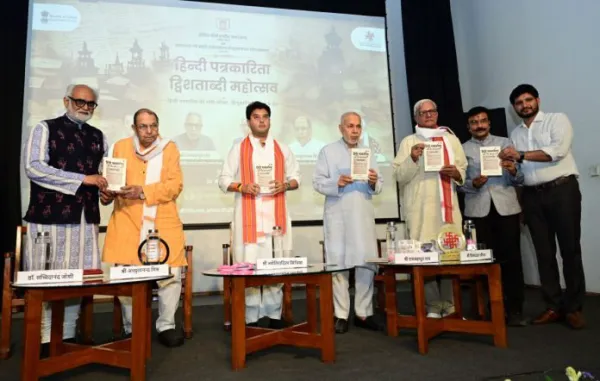
Union Minister Jyotiraditya Scindia Releases Commemorative Postage Stamp on 200 Years of Hindi Journalism
Three Books, Including Hindi Journalism: The Great Saga of 200 Years, Released; Historic Exhibition Becomes the Centre of Attraction
Marking a landmark moment in India's media history, the Government of India released a commemorative postage stamp and First Day Cover in honour of Udant Martand, the first Hindi newspaper, and its editor, Yugul Kishore Shukla, as Hindi journalism completed 200 years of service to the nation.
The commemorative event was jointly organized by the Indira Gandhi National Centre for the Arts (IGNCA), an autonomous institution under the Ministry of Culture, and the Madhavrao Sapre Memorial Newspaper Museum and Research Institute, Bhopal. The occasion also witnessed the release of several publications documenting the remarkable journey of Hindi journalism over the last two centuries.
In a message read out by IGNCA Chairman Rambhadur Rai, Prime Minister Narendra Modi described the bicentenary of Hindi journalism as "a celebration of India's consciousness, thought, and public awakening." He noted that the journey, which began with the publication of Udant Martand in 1826, represents an important chapter in the intellectual and democratic evolution of the nation.
Addressing the gathering as Chief Guest, Union Minister Jyotiraditya Scindia said that the history of journalism is inseparable from the history of India itself. Calling the event a celebration of the nation's intellectual consciousness, he emphasized that journalism is far more than a profession-it is a movement of national awakening. While technology, platforms, and methods of communication may evolve, he stressed that the fundamental responsibility of journalism must remain unchanged.
A major highlight of the programme was the release of the book Hindi Journalism: The Great Saga of 200 Years, edited by Padma Shri Vijaydutt Shridhar and Dr. Sachchidanand Joshi. The volume brings together contributions from 30 distinguished authors and chronicles the origin, growth, achievements, and contemporary challenges of Hindi journalism. Another notable publication launched during the event was Non-Hindi Contributors to Hindi Journalism by Dr. Shrikant Singh, which highlights the significant role played by journalists from non-Hindi-speaking regions in shaping Hindi media.
The celebrations also featured a special exhibition showcasing the 200-year journey of Hindi journalism. Rare photographs, archival documents, and historical records of prominent newspapers, magazines, and pioneering editors were displayed, offering visitors a unique opportunity to trace the evolution of Hindi journalism from Udant Martand to the modern digital era. The exhibition attracted considerable interest from students, researchers, media professionals, and history enthusiasts.
In his presidential address, Rambhadur Rai underlined the close relationship between democracy and journalism, stating that journalism can thrive only in a democratic environment. He also raised concerns about the growing volume of unverified content circulating on social media, reminding the audience that not everything shared online qualifies as news. According to him, credibility, verification, and accountability remain the defining characteristics of professional journalism.
Vijaydutt Shridhar described the 200-year history of Hindi journalism as a journey marked by resilience and resistance, while Dr. Sachchidanand Joshi observed that journalism today faces numerous challenges, with language journalism confronting even greater difficulties. He noted that the history of Hindi journalism is deeply intertwined with the preservation of India's cultural identity and civilizational consciousness.
Former Vice-Chancellor of Makhanlal Chaturvedi National University of Journalism and Communication, Achyutanand Mishra, paid tribute to legendary journalist-patriots such as Makhanlal Chaturvedi and Ganesh Shankar Vidyarthi. He recalled an era when journalists placed the nation above personal interests and dedicated their lives to public service and national causes.
The programme also featured the screening of a short documentary produced by the IGNCA Media Centre on the 200-year journey of Hindi journalism. Additionally, Dr. Pragya Paliwal, Vice-Chancellor of the Indian Institute of Mass Communication (IIMC), and Prof. Pramod Kumar presented a special edition of Sanchar Madhyam magazine titled Hindi Journalism: 200 Years.
Guests were honoured with commemorative mementoes by IGNCA, while the Sapre Museum presented a specially designed commemorative pen as a token of remembrance. The event concluded with a vote of thanks by Anurag Punetha, Head of the IGNCA Media Centre, while renowned news anchor Preeti Singh conducted the proceedings.
The bicentenary celebration served not only as a tribute to the rich legacy of Hindi journalism but also as a reflection on its future role in a rapidly evolving media landscape. As journalism navigates the challenges of the digital age, the event reinforced the enduring importance of truth, public service, democratic values, and cultural consciousness-the principles that have guided Hindi journalism for two centuries.