
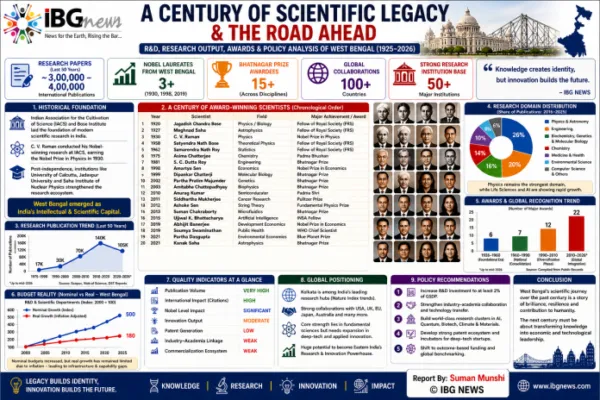

West Bengal-particularly Kolkata-has long been one of the foundational pillars of modern scientific research in India.
Over the past century, the region has not only nurtured intellectual traditions but has also contributed significantly to global science through research publications, Nobel laureates, and institutional excellence.
However, the central question today is no longer about past glory-
👉 Can this legacy be transformed into future technological and economic leadership?
This analytical report attempts to answer that question through a deep evaluation of history, data, and future strategy.
The roots of scientific research in West Bengal can be traced to institutions such as the Indian Association for the Cultivation of Science and the Bose Institute, which laid the foundation of modern scientific inquiry in India.
It was at IACS that C. V. Raman conducted his groundbreaking work, earning the Nobel Prize in Physics in 1930.
Post-independence, institutions like University of Calcutta, Jadavpur University, and Saha Institute of Nuclear Physics strengthened the research ecosystem.
👉 During this period, West Bengal emerged as:
India's intellectual and scientific capital
Over the past five decades, West Bengal has produced an estimated:
| Period | Estimated Publications | Key Characteristics |
|---|---|---|
| 1975-1990 | 15K-20K | Slow growth |
| 1990-2000 | 25K-35K | Beginning of globalization |
| 2000-2010 | 60K-80K | Rise of IT & biotech |
| 2010-2020 | 120K-160K | Publication boom |
| 2020-2026 | 90K-120K | COVID + AI surge |
👉 Key Insight:
West Bengal is among India's top research-producing regions in terms of volume.
| Year | Scientist | Field | Major Achievement |
|---|---|---|---|
| 1920 | Jagadish Chandra Bose | Physics/Biology | Fellow of Royal Society |
| 1927 | Meghnad Saha | Astrophysics | Fellow of Royal Society |
| 1930 | C. V. Raman | Physics | Nobel Prize |
| 1958 | Satyendra Nath Bose | Theoretical Physics | FRS |
| 1962 | Samarendra Nath Roy | Statistics | FRS |
| 1975 | Asima Chatterjee | Chemistry | Padma Bhushan |
| 1981 | S. C. Dutta Roy | Engineering | Bhatnagar Prize |
| 1998 | Amartya Sen | Economics | Nobel Prize |
| 1999 | Dipankar Chatterji | Biology | Bhatnagar Prize |
| 2002 | Partha Pratim Majumder | Genetics | Bhatnagar Prize |
| 2003 | Amitabha Chattopadhyay | Biophysics | Bhatnagar Prize |
| 2010 | Anurag Kumar | Semiconductor | Padma Shri |
| 2011 | Siddhartha Mukherjee | Cancer Research | Pulitzer Prize |
| 2012 | Ashoke Sen | String Theory | Fundamental Physics Prize |
| 2013 | Suman Chakraborty | Microfluidics | Bhatnagar Prize |
| 2015 | Ujjwal K. Bhattacharya | Artificial Intelligence | INSA Fellow |
| 2019 | Abhijit Banerjee | Development Economics | Nobel Prize |
| 2019 | Soumya Swaminathan | Public Health | WHO Chief Scientist |
| 2021 | Partha Dasgupta | Environmental Economics | Blue Planet Prize |
| 2021 | Kanak Saha | Astrophysics | Bhatnagar Prize |
| Indicator | Status |
|---|---|
| Publication volume | Very high |
| Global awards | Significant |
| Innovation output | Moderate |
| Patent ecosystem | Weak |
👉 Core Gap:
Strong knowledge production, weak translation into innovation
Despite nominal increases in funding over decades, inflation-adjusted investment remains limited, leading to:
West Bengal has the potential to lead in:
👉 Potential trajectory:
Eastern India's Research and Innovation Hub
West Bengal's scientific journey over the past century is one of remarkable intellectual achievement.
👉 Knowledge has been created
👉 Global recognition has been earned
But the next challenge is clear:
👉 Transforming knowledge into economic and technological power
"Legacy builds identity-but innovation builds the future."
✍️ Suman Munshi
© IBG NEWS