
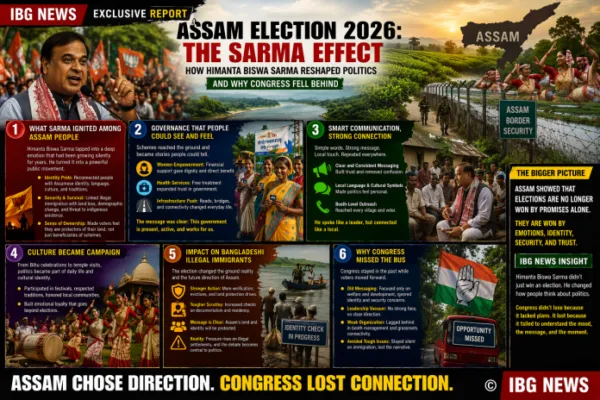

The recent electoral developments in Assam represent more than a routine democratic exercise.
What emerged from this election is a clear transformation in how politics is perceived, communicated, and experienced by voters. Instead of focusing solely on governance or economic delivery, the political narrative evolved into something deeper-an intersection of identity, security, and belonging.
This report is an original IBG NEWS analysis based on observed political trends, public discourse, and electoral behavior patterns. It does not replicate any single source but synthesizes multiple strands of ground-level understanding into a coherent interpretation.
A defining feature of this election was the transition from development-focused politics to what can be described as identity-centric engagement. Instead of presenting governance as a set of policy outcomes, the leadership framed political participation as a means of protecting cultural and territorial integrity.
Concerns around land use, demographic change, and migration were not discussed in isolation. They were woven into a broader narrative about the preservation of Assamese identity. This created a strong emotional connect with voters, many of whom began to interpret political choices as decisions about their future security and cultural continuity.
Another important dimension of the electoral strategy was the emphasis on making governance tangible and experiential. Welfare initiatives, infrastructure projects, and administrative actions were communicated in a way that made them directly relatable to everyday life.
Rather than relying on abstract statistics, the approach highlighted individual stories and visible outcomes. This helped create a perception that governance was not distant or bureaucratic, but something that could be seen, felt, and experienced.
Such perception-building played a crucial role in strengthening trust, especially in rural and semi-urban areas where direct interaction with state mechanisms often shapes political opinion.
The communication strategy adopted during the election was notable for its clarity and discipline. Messages were simplified without being diluted, allowing them to resonate across diverse demographic groups.
Equally significant was the alignment of political messaging with cultural context. By incorporating local language, traditions, and symbols, the narrative felt rooted in the lived realities of the people. This approach reduced the distance between leadership and electorate, fostering a sense of familiarity and shared purpose.
The integration of political engagement with cultural life further strengthened this connection. Participation in local festivals, community events, and traditional gatherings was not merely symbolic. It signaled that political leadership was embedded within the cultural fabric of society.
This approach transformed political support into something more enduring than transactional loyalty. It became a form of cultural alignment, where voters perceived leadership as representative of their identity rather than just their governance preferences.
One of the most impactful elements of the election was the transformation of the immigration debate. The presence of undocumented migrants, particularly from Bangladesh, has long been a subject of discussion in Assam. However, the framing of this issue underwent a significant shift.
Earlier discussions often focused on economic aspects such as labor and resource distribution. In the current context, the conversation moved toward identity, land, and long-term demographic balance. This reframing elevated the issue from a policy concern to a matter of collective identity.
Following this shift, there has been increased emphasis on administrative measures such as verification processes, land regulation, and border monitoring. These actions are presented as necessary steps to address longstanding concerns.
At the same time, public perception has evolved. A significant section of voters now views immigration through a lens of security and cultural preservation, which influences both political expectations and policy acceptance.
The heightened focus on immigration also brings complex social dynamics. Increased scrutiny and enforcement can lead to:
These developments highlight the need for careful balancing between policy objectives and social cohesion.
The Congress campaign largely continued to emphasize development, welfare, and inclusive politics. While these remain important, they did not fully align with the evolving priorities of the electorate.
As a result, the party's messaging appeared disconnected from the dominant concerns shaping voter sentiment.
In contrast to a clearly defined leadership structure on the opposing side, Congress lacked a singular, commanding presence in Assam. This made it difficult to project a unified vision or generate momentum.
Leadership plays a crucial role in translating ideas into mass appeal, and its absence can significantly weaken electoral impact.
Effective electoral campaigns increasingly depend on detailed ground-level organization and sustained engagement. In this regard, Congress faced challenges in matching the scale and efficiency of its competitor's network.
This gap affected its ability to communicate consistently and mobilize support effectively.
Perhaps the most critical limitation was the hesitation to address sensitive topics such as immigration directly. By not articulating a clear position, the party allowed the narrative to be shaped by others.
In contemporary politics, avoiding key issues often leads to loss of relevance rather than neutrality.
The Assam election illustrates a broader shift in political strategy, where success increasingly depends on the ability to combine:
This model is likely to influence political approaches in other regions, making it an important case study for future elections.
The outcome in Assam reflects a deeper transformation in how voters engage with politics. Decisions are no longer based solely on policy evaluation but are increasingly shaped by perceptions of identity, security, and belonging.
For political parties, this underscores the importance of adapting to changing voter expectations. For society, it raises important questions about how to balance identity-driven politics with inclusivity and cohesion.
What is clear, however, is that Assam has set a precedent.
👉 Elections are no longer just about governance-they are about how people see themselves and their future.
© IBG NEWS - Original Research & Analysis (Copyright-Free Editorial Content)