





Carbon Footprint Labelling Can Drive Environmental Awareness: Dr. Sachchidanand Joshi
2nd June, New Delhi:
In the lead-up to World Environment Day, the Indira Gandhi National Centre for the Arts (IGNCA), in collaboration with The Himalayan Environmental Studies and Conservation Organization (HESCO), organised a Round Table Conference on 'Carbon Footprint', bringing together environmentalists, legal experts, sociologists, community leaders, academicians, and policy stakeholders to deliberate on innovative approaches to climate responsibility. Against the backdrop of increasing climate volatility and rapidly evolving consumption patterns, the conference examined the proposal of introducing mandatory Carbon Footprint declarations on commercial products, enabling consumers to make informed choices while encouraging greater environmental accountability across industries. Among those present on the occasion were Dr. Sachchidanand Joshi, Member Secretary, IGNCA; Padma Bhushan Dr. Anil P. Joshi, noted environmentalist and green activist; Prof. Shekhar Mande, President, Indian National Science Academy, INSA; Justice Sangita Dhingra; Prof. Sunil Rai, Vice-Chancellor, UPES; Prof. (Dr.) Priyanka Kaushal, CRDT, IIT Delhi; Dr. Vatsala working on Carbon Footprint; Prof. Ved Prakash of Kirori Mal College, University of Delhi; Dr. Anil Sagar; Pankaj Malviya, Environment Activist; Pawan Singh, Environment Activist, and Shri Abhay Mishra, Convenor of Nadi Utsav.
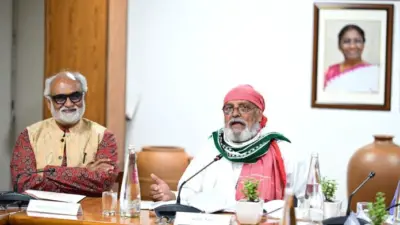
 Participants at the Round Table Conference
On this occasion, Dr. Sachchidanand Joshi emphasised that, as a society and as a nation, we need to think seriously about environmental concerns. He noted that bringing together individuals engaged in rigorous research and meaningful work in this field would benefit all stakeholders and help bridge existing knowledge gaps. Dr. Joshi further observed that if food packages can display information such as calories and other nutritional details, commercial products should likewise carry information on their carbon footprint. Such a measure, he said, would create greater public awareness and encourage consumers to make environmentally conscious choices by being more sensitive to the carbon emissions associated with the products they use. Dr. Joshi remarked that "Cleanliness is divinity, and rivers are life." He stated that the present deliberation marks the beginning of an important dialogue and expressed hope that the suggestions, conclusions, and recommendations emerging from the session would be compiled and sent to the Hon'ble Prime Minister in the form of a letter, enabling the outcomes of the discussion to contribute meaningfully to policy discourse and public awareness.
During the discourse, Dr. Anil P. Joshi highlighted how consumer habits and patterns of consumerism can significantly affect carbon footprints. He remarked that products should display the consequential environmental effects of lifestyles and consumption choices, enabling consumers to make more informed decisions. Referring to available data, he noted that nearly 40 billion tonnes of carbon are emitted globally each year, while fluorinated carbon emissions account for approximately 1.5to 2 billion tonnes. He further observed that the possibility of reversing the changes remains limited, estimating it at around 10 to 12 percent.
Dr. Anil Joshi stated that nature treats everyone equally and presented comparative data on the carbon emissions associated with homemade and commercially produced products, highlighting the differences in their environmental impact. He emphasised that ecological and organic food practices can help reduce carbon emissions and argued that changes in consumer habits can significantly lower carbon footprints. Citing traditional methods such as low-speed grinding, he noted that they not only contribute to better health but also result in a lower carbon footprint.
Dr. Shekhar Mande highlighted the growing concerns surrounding carbon and methane emissions and their adverse impact on the environment. He emphasised the need to curb greenhouse gas emissions and referred to ongoing efforts in this direction, including the Carbon Trading Scheme. Drawing upon Indian knowledge traditions, he observed that India has a long-standing culture of viewing issues holistically, where knowledge, inquiry, reflection, and rational thought have traditionally guided decision-making. Emphasising the need for continuous knowledge generation and innovation, he stated that environmental discourse must incorporate ideas that are both sustainable and practical while fostering climate resilience.
Prof. Sunil Rai shared his observations from an academic perspective, noting that environmental challenges operate at two levels, society and industrial society, and called for a balance between the two. He remarked that if consumers become contributors to the solution, the problem can be addressed to a large extent, observing that nearly 70 per cent of the issue relates to consumer practices and 30 per cent to production.
He cautioned that if concerns relating to carbon footprints worsen, revival becomes far more difficult, making early intervention essential. Raising pertinent questions on consumption, he reflected on what, why, when, and how much should be consumed, while observing that the ability to waste is often associated with affluence. He noted that India traditionally followed sustainable practices, many of which have gradually declined. Prof. Rai also highlighted that many engineering systems are over-designed and stressed that sustainable process engineering and process improvements can significantly reduce environmental impact.
The other delegates also shared their valuable insights and perspectives on the subject. The Round Table Conference on Carbon Footprint witnessed the participation of scholars, experts, and stakeholders from diverse fields, leading to a constructive and meaningful discourse. The suggestions, observations, and recommendations that emerged from the deliberations will be compiled for further consideration, with the aim of contributing to informed discussions and effective policymaking on environmental concerns and climate responsibility.