

By Suman Munshi
For decades, the red-light district of Sonagachi , Kalighat in Kolkata has been widely known as one of the largest sex-work hubs in South Asia.
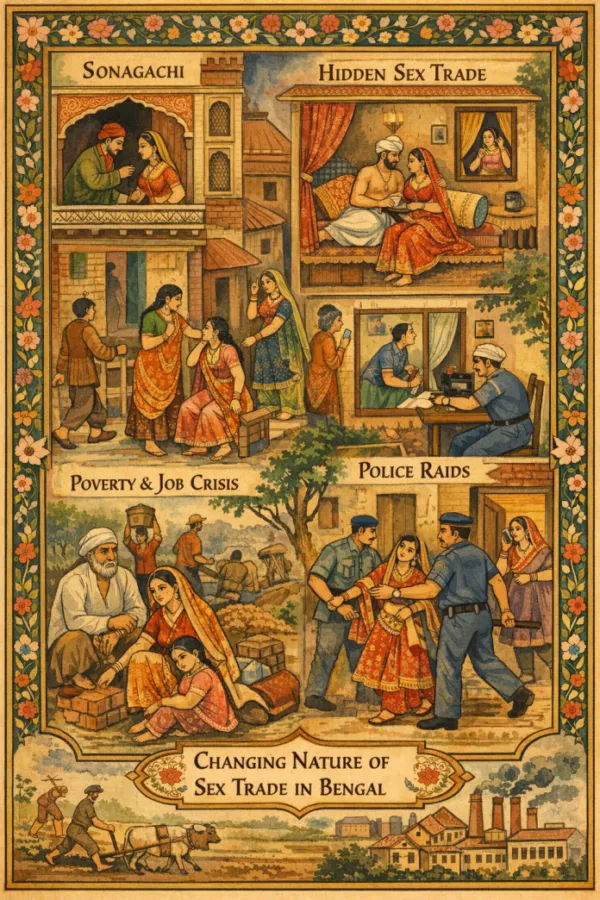
However, researchers and law-enforcement officials say the structure of the sex trade in West Bengal has been quietly changing over the past decade.
While traditional red-light neighborhoods still exist, authorities and social workers report a noticeable rise in small, discreet operations run from residential homes and rented apartments across urban and semi-urban areas.
This shift reflects broader social and economic changes affecting the region.
Historically, prostitution in Bengal was concentrated in identifiable localities such as Sonagachi and parts of central Kolkata. These areas developed during the colonial era when the city served as a major port and commercial center under British India.
In recent years, however, enforcement activity, urban redevelopment, and changing technology have contributed to the emergence of a more decentralized network.
Law-enforcement officials say some activities now take place inside ordinary residential buildings, making them difficult to detect.
Cities such as Siliguri, Asansol, and growing suburban zones around Kolkata have reported occasional cases where apartments were allegedly used for organized prostitution.
Communication between clients and intermediaries often occurs through mobile phones, messaging platforms, or social media, allowing transactions to be arranged discreetly.
Social researchers studying the issue say that economic hardship and unemployment have played an important role in the expansion of hidden sex-trade networks over the last decade.
In several districts of West Bengal, especially rural and semi-urban areas, limited employment opportunities and declining traditional industries have created economic pressure on many households.
Some analysts say that migration to cities without stable job prospects has pushed vulnerable individuals into informal or precarious forms of work.
According to activists working with marginalized communities, the absence of reliable income sources can make individuals more susceptible to entering or being drawn into exploitative economic arrangements.
Experts note that the issue is not unique to Bengal and reflects a broader pattern seen in many developing urban regions where rapid urbanization and job scarcity intersect.
India's legal approach to prostitution remains complex. Under the Immoral Traffic (Prevention) Act, activities such as running brothels, trafficking individuals, and public solicitation are punishable offences.
Police occasionally conduct raids in residential buildings suspected of illegal activities, particularly when trafficking or coercion is alleged.
However, legal experts point out that the law distinguishes between trafficking and certain forms of consensual adult sex work, creating an ongoing policy debate about regulation, worker safety, and human rights.
Community organizations in Kolkata, including the Durbar Mahila Samanwaya Committee, have long emphasized the importance of public health outreach.
Programs in red-light areas have focused on:
Activists warn that when sex work shifts into hidden residential locations, it becomes harder for public health initiatives and social support programs to reach vulnerable individuals.
Observers say the transformation of the sex trade in Bengal reflects broader societal trends-urban growth, digital communication, and economic pressures.
While traditional red-light districts such as Sonagachi remain well known, the rise of discreet home-based operations indicates that the trade is becoming less visible but more dispersed.
Experts suggest that addressing the issue will require a combination of economic development, job creation, social welfare programs, and targeted law enforcement to reduce exploitation and support vulnerable communities.
The history of the sex trade in Bengal is closely tied to the social, economic, and political transformations that shaped the region over several centuries. From royal courts and courtesan traditions to colonial urban expansion and modern urban economies, prostitution in Bengal evolved alongside the development of cities, migration patterns, and changing social norms.
Before the colonial period, forms of professional companionship and performance existed in royal courts across the Indian subcontinent. In Bengal and nearby regions, highly trained courtesans were often associated with music, dance, and poetry. These women sometimes performed in royal courts and wealthy households.
Unlike modern commercial sex work, many courtesans were part of elite cultural traditions and were respected as performers and artists.
The modern structure of red-light districts in Bengal largely emerged during the colonial period when Kolkata became the capital of British India in the late 18th and early 19th centuries.
Kolkata rapidly grew into one of Asia's largest trading ports. The influx of:
created demand for entertainment districts.
During this period, areas such as Sonagachi began to develop as organized prostitution zones. Many brothels operated near markets, ports, and military barracks.
British colonial authorities at times attempted to regulate prostitution through public health laws aimed at controlling sexually transmitted diseases among soldiers.
By the late 19th century, Kolkata had become one of the largest cities in the British Empire, and its entertainment districts expanded accordingly.
Different categories of sex workers existed during this period:
Economic hardship, migration from rural areas, and social displacement contributed to the growth of these occupations.
After India's independence in 1947, the structure of prostitution in Bengal changed again.
Urban migration increased dramatically, particularly following the Partition of India, which brought millions of refugees into Kolkata and surrounding districts.
The sudden population growth and limited employment opportunities created economic pressure in many urban neighbourhoods. Red-light districts such as Sonagachi continued to expand during this period.
In the late 20th century, public health campaigns and rights-based activism began to transform the conversation around sex work in Bengal.
Organizations such as the Durbar Mahila Samanwaya Committee emerged in the 1990s, advocating for:
These initiatives gained international attention for community-based approaches to public health.
In recent years, the nature of the sex trade in Bengal has shifted. While traditional red-light districts remain, economic pressures and technological changes have led to a more dispersed and less visible structure.
Mobile phones, social media, and private networks have allowed some activities to move away from well-known districts into apartments or residential areas.
The history of the sex trade in Bengal reflects broader patterns of urban development, economic inequality, migration, and social change. From courtly courtesans to colonial entertainment districts and modern rights movements, the evolution of the trade mirrors the complex social history of Bengal itself.
Understanding this historical background helps explain why places like Sonagachi remain significant not only as urban neighborhoods but also as sites of ongoing debates about public health, labour rights, and social policy.
The evolving pattern of prostitution in Bengal highlights the complex relationship between economic opportunity, urban transformation, and social policy. As cities continue to expand and employment challenges persist, the issue remains part of a larger conversation about inequality, public health, and the future of urban life in eastern India.