





By Suman Munshi
Kolkata,17 May 2026
Just finished your 10+2, got good marks, but not getting into enough to crack Engineering or Medical, then the definite question comes, what to choose and get a career secure option other than the IT rat race.
A science that helps to crack tough crimes and frauds, and saves countries from terror strikes often neglected but a sought-after career in India.
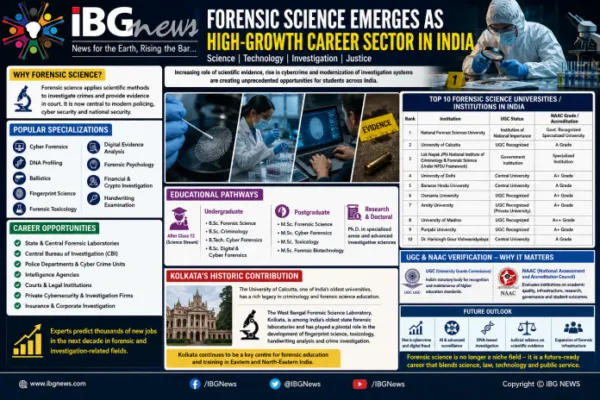
India's rapidly evolving criminal justice and cybersecurity ecosystem is transforming Forensic Science into one of the country's most promising career options for science students. From DNA analysis and cybercrime investigation to digital evidence recovery and forensic toxicology, the discipline is increasingly becoming central to modern policing, judicial processes, and national security operations.
Education experts and industry professionals say that the growing dependence on scientific evidence in courts, expansion of cybercrime units, and modernization of forensic laboratories are driving unprecedented demand for trained forensic experts across India.
Investigative agencies are increasingly relying on forensic methods to solve complex crimes involving:
Specialized areas gaining popularity among students include:
Experts note that students with strong analytical abilities, scientific temperament, and interest in technology and investigation are well-suited for this profession.
With the increasing popularity of forensic science courses, academic experts are advising students to carefully verify institutional credibility before admission.
The University Grants Commission remains India's primary statutory authority responsible for recognizing universities and maintaining standards of higher education. Universities operating under UGC recognition are considered academically valid for higher studies and government employment eligibility.
Similarly, the National Assessment and Accreditation Council evaluates institutions on parameters including academic quality, infrastructure, governance, research, innovation, and student outcomes through NAAC grading systems such as A, A+, and A++.
Institutions with stronger NAAC ratings are generally viewed as having superior academic ecosystems and research facilities.
The National Forensic Sciences University has emerged as India's premier dedicated forensic sciences institution. Established originally as Gujarat Forensic Sciences University and later upgraded into an Institution of National Importance under an Act of Parliament, the university is widely regarded as the country's leading specialized forensic education center.
The university offers advanced programs in:
NFSU has also expanded through multiple campuses across India and international collaborations.
Kolkata continues to maintain a historically important position in India's forensic science landscape. The University of Calcutta, one of India's oldest universities, has long contributed to criminology and forensic education through academic and research programs.
The city also houses the West Bengal Forensic Science Laboratory, regarded among India's oldest state forensic laboratories. Kolkata historically played a major role in the development of fingerprint science, handwriting examination, toxicology, and criminal investigation methodologies during both the colonial and post-independence eras.
Students from eastern and northeastern India continue to look toward Kolkata for forensic and criminology education opportunities.
Based on UGC recognition, academic reputation, forensic specialization, and NAAC accreditation status, major institutions offering forensic science education include:
| Institution | Status | NAAC Accreditation | Specialization |
|---|---|---|---|
| National Forensic Sciences University | Institution of National Importance | Government-recognized specialized university | Dedicated Forensic Sciences |
| University of Calcutta | UGC Recognized | NAAC A Grade | Criminology & Forensic Studies |
| University of Delhi | Central University | NAAC A+ | Applied Sciences & Criminology |
| University of Madras | UGC Recognized | NAAC A++ | Forensic-related Research |
| Banaras Hindu University | Central University | NAAC A Grade | Toxicology & Scientific Research |
| Osmania University | UGC Recognized | NAAC A+ | Forensic Programs |
| Punjabi University | UGC Recognized | NAAC A+ | Criminology & Forensic Science |
| Amity University | UGC Recognized Private University | NAAC A+ | Cyber & Digital Forensics |
| Dr. Harisingh Gour Vishwavidyalaya | Central University | NAAC A Grade | Applied & Forensic Sciences |
| Lok Nayak Jayaprakash Narayan National Institute of Criminology and Forensic Science | Government Institution under NFSU framework | Specialized Institution | Criminology & Investigation Sciences |
The future scope of forensic science in India is being strengthened by:
Career opportunities are expanding across:
Experts believe specialists in cyber forensics, digital investigation, and forensic biotechnology are expected to witness particularly strong demand in the coming decade.
Despite rapid growth, India still faces challenges, including:
However, ongoing modernization initiatives and government investment are gradually strengthening the country's forensic ecosystem.
Students aspiring to build a career in Forensic Science must understand that admission procedures vary depending on the university, course level, and specialization. While some institutions offer direct merit-based admission, others conduct national-level or university-specific entrance examinations.
Most universities require:
Candidates usually need:
Several leading institutions conduct entrance tests for admission.
National Forensic Sciences University conducts the:
The entrance examination generally includes:
Institutions such as:
may use:
Private institutions like:
Often conduct:
Cut-off marks vary every year depending on:
| Institution Type | Approximate Cut-Off |
|---|---|
| Top Central Universities | 80%-95% in qualifying exams or high CUET percentile |
| NFSU Competitive Programs | Moderate to High NFAT scores |
| State Universities | 60%-80% aggregate |
| Private Universities | 50%-75% aggregate |
For highly competitive programs in cyber forensics and digital investigation, the cut-offs are generally higher due to increasing demand.
Students generally need:
Experts advise students to strengthen:
Participation in science fairs, cybersecurity workshops, and Olympiads can also improve academic profiles.
With rising awareness about forensic careers and increasing employment opportunities in cybercrime and digital investigation, admission competition is steadily increasing in reputed institutions.
Academic counselors recommend that students:
Experts believe India's increasing emphasis on evidence-based policing, cyber security, artificial intelligence, and digital governance will continue to expand demand for skilled forensic professionals.
As a result, admissions into forensic science programs are expected to become more competitive in the coming years, especially in premier institutions offering advanced laboratory facilities and industry-linked training.
Industry observers say forensic science is no longer a niche profession but a rapidly evolving interdisciplinary field combining science, law, artificial intelligence, cyber security, and national security operations.
As India strengthens evidence-based policing and digital investigation capabilities, forensic science is expected to become one of the country's most strategically important career sectors for the next generation of students.