





By Suman Munshi, Chief Editor, IBG NEWS
Kolkata | 14 May 2026
For generations, West Bengal stood at the heart of India's intellectual identity.
The state produced Nobel laureates, scientists, economists, jurists, freedom fighters, poets, and educators who helped shape not only Bengal's social consciousness but also India's modern democratic and scientific framework. Institutions such as the University of Calcutta, Presidency University, Jadavpur University, and several missionary and public schools once symbolized academic excellence across South Asia.
Yet today, education experts, policymakers, parents, and students increasingly ask a difficult question:
Has West Bengal gradually lost the educational edge that once defined it?
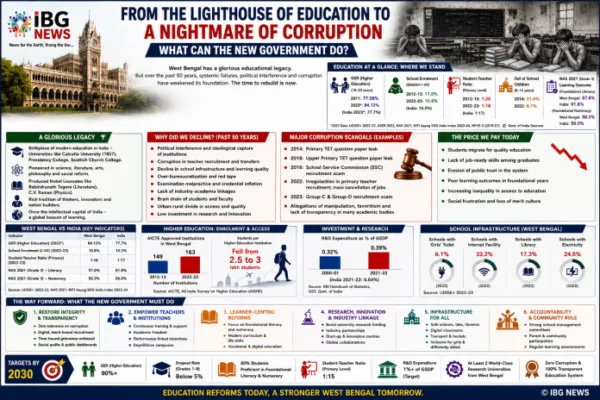
A detailed investigation by IBG NEWS based on publicly available government data, policy reports, parliamentary observations, educational surveys, and institutional trends suggests that while the state still retains major academic strengths, multiple structural weaknesses accumulated over decades have reduced its long-term competitiveness.
The issue is not a sudden collapse.
The concern is slow institutional erosion.
The roots of Bengal's educational dominance go back to the 19th century Bengal Renaissance.
The region became a center of:
The University of Calcutta, established in 1857, became one of Asia's earliest modern universities. Over time, Bengal produced globally respected intellectuals including Jagadish Chandra Bose, Meghnad Saha, Amartya Sen, Satyajit Ray, and numerous civil servants and researchers.
Even after Independence, the state remained one of India's strongest educational centers.
However, economists and education researchers argue that the educational system gradually became disconnected from the rapidly changing realities of technology-driven global competition.
West Bengal achieved major progress in literacy expansion over the decades.
According to Census trends, India's literacy rate rose from approximately 18.3% in 1951 to over 69% by 2011. West Bengal also witnessed substantial educational expansion through government schools, aided institutions, and rural educational outreach.
Yet experts warn that literacy growth alone cannot define educational success in the 21st century.
The real indicators now include:
This is where concerns become sharper.
Government data across India shows that enrollment levels improved significantly over the last two decades.
However, independent educational surveys indicate that foundational learning outcomes remain uneven.
The Annual Status of Education Report (ASER), one of India's most closely watched educational surveys, repeatedly highlighted concerns regarding reading and arithmetic abilities among school children.
The ASER 2021 report for West Bengal emphasized the need for measurable learning recovery after pandemic-related disruption.
Educational analysts note that many students nationally remain enrolled in school systems while struggling with basic comprehension and mathematical ability appropriate for their grade levels.
The challenge therefore shifted from "school access" to "learning effectiveness."
Perhaps no issue damaged public confidence in West Bengal's education system more severely in recent years than allegations surrounding school recruitment irregularities.
Court-monitored investigations, legal proceedings, canceled appointments, and administrative controversies generated a prolonged credibility crisis.
The consequences extended far beyond politics.
Thousands of students preparing for teaching careers began questioning whether merit alone was sufficient for recruitment.
Educational administrators privately admit that once recruitment systems lose public trust, institutional morale weakens rapidly.
Teachers form the backbone of educational credibility.
If recruitment becomes controversial, the long-term damage extends to:
West Bengal has historically maintained one of India's most politically active campus cultures.
Supporters argue that political engagement created democratic awareness and intellectual activism.
Critics, however, claim that excessive politicization gradually weakened academic discipline.
Over decades, several campuses across political eras witnessed:
International education studies consistently show that universities perform best when academic governance remains institutionally stable and professionally autonomous.
Educational researchers warn that prolonged political confrontation inside campuses often discourages research investment, private collaboration, and international partnerships.
Education systems do not operate independently from economic ecosystems.
Several economists interviewed by IBG NEWS pointed toward the long-term industrial slowdown in West Bengal as a major structural factor affecting educational competitiveness.
As technology corridors expanded in Bengaluru, Hyderabad, Pune, Gurugram, and Noida, students increasingly migrated outside West Bengal for employment and higher education opportunities.
This produced a cycle that experts describe as "institutional outflow pressure."
The cycle operates in four stages:
Today, many of West Bengal's brightest graduates continue contributing significantly to India's economy - but often from outside the state.
Across India, parents increasingly moved children toward private educational institutions when government school quality appeared uncertain.
Policy analyses referencing ASER data from 2024 observed that private school students often outperformed government school students in reading and arithmetic assessments.
The gap was particularly visible in mathematics.
Education researchers caution that this trend reflects more than market preference.
It reflects parental anxiety.
When families lose confidence in foundational learning outcomes, they often attempt to compensate through private schooling, coaching systems, or migration toward urban educational hubs.
While elite institutions in Kolkata and several urban districts continue producing high-performing students, educational inequality remains visible between urban and rural regions.
Teachers and administrators interviewed across districts frequently cite recurring challenges including:
The pandemic further exposed these disparities.
Students without smartphones, stable internet access, or digital learning environments suffered disproportionately.
Educational experts warn that the digital divide may become the defining educational inequality of the next decade.
Across India, repeated question paper leaks and examination controversies increasingly threaten trust in public certification systems.
West Bengal has not remained isolated from these concerns.
Education specialists argue that examination integrity forms the foundation of meritocratic mobility.
Once students begin believing that manipulation, cheating networks, or political influence determine outcomes, the moral authority of the system itself weakens.
Several educational policy experts now advocate:
India's globally competitive academic institutions increasingly rely on:
Although West Bengal retains prestigious institutions with strong intellectual legacies, researchers argue that modernization has been comparatively slower in relation to emerging innovation centers.
A growing number of researchers from the state now relocate for:
This weakens long-term institutional continuity.
Public education datasets and parliamentary observations indicate several recurring themes:
According to policy analysis using UDISE+ data:
Educational economists warn that secondary-level dropout and disengagement directly affect long-term workforce competitiveness.
Most experts interviewed by IBG NEWS believe recovery remains entirely possible.
The state still possesses major advantages:
However, educational revival would likely require structural reform rather than symbolic policy announcements.
Experts recommend:
Educational administrators argue that campuses require:
Global evidence shows that literacy and numeracy recovery during early schooling determines long-term educational success.
Education specialists emphasize:
Future competitiveness increasingly depends on:
Analysts warn that states failing to modernize curricula risk long-term economic decline.
Experts recommend creating:
Suggested reforms include:
West Bengal's education system remains one of India's most historically significant educational ecosystems.
But history alone cannot sustain future competitiveness.
The state now faces a defining transition period.
If institutional trust, recruitment transparency, research modernization, and foundational learning quality improve, West Bengal could once again emerge as one of India's strongest knowledge economies.
If reforms remain delayed, however, the gradual erosion of talent, confidence, and competitiveness may accelerate further.
The battle for educational recovery is no longer merely about schools.
It is about the future economic, technological, and intellectual position of the state itself.
Copyright © IBG NEWS