




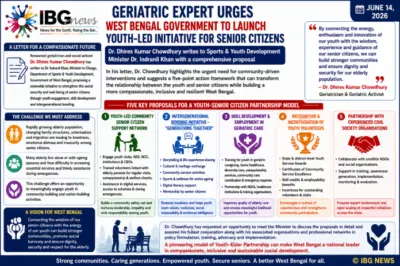

Kolkata, June 14, 2026: Renowned geriatrician and social activist Dr. Dhires Kumar Chowdhury has written to Dr. Indranil Khan , Hon'ble Minister-in-Charge of the Department of Sports & Youth Development, Government of West Bengal , proposing a comprehensive state-level initiative aimed at strengthening the social security and well-being of senior citizens through structured youth engagement, skill development and intergenerational bonding.
In his letter, Dr. Chowdhury congratulated the Minister on assuming office and expressed confidence that the Department could pioneer innovative models of community participation by connecting the energy of young people with the needs of the state's growing elderly population.
Highlighting changing family structures, urbanisation and migration, Dr. Chowdhury noted that an increasing number of senior citizens now live alone or only with ageing spouses, often facing loneliness, emotional distress and limited access to timely assistance during emergencies.
One of the key recommendations is the creation of a statewide Youth for Senior Citizens programme, involving local youth clubs, sports clubs, NSS and NCC units, educational institutions and community organisations.
Under the proposal, trained youth volunteers would periodically visit elderly residents in their localities, provide companionship, assist with digital services, help them access government welfare schemes and extend support during medical or emergency situations.
According to Dr. Chowdhury, such a model would simultaneously create a community-based safety net for senior citizens while fostering leadership, empathy and civic responsibility among young people.
The letter also proposes a dedicated "Generations Together" programme designed to strengthen interaction between youth and senior citizens through:
Dr. Chowdhury believes that such initiatives would reduce social isolation among the elderly while preserving Bengal's cultural heritage and strengthening intergenerational understanding.
Recognising the growing demand for elderly care services, the geriatric specialist has also suggested structured training programmes for young men and women in:
He stated that partnerships with credible NGOs, healthcare institutions and training organisations could create professional opportunities for thousands of youth while improving the quality of elderly care across the state.
To encourage sustained participation, Dr. Chowdhury recommended introducing:
He argued that such recognition would promote a culture of volunteerism and strengthen community participation among young citizens.
The letter further recommends collaboration between the Government and experienced civil society organisations working in elderly care to support training, awareness campaigns, programme implementation and monitoring.
Dr. Chowdhury concluded by expressing his willingness to meet the Minister to discuss the proposals in detail and offered the support of his professional and social organisations in policy formulation, training and implementation.
The proposals, if considered, seek to integrate youth development with elderly welfare, creating an innovative community-based model that addresses demographic challenges while promoting social harmony, employability and active citizenship in West Bengal.
Copy of the letter sent to the minister by mail:
To,
Dr. Indranil Khan
Hon'ble Minister-in-Charge
Department of Sports & Youth Development
Government of West Bengal
Subject: Proposal for Strengthening Social Security of Senior Citizens through Youth Engagement, Skill Development and Intergenerational Bonding in West Bengal
Hon'ble Sir,
Greetings of the Day.
At the very outset, please accept my heartfelt congratulations on your remarkable electoral victory and your induction into the esteemed responsibility of leading the Department of Sports & Youth Development, Government of West Bengal. I am confident that under your dynamic, visionary and compassionate leadership, the Department will continue to inspire and empower the youth of our state while creating innovative models of social development and community engagement.
I take this opportunity to draw your kind attention to an emerging social challenge that demands urgent intervention and presents a unique opportunity for constructive youth participation - the growing vulnerability, isolation and insecurity of senior citizens in our society.
West Bengal, like the rest of India, is witnessing a rapid demographic transition with a steadily increasing elderly population. Simultaneously, changing family structures, urbanisation, migration for education and employment, and evolving social dynamics have resulted in a growing number of senior citizens living alone or only with their ageing spouses. Many of them face loneliness, emotional distress, inadequate social support, difficulty in accessing essential services and, at times, emergency situations without immediate assistance.
While these challenges primarily affect senior citizens, they also present an opportunity to meaningfully engage young people in community-building and nation-building activities. In an era where social cohesion and human connection are increasingly under strain, fostering stronger bonds between generations can create a more compassionate, resilient and inclusive society.
As a Geriatrician and Geriatric Activist working closely with elderly persons for nearly two decades, I have witnessed firsthand both the challenges faced by senior citizens and the tremendous potential of young people to become catalysts of positive social change. I therefore humbly place before your kind consideration the following proposals.
The Department may consider launching a structured state-wide "Youth for Senior Citizens" programme by engaging local youth clubs, sports clubs, NSS units, NCC units, educational institutions and community-based organisations.
Under this initiative, trained youth volunteers may be linked with elderly persons residing alone or with ageing spouses within their respective localities. These volunteers may provide periodic visits, companionship, welfare checks, digital assistance, support in accessing Government schemes, and assistance during emergencies such as arranging ambulance services, hospital admissions and communication with family members.
Such a programme would create a community-based social safety net for senior citizens while simultaneously nurturing leadership qualities, civic responsibility, empathy and social commitment among young people.
The Department may consider introducing a dedicated intergenerational engagement programme to strengthen meaningful interaction between youth and senior citizens.
Activities may include:
Such initiatives would help reduce loneliness among senior citizens while enabling young people to learn values, resilience, social responsibility and emotional intelligence from older generations.
This initiative would also help preserve our rich cultural heritage and reinforce the traditional values of respect, compassion and social harmony that have long been the strength of Bengal.
One of the most pressing concerns in elderly care today is the severe shortage of trained geriatric caregivers.
Despite growing demand, caregiving services remain largely unregulated, with many agencies operating without standardised training, resulting in compromised quality of care and limited professional opportunities for aspiring caregivers.
The Department may consider partnering with credible NGOs, healthcare institutions and training organisations to establish structured training programmes for young men and women in:
This initiative would not only improve the quality of elderly care but also generate meaningful livelihood opportunities for thousands of young people across urban, semi-urban and rural areas of West Bengal.
To ensure sustainability and encourage active participation, the Government may consider introducing:
Such recognition would encourage a culture of volunteerism and community service among young people while strengthening their role as responsible citizens.
Several credible NGOs and social organisations working in the field of elderly care possess extensive grassroots experience, trained manpower and implementation capacity.
The Government may consider developing a collaborative framework through which such organisations can contribute towards training, awareness generation, programme implementation, monitoring and evaluation.
This would ensure efficient utilisation of existing expertise and facilitate rapid scaling of impactful initiatives across the state.
Hon'ble Sir, I sincerely believe that West Bengal has the opportunity to become a national leader in creating a pioneering model of Youth-Elder Partnership for Social Development.
By connecting the energy, enthusiasm and innovation of our youth with the wisdom, experience and guidance of our senior citizens, we can build stronger communities, promote social harmony, create new livelihood opportunities and ensure dignity and security for our elderly population.
Such a visionary initiative would not merely address the challenges of ageing but would also inspire a new generation of socially responsible youth committed to community service and nation-building.
I would be deeply honoured if I could be granted an opportunity to meet you at your convenience to discuss these proposals in greater detail and share practical field experiences that may assist in developing such initiatives.
I assure you of my fullest cooperation and support, along with that of my associated organisations and professional networks, in policy formulation, training, advocacy and implementation whenever required.
With highest regards and best wishes for your continued success.
Yours sincerely,
Dr. Dhires Kumar Chowdhury
Geriatrician & Geriatric Activist
Fellow, Geriatric Society of India
Founder Director, Banchbo Healing Touch Foundation
President, Banchbo Socio-Cultural Association
Treasurer, Geriatric Society of India, West Bengal Branch
Vice President, Protect The Warriors
National Committee Member, Home Care Association of India
Task Force Member, Healthcare Sector Skill Council, Skill India
Advisor, Ramakrishna Mission Vidyamandira, Bose House Campus
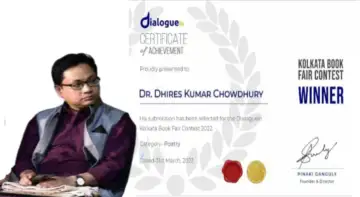 Award for Dr. Dires Chowdhury in Poetry Writing