





By IBG NEWS Desk
As debates resurface around the political legacy of Jogendra Nath Mandal , a recurring question often arises in public discourse: How many districts joined Pakistan because of his support?
The historical answer requires precision, because the partition of Bengal was not decided by any single leader, but Mandal's political alignment did have symbolic and localized influence.
At the time of Partition in 1947, undivided Bengal had 27 districts.
Based on the Radcliffe Award:
These districts together formed East Pakistan, home to a large Hindu minority at the time.
Directly: No.
Indirectly and politically: Partially, at the margins.
However, Mandal's support mattered in three indirect ways:
As the most prominent Scheduled Caste Hindu leader in Bengal:
Pakistan was not opposed by all Hindus
In districts with large Namasudra and Dalit populations-such as:
his political line diluted consolidated Hindu opposition to Partition.
During the critical years (1945-47):
This division reduced bargaining strength when Bengal's fate was negotiated, especially compared to Punjab, where Hindu-Sikh unity was stronger.
While Mandal did not "deliver" districts, his support:
East Bengal could be governed without Hindu consent
This assumption later proved catastrophically wrong.
| Claim | Historical Reality |
|---|---|
| Mandal caused districts to go to Pakistan | ❌ Incorrect |
| Mandal influenced Bengal politics | ✅ Yes |
| 17 districts went to East Pakistan | ✅ Fact |
| His support legitimised Partition narratives | ✅ Partially |
| His expectations were fulfilled | ❌ No |
The fact that 17 districts with ancient Hindu civilisational roots went to Pakistan-and later Bangladesh-forms the backdrop to the steady decline of Hindus from over 22% (1947) to under 8% today.
For critics, this reinforces the argument that Mandal's political calculation:
His own 1950 resignation letter acknowledged that the assumptions underpinning his support for Pakistan had collapsed.
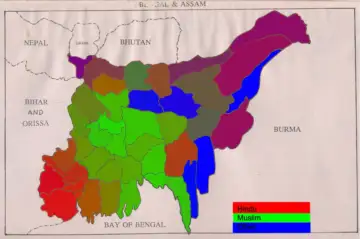
(Based primarily on the 1941 Census - the last full census before Partition)
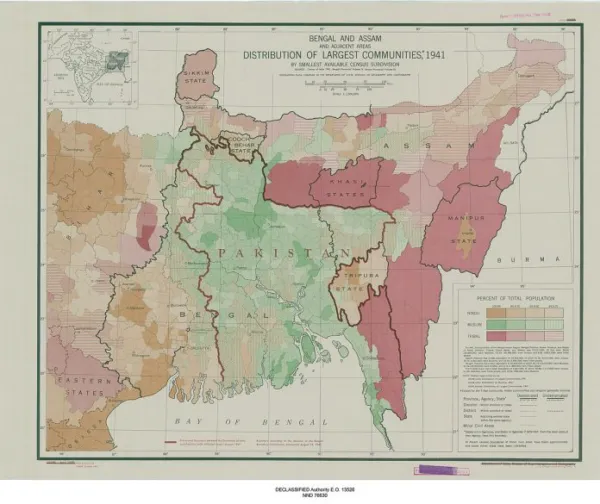
The partition of undivided Bengal was decided largely on district-level religious majorities as recorded in the 1941 Census, along with administrative contiguity. Below is a district-wise demographic snapshot showing why specific districts went to East Pakistan and others to India (West Bengal).
| District (1947) | Hindu % | Muslim % | Outcome |
|---|---|---|---|
| Calcutta | ~73% | ~23% | India |
| Howrah | ~65% | ~33% | India |
| Hooghly | ~68% | ~30% | India |
| Midnapore | ~55% | ~44% | India |
| Bankura | ~80% | ~19% | India |
| Birbhum | ~55% | ~44% | India |
| Burdwan | ~56% | ~42% | India |
| Nadia | ~61% | ~38% | India |
| Murshidabad | ~44% | ~56% | India(strategic exception) |
| 24 Parganas | ~58% | ~41% | India |
Key exception:Murshidabad had a Muslim majority but remained with India due to river systems, Calcutta port access, and administrative logic.
| District (1947) | Muslim % | Hindu % | Outcome |
|---|---|---|---|
| Dacca | ~70% | ~29% | East Pakistan |
| Mymensingh | ~69% | ~30% | East Pakistan |
| Faridpur | ~67% | ~32% | East Pakistan |
| Bakarganj (Barisal) | ~72% | ~27% | East Pakistan |
| Tippera (Comilla) | ~76% | ~23% | East Pakistan |
| Noakhali | ~75% | ~24% | East Pakistan |
| Chittagong | ~71% | ~28% | East Pakistan |
| Chittagong Hill Tracts | ~98% tribal (non-Muslim) | - | East Pakistan(strategic) |
| Rajshahi | ~65% | ~34% | East Pakistan |
| Dinajpur (major part) | ~55% | ~44% | East Pakistan |
| Rangpur | ~70% | ~29% | East Pakistan |
| Bogra | ~80% | ~19% | East Pakistan |
| Pabna | ~73% | ~26% | East Pakistan |
| Jessore | ~52% | ~48% | East Pakistan |
| Khulna | ~50-52% | ~48-50% | East Pakistan |
| Kushtia | ~64% | ~35% | East Pakistan |
| Sylhet (Assam) | ~56% | ~43% | East Pakistan (via referendum) |
- River systems (Bhagirathi-Hooghly)
- Port access (Calcutta)
- Administrative coherence
This explains anomalies like:
This demographic map explains:
The 1947 Bengal Partition followed district-level religious majorities from the 1941 Census-sending 17 Muslim-majority districts to Pakistan and 10 Hindu-majority districts to India-while leaving behind millions of Hindus in East Bengal, whose demographic decline continues to shape history and politics today.
Jogendra Nath Mandal did not redraw Bengal's map-but his political alignment shaped the atmosphere in which 17 districts became part of Pakistan.
Those districts today lie in Bangladesh, where the Hindu population continues to shrink, making Partition-era choices feel painfully contemporary.
History thus judges Mandal less by intent and more by outcome-a reminder that symbolic political endorsements during civilizational ruptures can carry consequences far beyond their immediate context.
*** Please refer to official government notifications for any official reference, as data may vary for different sources referred.***