




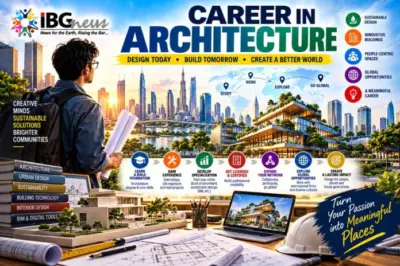

By Suman Munshi | IBG NEWS
Architecture is changing faster than at almost any point in its history. The profession is no longer limited to drawing plans, preparing elevations and supervising construction.
Today's architect is expected to understand design, technology, sustainability, construction, data, artificial intelligence, economics, human behaviour and communication.
The most successful architects of the coming decade will not simply be those who can produce attractive buildings. They will be professionals who can understand complex problems, develop intelligent design responses, test those ideas digitally, communicate them convincingly and turn them into buildings that perform in the real world.
Becoming such an architect requires a deliberate skill-building strategy rather than learning software randomly or collecting certificates.
The foundation of great architecture is not software. It is observation and reasoning.
A strong architect begins by asking:
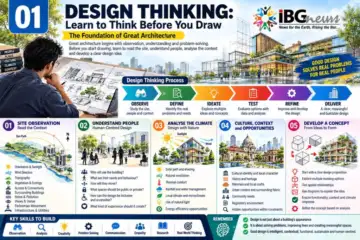 01 DESIGN THINKING
A useful framework is:
Observe → Define → Ideate → Test → Refine → Deliver
Site observation
Learn to analyse:
Spatial thinking
Understand how people experience:
Concept development
Don't begin every project with a building shape. Begin with a problem and a proposition.
The best concepts should explain why the building looks, works and feels the way it does.
Great design is not decoration added to a building. It is intelligent problem-solving expressed through space.
A brilliant idea that cannot be communicated effectively is unlikely to survive a real project.
Architects communicate with clients, engineers, contractors, authorities, consultants, developers and users. Each audience understands information differently.
Therefore, communication should become a core professional skill.
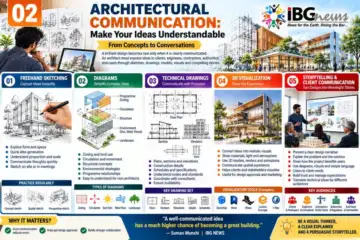 02 ARCHITECTURAL COMMUNICATION
Freehand sketching
Sketch rapidly to explore:
Diagrams
Learn to convert complex information into simple graphics:
Technical drawings
Become comfortable with:
3D visualization
Use models and renders to explain spatial experience rather than simply creating attractive images.
Storytelling
A strong presentation should answer:
One of the biggest differences between an inexperienced designer and a mature architect is the understanding of constructability.
A building is not merely a composition of forms. It is a coordinated system.
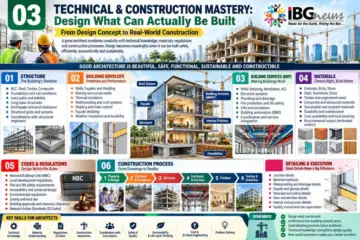 03 TECHNICAL CONSTRUCTION MASTERY
Structure
Understand the principles behind:
Building envelope
Learn about:
Building services
Gain working knowledge of:
Materials
Study how materials behave, not merely how they look.
Understand:
A professional architect must understand the regulatory environment applicable to each project.
In India, this includes relevant provisions of the National Building Code, local development regulations, fire requirements, accessibility provisions and environmental regulations, together with applicable standards and authority requirements.
The goal is not to memorise every regulation.
The goal is to know where requirements influence design decisions.
Building Information Modelling has fundamentally changed how architecture can be delivered.
A BIM model can become a coordinated information environment connecting architecture with structure, MEP, quantities, documentation and eventually building operations.
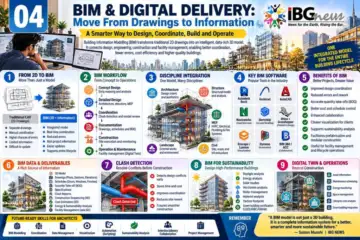 04 - BIM & Digital Delivery
Level 1 - Modelling
Learn:
Level 2 - Documentation
Develop competence in:
Level 3 - Coordination
Understand:
Level 4 - Data
Learn to use models for:
Level 5 - Digital twins
Understand how digital information can eventually support:
The objective is to move from "I can model a building" to "I can manage building information."
Artificial intelligence will change architectural workflows, but it does not eliminate the need for architects.
The important distinction is between using AI to generate images and using computation to improve design decisions.
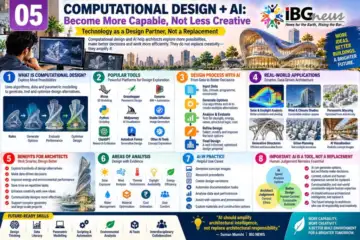 05 - Computational Design + AI
Useful tools include:
A parametric workflow can explore alternatives based on:
Instead of producing one solution, the architect can investigate hundreds of possibilities and compare them.
AI can assist with:
But the architect remains responsible for:
judgement + context + ethics + constructability + human experience.
AI should amplify architectural intelligence, not replace architectural responsibility.
AI should amplify architectural intelligence, not replace architectural responsibility.
Sustainability should not be treated as a decorative feature added near the end of a project.
It should influence the design from the beginning.
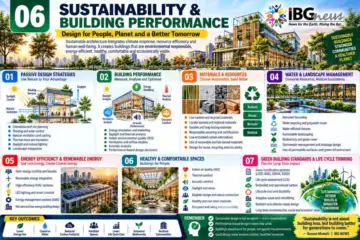 06 - Sustainability & Building Performance
Understand:
Develop familiarity with:
The modern architect should increasingly understand:
A truly sustainable building also considers:
The future of architecture is moving from simply "green buildings" toward high-performance buildings designed around measurable outcomes.
An architect who only understands drawings has an incomplete understanding of architecture.
Construction sites teach lessons that no software can fully reproduce.
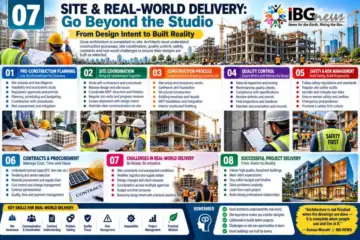 7. Site & Real-World Delivery: Go Beyond the Studio
Spend time observing:
On-site experience reveals why:
A strong architect therefore develops a continuous feedback loop:
Design → Construction → Observation → Learning → Better Design
Architecture is also a professional service and a business.
An architect who understands design but cannot manage clients, budgets, contracts or teams will struggle to lead major projects.
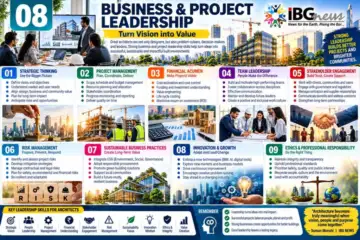 8. Business & Project Leadership
Learn the basics of:
A good architect should be able to identify:
What the client says → What the client needs → What the project actually requires
These three things are not always identical.
Major projects involve:
The architect increasingly acts as a coordinator and leader of a multidisciplinary system.
A portfolio should not simply demonstrate that you can make attractive drawings.
It should reveal how you think.
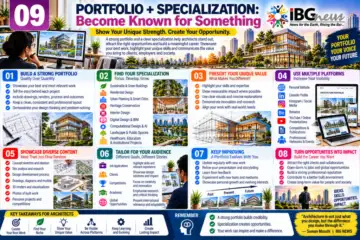 9. Portfolio + Specialization: Become Known for Something
Show the journey, not just the final render.
The modern architectural profession offers numerous directions:
You do not have to specialize immediately.
But after gaining broad experience, developing one area of exceptional depth can dramatically increase professional value.
A realistic career strategy is more valuable than simply applying everywhere.
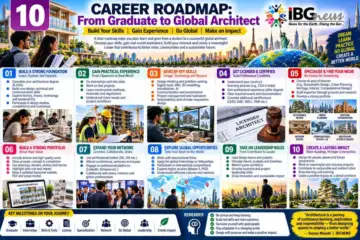 10 - Career Roadmap: From Graduate to Global Architect
0-2 years
Concentrate on:
Your objective should be learning how real projects work.
2-5 years
Add:
At this stage, begin identifying your strongest professional direction.
5-8 years
Become highly competent in a selected area.
For example:
Architecture + BIM
or
Architecture + Computational Design
or
Architecture + Sustainability
or
Architecture + Healthcare
or
Architecture + Urban Design
8+ years
Move toward:
The objective becomes creating and leading systems rather than simply completing tasks.
The best first employer is not necessarily the company with the most famous name.
Look for a practice where you can experience:
Design + Documentation + BIM + Consultants + Construction + Client Interaction
Some internationally prominent practices that can provide exposure to advanced design, technology, multidisciplinary collaboration or complex projects include:
These organizations differ considerably in culture and specialization, so candidates should research the individual studio, project type, role and learning opportunities rather than applying solely because of brand recognition.
India also has an increasingly sophisticated architectural ecosystem.
Young professionals can research practices such as:
The right choice depends on the kind of architect you want to become.
For example:
Want sustainability?
Look for practices where environmental performance is integrated into design.
Want large-scale projects?
Look for multidisciplinary firms working on airports, campuses, infrastructure, commercial developments and master plans.
Want computational design?
Prioritize studios using parametric modelling, scripting and advanced digital workflows.
Want construction knowledge?
Choose a practice where architects remain closely connected with documentation and site execution.
A highly competitive architect should aim for a combination such as:
Architectural thinking + spatial intelligence + conceptual design
Construction + structure + materials + detailing + codes
Revit/BIM + Rhino + Grasshopper/Dynamo + visualization
Generative AI + image workflows + automation + research assistance
Energy + daylight + thermal comfort + acoustics + sustainability
Cost + contracts + project management + client communication
Listening + empathy + leadership + collaboration
This combination is much more powerful than becoming an expert in one software package.
| Period | Primary Objective | Skills to Build |
|---|---|---|
| Year 1 | Architectural Foundation | Design, sketching, CAD, Revit, construction basics |
| Year 2 | Digital + Technical Growth | BIM, Rhino, visualization, detailing, site experience |
| Year 3 | Advanced Professional Capability | Grasshopper, AI, sustainability, performance analysis, project leadership |
Alongside these technical skills, maintain a continuous architecture portfolio.
Every significant project should become a case study.
Do not try to master 30 software applications.
Focus on a high-value core.
Revit/BIM
For professional documentation and coordination.
Rhino
For advanced 3D modelling and complex geometry.
Grasshopper or Dynamo
For computational and parametric workflows.
One high-quality visualization platform
For design communication.
AI tools
For ideation, research and workflow acceleration.
Excel/data skills
For project, quantity and analytical work.
Then deepen your understanding of architecture itself.
Software changes.
Architectural thinking remains.
The next generation of architects will not be divided simply into people who use AI and people who do not.
The real distinction will be between professionals who:
generate images
and those who can:
define problems → analyse evidence → develop concepts → test alternatives → coordinate disciplines → understand construction → measure performance → communicate decisions → deliver buildings.
That is the difference between being a software operator and becoming an architect.
A great modern architect can be thought of as:
Design Intelligence
= A Future-Ready Architect
The ultimate objective should not be to become merely employable.
It should be to become valuable, adaptable and difficult to replace.
The architect of the future will combine the imagination of a designer, the precision of an engineer, the curiosity of a researcher, the practical knowledge of a builder and the judgement of a leader.
That is the skill set required to become not just an architect-but a great architecture professional.
- Suman Munshi | IBG NEWS