
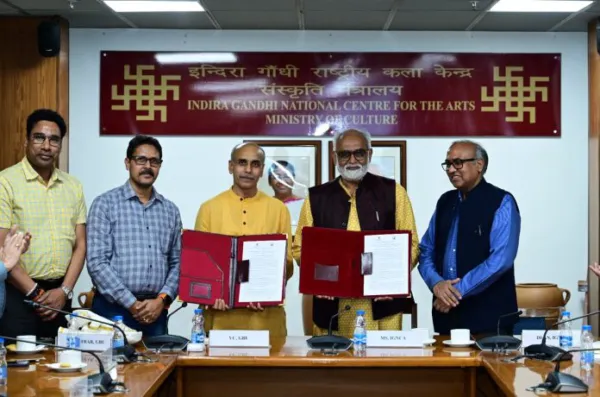

IGNCA Signs MoU with GBU for Integration of Traditional Knowledge and Modern Science
16th April, New Delhi: To explore new dimensions of knowledge through the integration of India's traditional knowledge systems with modern science, the Indira Gandhi National Centre for the Arts (IGNCA) and Gautam Buddha University, Greater Noida (GBU), signed a Memorandum of Understanding. On this occasion, IGNCA was represented by Dr. Sachchidanand Joshi, Member Secretary, IGNCA; Prof. (Dr.) Ramesh Chandra Gaur, Dean and Head of the Kalānidhi Division; Prof. Sudhir Lal, Head of the Kalākosha and CIL; Shri Anurag Punetha, Head of the Media Centre; Prof. Dharam Chand Choubey, Professor and Head of Brihattar Bharat and Area Studies, along with several other officials. Representing Gautam Buddha University were Prof. Rana Pratap Singh, Vice-Chancellor, GBU; Prof. Chandra Kumar Singh, Registrar; Prof. Uttam Kumar; and other faculty members and officials. The MoU was signed by Prof. (Dr.) Ramesh Chandra Gaur on behalf of IGNCA and Prof. Chandra Kumar Singh on behalf of GBU.
Speaking on the occasion, Dr. Sachchidanand Joshi remarked that, since the implementation of the National Education Policy, there has been a growing interest in exploring new horizons within the Indian education and knowledge systems. However, he observed that much of this effort continues to remain confined within conventional frameworks. He emphasised the need to move beyond established boundaries in order to discover new dimensions. He noted that this MoU represents a distinctive initiative, bringing together scholars from life sciences, medical sciences, and Ayurveda to engage with elements embedded within India's classical traditions. Such an approach, he suggested, has the potential to uncover areas of knowledge that have so far remained unexplored, thereby opening new pathways in the domain of knowledge.
Prof. Rana Pratap Singh stated that, during discussions on potential areas of collaboration, it emerged that a substantial digital repository of manuscripts is already available. He suggested that these manuscripts could be systematically studied to identify and interpret the knowledge contained within them. Their ideas, information, and existing translations could serve as the basis for research, while their contemporary relevance could be assessed in terms of their applicability to society at large. He noted that such knowledge-oriented projects could form the foundation of collaborative work between the two institutions.
Sharing his perspective, Prof. Ramesh Chandra Gaur remarked that this represents a meaningful form of collaboration, as IGNCA possesses expertise in scripts and textual interpretation, while Gautam Buddha University has specialists with deep subject knowledge. He pointed out that this convergence creates a space for substantive academic work. Referring to the example of Ayurvedic biology, he described it as an illustration of the synthesis between Indian knowledge traditions and modern medical and biological sciences. He further informed that IGNCA has collected approximately three lakh manuscripts from 52 libraries across India, all of which have been digitised and preserved in microfilm form. Over the past seven years, a descriptive catalogue of these manuscripts has been prepared, covering subjects such as Vedanta, Buddhism, and Ayurveda. A total of 53 subject areas have been identified, enabling a structured starting point for collaborative research.Prof. Dharam Chand Choubey informed that, as part of the first phase of implementation of this agreement, IGNCA will establish the Buddha Map model titled 'Buddha Shasanam Chiram Tishthatu' (May the teachings of the Buddha endure) at Gautam Buddha University. This model presents, through a mapped representation, key locations associated with the life of Lord Buddha and the spread of Buddhism across India and other parts of Asia. It seeks to offer a clear and concise understanding of what is known and transmitted about the Buddha, Buddhism, and its expansion.