

IIT Bhubaneswar Strengthens Innovation Dialogue with Session on Technology Commercialisation and Start-ups
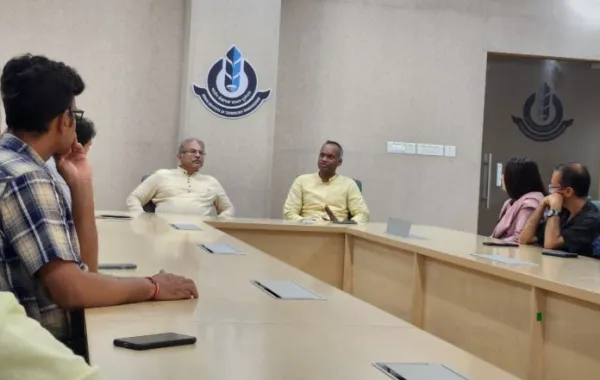
Bhubaneswar, 24th April 2026: As a part of its 100 CUBE entrepreneurship development initiative, the Indian Institute of Technology (IIT) Bhubaneswar hosted an insightful session on Technology Commercialisation on 23rd April 2026. The session brought together faculty members, researchers, innovators, and members of the Institute's innovation and incubation ecosystem for an interaction with 2025 Rashtriya Vigyan Puraskar awardee Prof. Mohanasankar Sivaprakasam from Indian Institute of Technology Madras. Ways of translating academic research into impactful technologies and commercially viable products were discussed in the session.
At the outset, Prof. Shreepad Karmalkar stated that the 100 CUBE initiative of the institute aims at mentoring 100 start-ups, each of worth at least Rs. 100 Cr by 100th year of Odisha, i.e. 2036. He outlined two key steps taken by the institute towards this aim. These include a mandatory course on 'Research & Entrepreneurship' for research students, and the mandate for each faculty member to identify two industries for collaboration to strengthen industry-academia ties. He mentioned that the institute is presently mentoring 140 start-ups, of which 8 are led by IIT faculty, 16 by IIT students and rest more than 100 by others.
Prof. Mohanasankar praised the above efforts of IIT Bhubaneswar, and appreciated the variety in the areas covered by the start-ups as well as the fact that the institute has attracted a large number of non-IIT entrepreneurs. He shared insights from his extensive experience in deep-tech innovation, industry collaboration, and building successful technology ecosystems. Reinforcing the importance of industry collaboration, he noted that "you have to create very strong industry linkages… a connect and collaboration where one influences the other," adding that such partnerships are key to building sustainable technology commercialisation ecosystems. Emphasising the need for academic institutions to move beyond conventional research frameworks, he remarked, "Technology commercialization has multiple routes… incubation is one route, but not necessarily the only route. Co-developing products with industry and technology transfer through licensing are equally important pathways." He noted that impactful technology commercialisation is rooted in rigorous and intellectually strong research.
More than 50 persons participated in the lively interaction spanning 2 hours.