
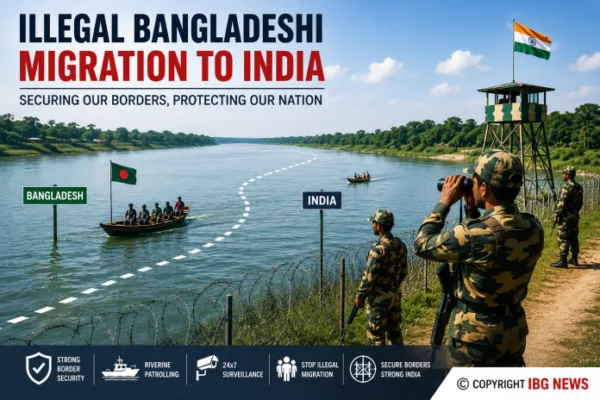

Illegal migration from Bangladesh into India has remained a major political, demographic, economic, and national security issue for several decades.
Eastern and Northeastern Indian states such as West Bengal, Assam, Tripura, and Meghalaya have repeatedly witnessed intense debate regarding undocumented migration, border management, demographic transformation, land pressure, electoral influence, and cultural change.
The India-Bangladesh border is one of the world's longest land borders, stretching across riverine terrain, forests, agricultural settlements, and densely populated rural regions. Due to geographical complexity and historical social connections, monitoring illegal cross-border movement has remained a difficult challenge for Indian authorities.
The issue is highly sensitive because it involves multiple dimensions, including labour migration, economic survival, refugee movement, climate displacement, border crime, and national security concerns. Experts also caution that demographic changes cannot automatically be attributed entirely to illegal migration, as fertility rates, internal migration, urbanisation, and economic migration within India also influence population patterns.
Cross-border migration into India increased during several important historical phases:
The migration issue became politically explosive during the Assam Movement between 1979 and 1985, eventually resulting in the Assam Accord. Since then, migration has remained one of the most debated political issues in Eastern India.
Several border districts of West Bengal have experienced notable population growth and settlement expansion over the last forty years.
| District | Observed Pattern | Key Concerns |
|---|---|---|
| Murshidabad | High population growth | Riverine infiltration concerns |
| Malda | Rapid rural expansion | Informal labour movement |
| North 24 Parganas | Urban-border population increase | Settlement pressure |
| Nadia | Border demographic change | Agricultural migration |
| South Dinajpur | Gradual border population rise | Cross-border movement |
Demographic studies have highlighted unusually high growth rates in several border regions compared with state averages. However, experts caution that population growth alone cannot conclusively prove illegal immigration.
West Bengal's Muslim population share increased significantly between 1951 and 2011. Analysts attribute the change to a combination of factors, including fertility rates, rural demographics, migration, and socio-economic conditions.
Assam remains the most politically sensitive state in the illegal migration debate.
| District | Observed Trend |
|---|---|
| Dhubri | High border density growth |
| Barpeta | Rural demographic expansion |
| Goalpara | Population restructuring |
| Karimganj | Border infiltration concerns |
| South Salmara-Mankachar | Riverine settlement growth |
| Nagaon | Migration-linked political debate |
Migration concerns in Assam have influenced politics, ethnic identity movements, and citizenship debates for decades.
The issue has also generated legal and humanitarian concerns regarding citizenship verification and wrongful exclusion.
Tripura has undergone one of the sharpest demographic transformations in post-independence India.
Historically, indigenous tribal communities formed the majority population in the state. However, large-scale migration after Partition and the 1971 war significantly altered the demographic balance.
Several tribal organisations and student groups continue to demand stronger border control and stricter citizenship verification mechanisms.
Compared to Assam and Tripura, Meghalaya has experienced relatively lower migration pressure, but security concerns continue in border districts due to difficult terrain and porous border stretches.
| District | Security Concern |
|---|---|
| South Garo Hills | Illegal crossing routes |
| West Jaintia Hills | Labour migration corridors |
| East Khasi Hills | Settlement monitoring concerns |
The Meghalaya government has periodically discussed stricter migrant verification systems and anti-infiltration monitoring.
Security analysts and law enforcement agencies have repeatedly identified several risks linked with uncontrolled illegal migration:
At the same time, civil rights groups warn against communal profiling and unverified demographic claims.
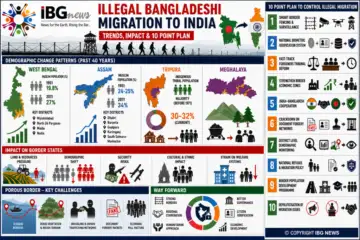 Illegal Migration to India Infographics
India should modernise the Indo-Bangladesh border through:
Special attention should be given to vulnerable riverine sectors in Assam and West Bengal.
A secure national verification framework should integrate:
Strong legal safeguards must protect genuine Indian citizens from wrongful exclusion.
Foreigners' Tribunals should be modernised through:
This would improve efficiency while protecting constitutional rights.
Authorities should intensify action against:
Document fraud often enables long-term illegal settlement.
India and Bangladesh should expand cooperation in:
Diplomatic coordination is essential for long-term border stability.
Border districts often suffer from poverty, unemployment, and dependence on informal economic activity.
India should invest in:
Economic stability can reduce illegal labour dependency.
Sensitive border districts should maintain dedicated monitoring systems for:
Monitoring must operate within constitutional and legal frameworks.
India currently lacks a comprehensive refugee framework.
A modern law should clearly distinguish between:
This would improve policy clarity and humanitarian accountability.
Border residents can play an important role in national security.
Authorities should create:
Border communities are often the first to observe suspicious activity.
Illegal migration has increasingly become a politically polarised issue.
A bipartisan national framework is necessary to avoid:
National security policy should remain evidence-based and constitutionally balanced.
The illegal migration issue also raises major constitutional and humanitarian questions.
Human rights organisations and legal experts have expressed concerns regarding:
Any long-term strategy must therefore comply with:
Illegal Bangladeshi migration into India remains one of the most complex challenges facing Eastern and Northeastern India. Over the past forty years, several districts in West Bengal, Assam, Tripura, and Meghalaya have experienced visible demographic and socio-political transformation, leading to continued political debate and policy action.
However, migration is not solely a security issue. It is also connected with economic inequality, climate displacement, labour demand, historical migration routes, and regional geopolitics.
India's long-term response must therefore combine:
Only a balanced, evidence-driven, and nationally coordinated strategy can effectively address illegal migration while preserving democratic stability and humanitarian responsibility.
By Suman Munshi,Chief Editor, IBG NEWS