

By PIB Delhi
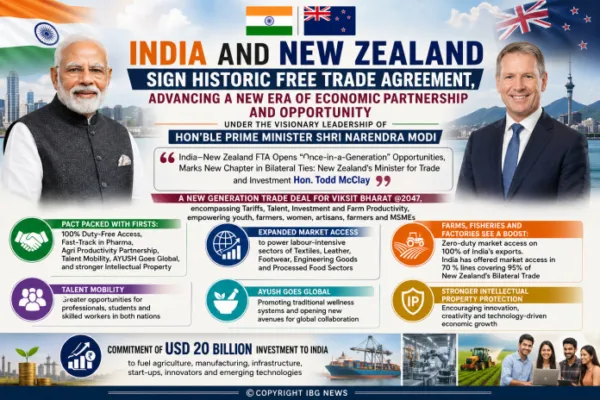
India and New Zealand today signed the India- New Zealand Free Trade Agreement (IN- NZ FTA) at Bharat Mandapam, New Delhi, under the vision and leadership of Hon'ble Prime Minister Shri Narendra Modi to strengthen India's global economic partnerships.
The Agreement was signed by Union Minister of Commerce and Industry Shri Piyush Goyal and New Zealand's Minister for Trade and Investment Hon. Todd McClay.
The signing ceremony brought together businesses and industry leaders from both countries, with Trade and Investment Minister Todd McClay leading a cross-party delegation of Members of Parliament and over 30 New Zealand businesses.
The signing of the India-New Zealand Free Trade Agreement marks a new and significant chapter in the bilateral relationship, reflecting shared ambition, deepening engagement, and a commitment to mutually beneficial growth said Mr. McClay.
In a message on the signing of the India-New Zealand Free Trade Agreement, Prime Minister of New Zealand Mr. Christopher Luxon termed it a historic milestone, noting that the deal unlocks major opportunities for trade, investment, and innovation for both countries. He highlighted that it will expand market access, support export growth, and enable collaboration in areas like agriculture, while also reinforcing a shared commitment to stable, rules-based trade and deeper people-to-people ties.
Speaking on the occasion, Mr. McClay, noted that the agreement is a "once-in-a-generation" opportunity that will create new avenues for exporters, generate employment, and unlock significant economic potential. It is expected to not only strengthen existing business ties but also accelerate the development of new partnerships, enhancing overall economic engagement between the two countries.
Highlighting the strong participation from New Zealand, he informed that over 40 representatives, including exporters, sector leaders, and business stakeholders, travelled to India to witness the occasion, underlining the importance attached to the agreement.
The agreement is expected to facilitate increased trade and investment flows by improving market access, reducing barriers, and establishing clear and predictable rules. It will support businesses of all sizes, including small and medium enterprises, ensuring wider distribution of the benefits of trade.
The Minister also underscored the role of people-to-people connections as a key pillar of the bilateral relationship. He noted that around 6% of New Zealand's population traces its heritage to India, with the Indian diaspora contributing significantly across sectors such as business, education, science, culture, sport, and public life.
He further highlighted the longstanding historical and cultural linkages between the two nations, including shared military history during the First World War and enduring sporting ties, particularly in cricket, which continues to strengthen bilateral engagement.
The agreement comes at a time of evolving global and regional dynamics, where reliable partnerships are increasingly important. New Zealand views India as a key partner in promoting regional stability, economic resilience, and shared prosperity.
Acknowledging India's rapid economic transformation, the Minister noted its growing role in global economic activity and reiterated New Zealand's commitment to partnering with India in its development journey.
The Minister expressed appreciation for the professionalism and dedication of officials involved in the negotiations, stating that the agreement reflects a balanced, forward-looking, and practical outcome. Both sides will now work closely towards effective implementation and delivery of the agreement.
Concluding his remarks, the Minister thanked the leadership of both countries for their vision and commitment, stating that the agreement is grounded in mutual respect, shared interests, and a clear ambition to further strengthen ties in the years ahead.
The negotiations were officially launched on March 16, 2025 on the eve of the Bilateral meeting of Hon'ble Prime Minister of India, Shri Narendra Modi and the Prime Minister of New Zealand, Rt Hon Christopher Luxon. This agreement is anchored on deep people-to-people connections and a partnership between vibrant democracies for advancing trade, economic cooperation, and strategic engagement across the Indo-Pacific. The merchandise bilateral trade between Oceania and India stood at approximately USD 26 billion in 2024-25. New Zealand is India's second-largest trading partner in the Oceania region, with bilateral trade valued at around USD 1.3 billion. With the coming into force of the India-New Zealand Free Trade Agreement, bilateral trade is expected to witness further growth, supported by enhanced market access, greater trade facilitation, and deeper economic engagement between the two countries.
Through five formal rounds of negotiations and several intersessions, both sides concluded the Agreement on 22 December 2025, just nine months after launch, making it one of the fastest FTAs concluded by India with a developed country.
Speaking on the Signing, Union Minister for Commerce and Industry Shri Piyush Goyal said "The India-New Zealand Free Trade Agreement marks a defining milestone in India's engagement with the developed world. It reflects Prime Minister Narendra Modi's vision of global economic partnerships for our farmers, women, youth, artisans and entrepreneurs. This is India's 9th Agreement in the past few years- with 38 developed countries. At the heart of the agreement is the empowerment for exports, agricultural productivity, student mobility, skills, investment and services. The investment commitment of USD 20 billion from New Zealand signals strong confidence in India's growth story. It places special emphasis on strengthening MSMEs, fostering innovation, and enabling women-led enterprises to thrive in global markets"
In a message Commerce Secretary Shri Rajesh Agrawal, said that "The India-New Zealand FTA marks a new era in our economic partnership, one marked by trust and complementary strengths. India now has a level playing field for exports to New Zealand. The FTA broadens its scope to agriculture productivity, organics, services, mobility, Ayush, and pharma access making the opportunities all-inclusive and future-oriented. The agreement gives a strong competitive push to India's labour-intensive sectors. India's exporters now have zero-duty access to New Zealand and the broader regional trade ecosystem. Indian exporters can operate with greater scale, and diversification in the Indo-Pacific. The deal offers predictability in today's uncertain world"
The India-New Zealand Free Trade Agreement was signed under the visionary leadership of Hon'ble Prime Minister Narendra Modi. The India - New Zealand Free Trade Agreement represents a new generation of strategic trade partnership, comprehensive, inclusive, confident, calibrated and rooted in national interest. Under the leadership of Prime Minister Shri Narendra Modi, India is forging partnerships with developed economies that deliver real market access for our labour-intensive sectors and holistic economic partnerships. This FTA stands as a testament to a new approach, where trade will drive jobs, empower youth, women and MSMEs, and align seamlessly with the vision of inclusive growth and economic resilience on the path to Viksit Bharat 2047. The FTA will enter into force after the completion of all domestic procedures and ratification in both countries.
Productivity to Prosperity for People: Tariffs, Talent, Transformation for Viksit Bharat 2047
Trade in Goods: Unprecedented 100% Duty-Free Access to New Zealand Market on entry into force
Calibrated Market access and sensitive Sectors Protected
Advancing Agricultural productivity Partnership, Farmer incomes and Rural Economies
Services: Best-Ever Offer by New Zealand empowers our Youth, Women and Professionals
Opening Skilled Employment Pathways and Global Experiences:
Enhanced Mobility Pathways for Indian Professionals, Students and Youth
Investment: USD 20 Billion Commitment for our innovators, industry and start up ecosystem
Market Entry fast tracked in a developed market for Pharmaceuticals and Medical Devices: Major Breakthrough
Intellectual Property Rights
Boosting MSMEs, Women Entrepreneurs, Incubators and Global Value Chain Integration
Rules of Origin: A Balanced and Robust Framework
Trade Remedies: Safeguarding India's Domestic Industry
Fast track mechanism for imports used for export manufacturing, Customs Procedure and Trade Facilitation:
Smart Regulation for Safe and Seamless Trade: Sanitary and Phytosanitary Measures
Pioneering Economic Cooperation and Technical Partnership
Cultural Trade, Traditional Knowledge and People-to-People Cooperation: A first in FTAs
Organics trade through Mutual Recognition Arrangement: A gateway to the Indo Pacific
Bilateral Trade: Strong Momentum, Vast Potential
From Farms, Fisheries to Factories: Deal power Key Sectors and States
Zero-duty market access will significantly boost India's key export sectors. Textiles and clothing, a cornerstone of exports, will see higher growth and job creation across apparel, home furnishings, fibres, and handloom products. Agriculture and processed foods will become more competitive with tariff elimination on products such as fruits, spices, cereals, coffee, and cocoa. Leather and footwear will gain from the removal of peak duties, strengthening India's global position. At the same time, engineering, manufacturing, and industrial sectors-including machinery, automotive, electronics, chemicals, plastics, and rubber-will benefit from tariff reductions, reinforcing India's diversified export base and deeper integration into global value chains.
At the state level, the India-New Zealand FTA is set to deliver broad-based gains, reflecting the diverse and specialised nature of India's export landscape. Key exporting states-from Gujarat's chemicals and gems, Maharashtra's pharmaceuticals and auto components, and Tamil Nadu's textiles, leather and auto components, Uttar Pradesh's leather, carpets and handicrafts, Punjab's agri products, Karnataka's pharma and electronics, and West Bengal's tea and engineering goods-are poised to benefit from improved price competitiveness. Coastal states like Andhra Pradesh and Kerala are likely to see higher value from marine exports, while the North-East could gain better market access for tea, spices, bamboo, and organic produce. Overall, the agreement is expected to further diversify and deepen India's export profile.
Link for Sector and State-Wise Gains