

"Women as Embodiments of Shakti Central to Indian Tradition" - Shri Ram Bahadur Rai
"'Mythology' Is Not the Right Term for Purana." - Dr. Sonal Mansingh
"Male Author's Work on Feminism Breaks Stereotypes" - Prof. Malashri Lal
- IGNCA organised a book launch and discussion of Women in the Womb of Time
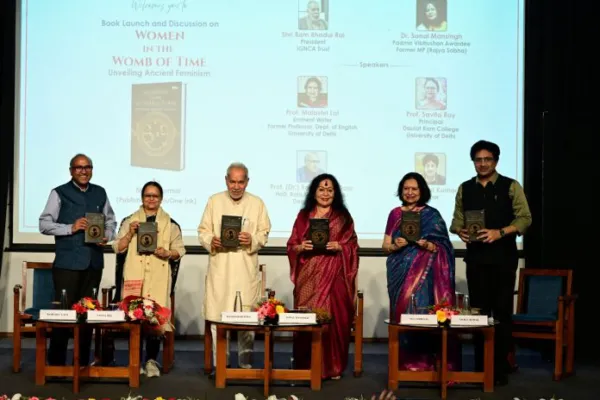
9th April, New Delhi: The Kala Nidhi Division of the Indira Gandhi National Centre for the Arts (IGNCA) held a book launch and discussion of the book 'Women in the Womb of Time: Unveiling Ancient Feminism' at the Samvet Auditorium, IGNCA. Authored by noted writer Shri Mukul Kumar and published by BlueOne Ink, the volume offered a nuanced engagement with the discourse on women in ancient Indian traditions, situating it within both historical inquiry and contemporary relevance. The programme was presided over by Shri Ram Bahadur Rai, President, IGNCA Trust. Padma Vibhushan awardee, eminent Nritya Guru, scholar, and former Member of Parliament, Dr. Sonal Mansingh, attended as Guest of Honour. The discussion featured distinguished scholars including Prof. Malashri Lal, Eminent Writer, Former Professor, Dept. of English, University of Delhi, Prof. Savita Roy, Principal, Daulat Ram College, University of Delhi and Prof. (Dr.) Ramesh Chandra Gaur, Dean IGNCA and HoD, Kala Nidhi Division . Author Shri Mukul Kumar also shared insights into the theme of the book, along with his research and writing process.
Shri Ram Bahadur Rai, on the occasion, said that there is something distinctive about this book, and that while reading it, one clearly realises that the author has examined the subject from every possible angle. He urged that the book be translated into Hindi and other Indian languages at the earliest. He noted that epics such as the Ramayana and the Mahabharata bring out the many dimensions of womanhood. He further stated that in Indian tradition, women have been viewed as embodiments of Shakti (power), and that this perspective can be better understood through texts such as the Durga Saptashati. Referring to the book, he said that Sita's existence reminds us that women's empowerment is not dependent on external circumstances, but is an inner process of sustaining one's own strength and inner light. He added that this work, in many ways, reflects the entirety of Indian civilisational history and can be regarded as a book of books.
Dr. Sonal Mansingh observed that translating traditional Indian vocabulary into English is deeply challenging, as it often fails to convey the depth and emotional resonance embedded in these expressions. She noted that the term 'mythology' is inadequate for Purana, which signifies ancient events preserved in collective memory rather than fiction, and called for a more appropriate articulation. Referring to the narrative of Ahalya, she emphasised the need to return to primary sources such as the Valmiki Ramayana to recover nuance and agency often lost in later retellings, adding that Indian traditions are better understood as embodiments of collective memory. Reflecting on the book's central idea, she remarked that time begins in the womb of a woman, with Kali as its governing force, emphasising the creative power of the feminine. She also stressed the importance of engaging with indigenous and tribal traditions as living knowledge systems, citing a Waghri community narrative of Mahishasura Mardini that offers an alternative perspective on Shakti, relationships, and balance.
Prof. Malashri Lal on the occasion said that Mukul Kumar's work on ancient feminism marks a bold and intellectually rigorous engagement with Indian literary traditions, one that enters the silences and gaps surrounding women within the civilisational continuum with rare depth and sensitivity. She observed that the book stands out not only for its scholarship but also for the fact that it is a male author undertaking a sustained inquiry into both ancient and modern feminism with sincerity and a commitment to truth. In doing so, it challenges the persistent assumption that feminist discourse must either be authored exclusively by women or framed in an inherently anti-male register. She noted that the work dispels the suspicion often directed at male scholars in this field, demonstrating instead that a balanced, coherent, and deeply researched engagement with feminism can emerge from intellectual honesty rather than ideological positioning. Reflecting on the contemporary unease with the term itself, she remarked that feminism has at times been reduced to a shrill or aggressive rhetoric, leading even women writers to distance themselves from the label, despite engaging with its concerns.
Author Mukul Kumar said that he would like to share the journey of this book, how it was born and how the idea emerged. He explained that the journey of writing this book can be understood through three words: serendipity, epiphany, and transcendence. Serendipity, he noted, refers to an event in the present that unexpectedly leads to a pleasant and fulfilling outcome in the future. He further said that feminism or femininity is a significant social phenomenon of our times, one that affects almost every sensitive individual, and has become one of the most important sociological trends in the country today. He shared that a question rooted in his historical consciousness kept recurring in his mind, why feminism and not masculinism. He wanted to understand where this idea truly originated. He added that this very inquiry ultimately led to the creation of this book.
Prof. Ramesh Chandra Gaur, while welcoming the speakers and guests, said that Shri Mukul Kumar has written a book on a unique subject. He mentioned that under the 'IGNCA Book Circle,' three to four books are launched and discussed every month, with the objective of connecting the author with readers. He noted that Mukul Kumar's book contains several references to Kautilya's Arthashastra, which show that concerns about the safety of women in the workplace, now addressed through modern laws and guidelines, had already been considered in India centuries ago as a responsibility of the state. He described this as a remarkable insight, supported by substantial evidence presented in the book. Speaking on the discourse of women, Prof. Savita Roy said that in Indian tradition, women and men have been viewed with equality, and therefore there is a need to return to our roots and cultural foundations.
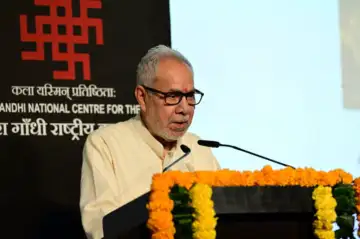 Shri Rambahadur Rai (1)
About the Book
This book explores the question of establishing Indian feminism as a possible philosophical subject. It highlights numerous examples of women's historical agency across different periods and regions within Indian history and texts. Works such as the Arthashastra and the Kamasutra also reflect upon the position of women. Similarly, in alternative social and religious traditions of India, such as Buddhism, women have held a significant presence. The author presents all these aspects in a commendable manner. The book raises the feminist dimension of Indian history as a critical inquiry, encouraging readers to rethink feminism within broader international, temporal, and geographical contexts.