




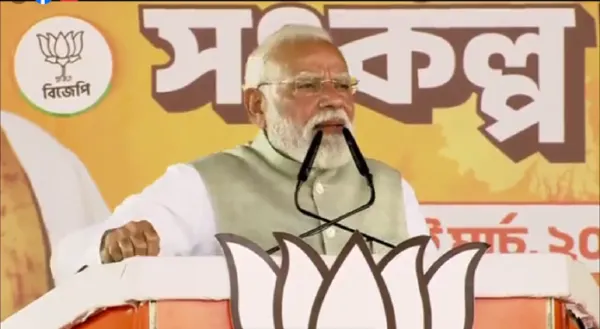

Kolkata, March 14: The massive rally addressed by Narendra Modi at Brigade Parade Ground on Saturday is being viewed by political observers as a major turning point in the run-up to the 2026 West Bengal Assembly elections .
The rally marks the formal launch of the Bharatiya Janata Party's campaign in the state ahead of what is expected to be one of the most fiercely contested elections in recent history. Political analysts believe the scale of mobilisation and the central leadership's direct involvement indicate that West Bengal will remain a key battleground in Indian politics.
Despite being traditionally dominated by regional forces, West Bengal has increasingly become a central political battlefield. The BJP has relied heavily on the popularity of Prime Minister Modi to expand its electoral base in the state.
Unlike the ruling Mamata Banerjee and her party, the All India Trinamool Congress, which maintains a strong grassroots network, the BJP's campaign often centres around the Prime Minister's national leadership and development narrative.
The strategy previously proved effective during the 2019 Indian general election, when the BJP secured 18 Lok Sabha seats in West Bengal, significantly strengthening its political presence.
The Brigade Parade Ground has historically been one of the most symbolic venues in Bengal politics. Major political forces have traditionally used Brigade rallies to demonstrate organisational strength and mass support.
For the BJP, the rally serves not only as a show of strength but also as a platform to consolidate its cadre network ahead of the elections.
Over the past 15 years, development trajectories in Uttar Pradesh and West Bengal have increasingly become a subject of political debate.
Uttar Pradesh has undergone significant infrastructure expansion, including expressways, airport modernization, and industrial investment corridors. Cities such as Lucknow, Noida, Ghaziabad and Varanasi have witnessed rapid transformation in connectivity and urban infrastructure.
West Bengal, on the other hand, has seen development largely centered around Kolkata and a few industrial pockets such as Durgapur and Haldia, with critics arguing that industrial expansion has not matched the pace seen in some other large states.
While both states have recorded economic growth, the nature of development has differed significantly, with West Bengal focusing more on welfare programs and social assistance schemes.
Several structural and policy factors have contributed to Uttar Pradesh's recent development momentum.
UP has invested heavily in infrastructure projects such as the Purvanchal Expressway, Bundelkhand Expressway and the upcoming Ganga Expressway, which have improved connectivity across the state.
The state government has actively promoted industrial investment through large events like the Global Investors Summit, attracting investments in sectors including electronics, manufacturing and logistics.
Cities such as Noida and Greater Noida have emerged as major technology and industrial hubs, benefiting from proximity to the National Capital Region.
Major redevelopment projects such as the Kashi Vishwanath Corridor in Varanasi have boosted tourism and local economic activity.
These initiatives have helped Uttar Pradesh position itself as one of India's fastest-growing state economies in recent years.
In contrast, critics argue that West Bengal has faced structural challenges that have slowed industrial expansion over the past decade.
Several major investment proposals in the past did not materialize, leading to a perception among investors of policy uncertainty.
Frequent political clashes between rival parties have often dominated headlines, overshadowing development debates.
A large number of workers from West Bengal continue to migrate to other states for employment opportunities, particularly in construction, manufacturing and service sectors.
While the state has made efforts through the Bengal Global Business Summit, analysts say the scale of industrial investment has remained comparatively smaller than in some other large states.
Political observers increasingly frame the debate between two development models.
West Bengal Model
Uttar Pradesh Model
The contrast between these models is expected to become a central political narrative during the West Bengal Assembly Election 2026 campaign.
The upcoming assembly election is expected to witness a fierce contest primarily between the ruling Trinamool Congress and the BJP, which has emerged as the principal opposition force in the state.
Other parties including the Indian National Congress and the Communist Party of India (Marxist) are also attempting to regain political space.
Analysts believe the outcome of the election will not only determine the political future of West Bengal but will also shape the broader balance of power in eastern India.
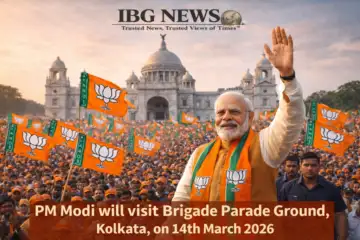 PM Rally at Kolkata
 (IBG NEWS Political Desk)