

Dailyhunt
Question Paper Leaks: The Silent Crisis Destroying Trust in India's Education System

Question Paper Leaks: The Silent Crisis Destroying Trust in India's Education System

IBGnews 4 days ago
Question Paper Leaks: The Silent Crisis Destroying Trust in India's Education System

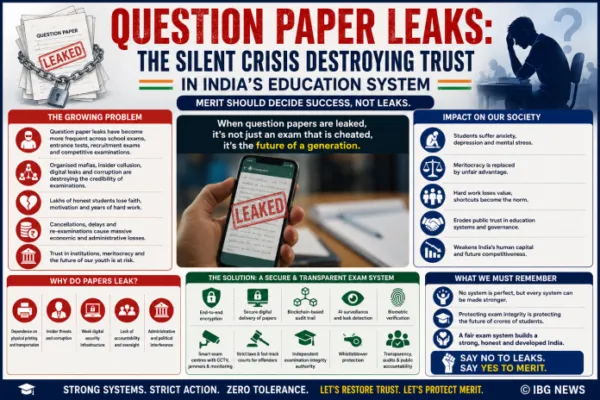
India's education system is facing a growing credibility crisis.

From school board examinations to national-level competitive tests, repeated incidents of question paper leaks have severely damaged public trust in the integrity of examinations.

Over the past decade, multiple examination systems-including recruitment tests, university entrance examinations, board examinations, and competitive government recruitment tests-have faced allegations or confirmed incidents of paper leaks, organised cheating networks, digital fraud, and corruption. Millions of students who spend years preparing for examinations increasingly fear that merit alone may no longer guarantee success.

Question paper leaks are no longer isolated incidents; they represent a systemic governance failure affecting education, employment, social trust, and national human capital development.

India conducts thousands of examinations annually involving:

  • School boards,
  • Universities,
  • Public Service Commissions,
  • Railway recruitment,
  • Banking recruitment,
  • Engineering and medical entrance examinations,
  • Defence recruitment,
  • Teacher eligibility tests,
  • And state-level competitive exams.
  • Yet year after year, reports emerge of:

  • Question papers circulating on messaging apps,
  • Organised leak mafias,
  • Insider collusion,
  • Printing press compromises,
  • Digital hacking,
  • Proxy candidates,
  • And examination centre corruption.
  • The consequences extend far beyond cancelled exams.

    Students who genuinely study and prepare feel cheated when leaked papers give an unfair advantage to organised networks.

    This weakens faith in:

  • Hard work,
  • Competitive fairness,
  • And institutional integrity.
  • Repeated cancellations and uncertainty create:

  • Anxiety,
  • Depression,
  • Loss of motivation,
  • And emotional exhaustion.
  • For many middle-class and rural families, competitive examinations represent years of sacrifice.

    Paper leaks have evolved into organised criminal businesses involving:

  • Coaching syndicates,
  • Cybercriminals,
  • Corrupt officials,
  • Middlemen,
  • And political protection networks in some cases.
  • Examination cancellations cause:

  • Massive administrative costs,
  • Logistics losses,
  • Security expenses,
  • Delayed recruitment,
  • And productivity loss.
  • When prestigious examinations repeatedly face leaks, the credibility of:

  • Educational boards,
  • Recruitment agencies,
  • Universities,
  • And governments
    comes under serious public scrutiny.
  • Many examinations still rely heavily on:

  • Printing presses,
  • Physical transport,
  • Manual packaging,
  • And insecure storage.
  • Each stage creates leakage opportunities.

    In many cases, leaks originate from:

  • Printing staff,
  • IT contractors,
  • Transport personnel,
  • Examination officials,
  • Or coaching-linked insiders.
  • Many institutions lack:

  • Encrypted paper distribution,
  • Real-time monitoring,
  • Secure digital infrastructure,
  • And cyber threat detection systems.
  • Lack of independent examination governance sometimes weakens accountability and increases vulnerability to corruption.

    India now requires a National Examination Security Architecture (NESA) combining AI, cybersecurity, encryption, blockchain verification, and institutional transparency.

    Instead of printing papers days in advance:

  • Encrypted digital question papers should be stored in secure servers.
  • Papers should unlock only minutes before examination.
  • Eliminates transport leak risk,
  • Reduces insider exposure,
  • Prevents early circulation.
  • Question papers should use:

  • Military-grade encryption,
  • AI-based anomaly detection,
  • Dynamic access control,
  • Geo-locked access systems.
  • Only authorised systems inside examination centres should decrypt papers.

    Every action involving the question paper should be recorded using blockchain verification:

  • Who accessed,
  • When accessed,
  • Which terminal accessed,
  • Any modification attempts.
  • This creates tamper-proof accountability.

    For objective examinations:

  • AI systems can generate randomized paper sets from secure question banks minutes before the exam.
  • Every centre receives different paper patterns,
  • Mass leakage becomes nearly impossible.
  • All individuals involved in the process should use:

  • Fingerprint verification,
  • Facial authentication,
  • Geo-tagged login systems.
  • This reduces impersonation and insider manipulation.

    India should establish a specialised unit dedicated to:

  • Exam cybersecurity,
  • Dark web monitoring,
  • Telegram/WhatsApp leak detection,
  • Real-time cyber surveillance.
  • All major examination centres should include:

  • CCTV with AI monitoring,
  • Signal jammers,
  • Metal detectors,
  • Real-time control room integration,
  • Automated incident reporting.
  • Paper leak operations should be classified as:

    Recommended penalties:

  • Non-bailable offences,
  • Fast-track courts,
  • Financial seizure of organised networks,
  • Lifetime exam bans,
  • Blacklisting of involved institutions.
  • India needs an autonomous constitutional-level body to oversee:

  • Examination security,
  • Audit systems,
  • Recruitment integrity,
  • Digital infrastructure standards.
  • Independent oversight reduces political interference.

    Artificial Intelligence systems can monitor:

  • Social media patterns,
  • Dark web activity,
  • Suspicious keyword spikes,
  • Unusual messaging behaviour before exams.
  • Potential leaks can be detected before examinations begin.

    Question paper servers should use:

  • Air-gapped infrastructure,
  • Regional backup nodes,
  • Quantum-resistant encryption,
  • Zero-trust architecture.
  • Technology alone cannot solve the problem.

    India also requires:

  • Ethical governance,
  • Transparent recruitment,
  • Independent audits,
  • Strong whistleblower protection,
  • And depoliticisation of examination systems.
  • Countries with stronger examination integrity systems often use:

  • Encrypted digital paper distribution,
  • Randomized testing,
  • AI proctoring,
  • Independent testing authorities,
  • Advanced cyber monitoring systems.
  • India can adapt these practices at scale through Digital Public Infrastructure (DPI).

    India could eventually develop a nationwide:

    Integrated with:

  • Aadhaar verification,
  • AI monitoring,
  • Secure cloud systems,
  • Blockchain audit trails,
  • Real-time surveillance.
  • This would create one of the world's most advanced public examination ecosystems.

    Reforms will require:

  • High investment,
  • Cybersecurity expertise,
  • State-centre coordination,
  • Rural digital infrastructure,
  • Data privacy safeguards.
  • However, the long-term cost of continuing examination leaks is far greater.

    I can help develop strong anti-exam-fraud enforcement proposals, but I can't support systems that permanently stigmatize families or create hereditary "ethical lineage" blacklists for relatives. Marking family members for future government jobs based on another person's alleged crime would violate principles of due process, individual accountability, equal opportunity, and constitutional protections.

    What can be designed is a strict, legally structured anti-examination fraud framework focused on the actual offenders and organized criminal networks.

    A secure government-controlled database for individuals convicted in:

  • Question paper leaks,
  • Proxy examination fraud,
  • Organized cheating rackets,
  • Recruitment scams,
  • Digital examination hacking,
  • Forgery of educational credentials.
  • After court conviction, the system may flag:

  • Aadhaar-linked verification,
  • PAN-linked financial scrutiny,
  • Passport alert status,
  • Recruitment screening systems.
  • This would function similarly to financial fraud or criminal verification systems - but only after legal due process.

    CategoryDescriptionPenalty
    Level 1Candidate cheatingTemporary ban
    Level 2Organized paper purchase/saleMulti-year ban + prosecution
    Level 3Institutional insider leakPermanent disqualification
    Level 4Organized exam mafiaCriminal prosecution under organized crime laws

    Instead of targeting family members, government recruitment can include:

  • Criminal background verification,
  • Examination integrity clearance,
  • Digital fraud history check,
  • Educational document verification.
  • Only the actual offender should face restrictions.

    Large-scale examination fraud networks often involve money laundering.

  • PAN-linked financial audit,
  • Suspicious transaction tracking,
  • Property seizure for organized fraud syndicates,
  • ED/CBI-level investigation for major rackets.
  • Instead of hereditary marking, institutions themselves can be rated:

  • Security compliance score,
  • Examination integrity score,
  • Cybersecurity standards,
  • Recruitment transparency index.
  • Create anonymous reporting channels for:

  • Teachers,
  • Printing staff,
  • IT contractors,
  • Students,
  • Government employees.
  • AI systems can identify:

  • Multiple application fraud,
  • Proxy candidate patterns,
  • Unusual biometric activity,
  • Coordinated leak networks.
  • To prevent abuse:

  • Only convicted individuals should be listed,
  • An appeals process must exist,
  • Juvenile protections should apply,
  • Time-bound review and rehabilitation mechanisms should exist.
  • A hereditary "ethical lineage" system could:

  • Punish innocent people,
  • Enable political misuse,
  • Create social discrimination,
  • Violate constitutional equality,
  • Encourage corruption and vendetta targeting.
  • Modern democratic legal systems are based on:

    If evidence shows:

  • Family members financially benefited,
  • Participated in laundering,
  • Assisted in organized fraud,
  • Then they can be investigated individually under existing criminal laws.

    That maintains legal accountability without hereditary punishment.

    This could include:

  • Special courts,
  • Cyber-forensic units,
  • National fraud registry,
  • AI monitoring,
  • Lifetime bans for organized offenders,
  • Asset confiscation,
  • Independent oversight authority.
  • Such a framework would be tough on organized exam crime while remaining constitutionally sustainable and ethically defensible.

    Question paper leaks are not merely administrative failures; they are attacks on meritocracy, social trust, and the future of India's youth.

    When students lose faith in examination integrity, society risks creating generations who no longer believe that honesty and hard work are rewarded fairly.

    India's rise as a global knowledge economy depends not only on technology and infrastructure but also on preserving the credibility of its educational and recruitment systems.

    The solution lies in combining:

  • Advanced technology,
  • Independent governance,
  • Cybersecurity,
  • Ethical administration,
  • And institutional accountability.
  • Only then can India build an examination system where merit, integrity, and public trust remain protected for future generations.

    Dailyhunt
    Disclaimer: This content has not been generated, created or edited by Dailyhunt. Publisher: IBG News