

By Suman Munshi, Chief Editor
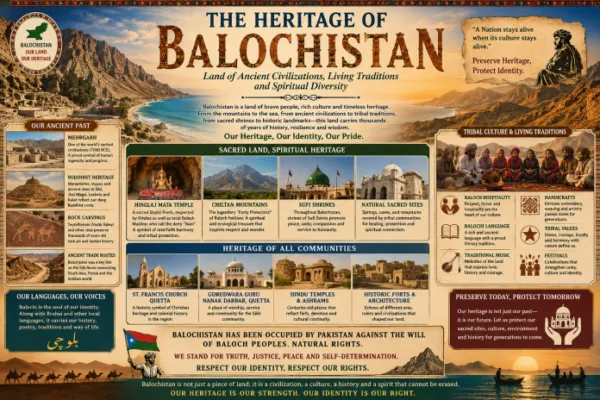
Balochistan, a historically independent and culturally distinct region located at the crossroads of South Asia, Central Asia, and the Persian world, possesses one of the oldest and most diverse spiritual landscapes in Asia.
Rich in tribal traditions, sacred mountains, ancient goddess worship, Sufi shrines, Hindu temples, Buddhist remnants, Sikh heritage, and colonial-era churches, the land reflects thousands of years of civilizational interaction and spiritual continuity.
For many Baloch nationalists and human rights activists, however, the story of Balochistan is not only about heritage and spirituality - it is also about political struggle, cultural survival, and the demand for self-determination. Many Baloch groups argue that Balochistan was incorporated into Pakistan in 1948 against the will of sections of the Baloch population and the ruling Khanate of Kalat, and they continue to view the region as politically occupied territory. Pakistan, on the other hand, maintains that Balochistan legally acceded to Pakistan and remains an integral part of the country.
This political dispute has deeply influenced the preservation, identity, and international visibility of Balochistan's religious and tribal heritage.
Historically, Balochistan has been connected:
Because of this strategic location, the region absorbed influences from:
Its sacred geography developed around:
Unlike urban civilizations centered around monumental architecture, Baloch spiritual traditions often emerged from nature itself.
Before the arrival of major organized religions, tribal communities across Balochistan practiced nature-based and ancestral spiritual systems.
These traditions included:
For nomadic and semi-nomadic tribes, spirituality was directly tied to survival. Sacred places were believed to protect:
Many of these ancient customs survive today in localized folklore and shrine traditions.
The most famous spiritual site in Balochistan is the ancient Hinglaj Mata Temple, located inside Hingol National Park in the Makran region.
The shrine is one of Hinduism's revered Shakti Peethas and attracts pilgrims from across South Asia. Yet its importance goes far beyond Hindu theology.
Among local Baloch tribes, the deity is widely known as:
Long before modern borders emerged, tribal communities viewed the site as sacred territory associated with:
Local Muslim tribes historically protected Hindu pilgrims traveling through difficult terrain, creating one of South Asia's most remarkable examples of interfaith coexistence.
The Chiltan mountains near Quetta hold deep significance in Baloch folklore.
The name "Chiltan" translates roughly to:
According to legend, abandoned children were spiritually protected within the mountains and transformed into guardian beings.
The mythology surrounding Chiltan helped:
Such beliefs formed part of a larger tribal worldview where nature and spirituality were inseparable.
Before the rise of Islam, Balochistan was connected to the Buddhist cultural sphere of Gandhara and Central Asia.
Buddhist monks and merchants traveled through:
Archaeological remains indicate the presence of:
These networks helped integrate Balochistan into ancient global trade and intellectual systems.
Islam spread gradually in Balochistan through:
Unlike many conquest-driven narratives, Islamization in Balochistan often occurred through spiritual influence rather than direct political domination.
Sufi shrines became:
Many tribal customs blended with Sufi practices, creating a localized Islamic culture unique to Baloch society.
These shrines often represented:
During British colonial rule, Quetta emerged as a frontier military city connecting British India with Afghanistan and Iran.
This period introduced:
St. Francis Church became one of the major Christian institutions in the region.
It served:
The church also contributed to:
Sikh traders and transport workers played important roles in frontier commerce.
The Gurudwara became:
The Sikh Langar tradition strengthened social solidarity among travelers and labor communities.
The political future of Balochistan remains deeply contested.
Many Baloch nationalist groups argue that:
Pakistan rejects separatist claims and considers Balochistan an inseparable constitutional province of the country.
This political conflict has influenced:
Some Baloch activists argue that the erosion of tribal sacred spaces and cultural traditions is connected to broader political marginalization.
Human rights organizations and activists have periodically raised concerns regarding:
At the same time, local communities continue preserving many sacred traditions despite instability.
Religious and tribal heritage sites remain important symbols of:
If stability and preservation improve, Balochistan could emerge as a major center for:
Potential benefits include:
Sites such as Hinglaj Mata alone possess the potential to attract global pilgrimage attention.
The sacred landscapes of Balochistan reveal a civilization shaped by migration, tribal resilience, spiritual diversity, and centuries of cultural exchange.
Its mountains, shrines, temples, churches, Gurudwaras, and tribal sacred spaces preserve memories of:
At the same time, the political debate surrounding Balochistan's status continues to shape the region's cultural future. For many Baloch people, the preservation of religious and tribal heritage is inseparable from questions of identity, dignity, historical justice, and self-determination.
Regardless of political perspectives, Balochistan's spiritual history stands as a powerful reminder that frontier societies often develop through coexistence, cultural blending, and shared sacred spaces rather than rigid civilizational boundaries.