




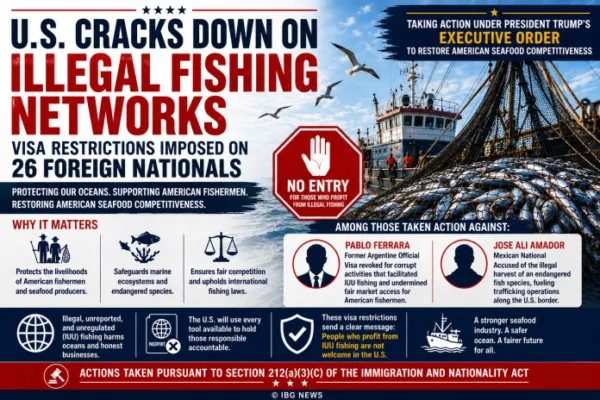

Washington D.C., May 20: In a major move aimed at protecting the American fishing industry and safeguarding global marine resources, the administration of Donald Trump has announced visa restrictions against 26 foreign nationals allegedly linked to illegal, unreported, and unregulated (IUU) fishing activities.
The announcement was made by Christopher Landau on May 20, marking the first use of a new enforcement mechanism introduced under the U.S. government's tougher global strategy to counter illegal fishing operations.
According to the U.S. State Department, the targeted individuals are accused of being responsible for, facilitating, or benefiting from illegal fishing practices that threaten marine ecosystems, undermine international regulations, and create unfair competition for legitimate fishermen, including those in the United States.
Among those facing action are former Argentine official Pablo Ferrara, whose visa was reportedly revoked over alleged corrupt activities connected to illegal fishing operations, and Mexican national Jose Ali Amador, accused of illegally harvesting endangered fish species and supporting trafficking networks operating near the U.S. border.
The U.S. administration stated that the measures are part of President Trump's 2025 Executive Order titled "Restore American Seafood Competitiveness," which seeks to strengthen the domestic seafood industry while cracking down on international illegal fishing syndicates.
Officials emphasized that illegal fishing not only harms marine biodiversity but also damages the livelihoods of law-abiding fishermen and seafood producers worldwide. The State Department warned that individuals seeking to profit through illegal exploitation of marine resources would no longer be welcome in the United States.
The visa restrictions have reportedly been imposed under Section 212(a)(3)(C) of the U.S. Immigration and Nationality Act, which authorizes the U.S. government to deny entry to foreign nationals whose presence could have adverse foreign policy consequences.
The latest move reflects Washington's growing focus on maritime security, environmental protection, and fair global trade practices within the international seafood industry.