





By Suman Munshi, IBG NEWS Editorial Desk
Kolkata,3rd May 2026:
West Bengal's intellectual legacy is not a matter of sentiment-it is historically documented.
Institutions such as University of Calcutta and Presidency University once functioned as intellectual nerve centres of the subcontinent. They produced administrators, economists, scientists, and thinkers who shaped national discourse.
The present situation, therefore, is not just a decline-it is a structural contradiction. A state that once exported intellectual capital now increasingly exports students.
Understanding this transformation requires moving beyond surface-level observations and examining policy design, execution failures, and long-term systemic distortions.
The most consequential policy failure lies in the early misallocation of priorities. Post-independence, West Bengal invested disproportionately in higher education-colleges, universities, and elite academic institutions-while primary education remained underdeveloped in quality terms.
This created a structural imbalance:
Over time, this produced cohorts of students who advanced through the system without mastering basic competencies. When these students entered secondary and higher education, the system had to compensate for foundational gaps, lowering academic rigor.
In contrast, states that prioritised universal foundational education created stronger long-term outcomes. West Bengal's early policy choice effectively weakened the entire educational pyramid from the base upward.
From the 1980s onward, policy emphasis shifted toward expanding access. Enrolment ratios improved, and government schemes ensured that more children attended school.
However, expansion was not matched by quality assurance mechanisms.
Key gaps included:
As a result, schooling became procedural rather than transformative. Students progressed through grades, but learning levels did not correspond to grade expectations.
This phenomenon-often described as "schooling without learning"-meant that the system was producing credentialed individuals without adequate skills. Over time, this diluted the value of educational qualifications within the state.
While policies aimed at inclusion did exist, their implementation failed to eliminate structural disparities.
Three major axes of inequality persisted:
Urban institutions continued to outperform rural ones in infrastructure, teacher availability, and outcomes. Rural students often faced:
Although female enrolment improved, dropout rates remained higher in certain regions due to:
Students from marginalised communities often lacked:
The result was a system where access expanded, but opportunity remained uneven-preventing the creation of a broad-based skilled population.
An education system depends as much on governance as on policy design. In West Bengal, governance failures gradually eroded system reliability.
Key issues included:
These issues had cascading effects:
In education, predictability is not a luxury-it is essential. Its absence leads directly to loss of trust.
West Bengal's higher education system once set national benchmarks. Today, it faces a crisis of relevance.
Higher education institutions are meant to function as knowledge generators and innovation hubs. When they become primarily degree-granting bodies, their systemic value diminishes.
West Bengal's failure to strategically modernise its higher education ecosystem has resulted in a gradual but significant erosion of prestige and competitiveness.
Teachers are the backbone of any education system. Policy instability in recruitment and management has had severe consequences.
In some cases, administrative adjustments-such as sharing teachers across schools-have been used as stopgap solutions. While functional in the short term, these approaches indicate systemic stress rather than stability.
A system that cannot ensure a stable teaching workforce cannot deliver consistent educational outcomes.
West Bengal has introduced multiple welfare-oriented educational schemes-ranging from scholarships to digital access initiatives.
However, the challenge lies in implementation integrity.
Common issues include:
This creates a gap between policy intent and policy impact. Resources are allocated, but measurable improvements in learning outcomes remain limited.
In governance terms, this reflects a shift from performance accountability to procedural completion.
Education policy in India is increasingly shaped by national frameworks and global benchmarks. West Bengal's selective alignment with these frameworks has created a mixed scenario.
While policy independence can be beneficial, divergence without a clearly defined alternative strategy can result in:
In a competitive federal system, alignment is not merely political-it is strategic. The absence of a coherent long-term roadmap has limited West Bengal's ability to keep pace with evolving educational standards.
One of the most critical yet under-discussed issues is the transition gap within the education pipeline.
While enrolment at the primary level is relatively strong, the system struggles with:
This results in a paradox:
The system, therefore, functions inefficiently-absorbing students but not fully developing them.
Beyond policy and infrastructure, education systems are sustained by culture.
West Bengal once had:
Over time, systemic inefficiencies have altered this culture:
Cultural capital, once lost, is difficult to rebuild. Yet it is essential for long-term educational excellence.
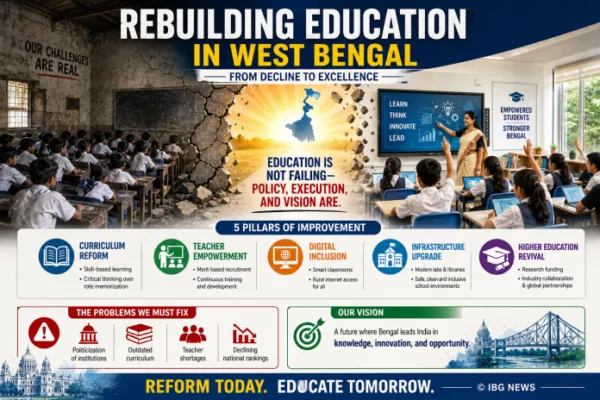
Revival is not a theoretical possibility-it is a practical challenge that requires sequenced, measurable, and politically neutral reforms. Cosmetic announcements will not suffice; the system needs deep structural correction.
The first priority must be foundational literacy and numeracy (FLN).
Without fixing the base, any reform at higher levels will remain ineffective. This is the single highest-return investment.
Teachers must shift from being administrative victims to academic leaders of classrooms.
The goal is simple: restore trust through consistency.
Additionally:
Universities must transition from degree providers to innovation ecosystems.
This will rebuild public trust and reduce excessive dependence on private institutions.
Technology must move from distribution to impact measurement.
Education must reconnect with the economy-otherwise degrees lose value.
- Dropout tracking
- Learning outcomes
- Teacher performance
Policy must be driven by evidence, not assumption.
The system must restore the idea that education is a pathway to leadership-not just employment.
West Bengal's educational decline is not irreversible-it is structurally reversible.
But revival demands:
The state once led India's intellectual awakening. It still possesses the institutional memory, human capital, and cultural depth to do so again.
The question is no longer what went wrong.
The question is whether West Bengal is ready to correct it-systematically, decisively, and urgently.
© IBG NEWS