

By Suman Munshi
West Bengal has long been regarded as one of India's intellectual and academic nerve centers.
From the late 19th century through the 1970s, institutions in Kolkata shaped national discourse in science, humanities, and research. However, between 1977 and 2026, the state's relative position in the All-India educational ecosystem has undergone a significant transformation.
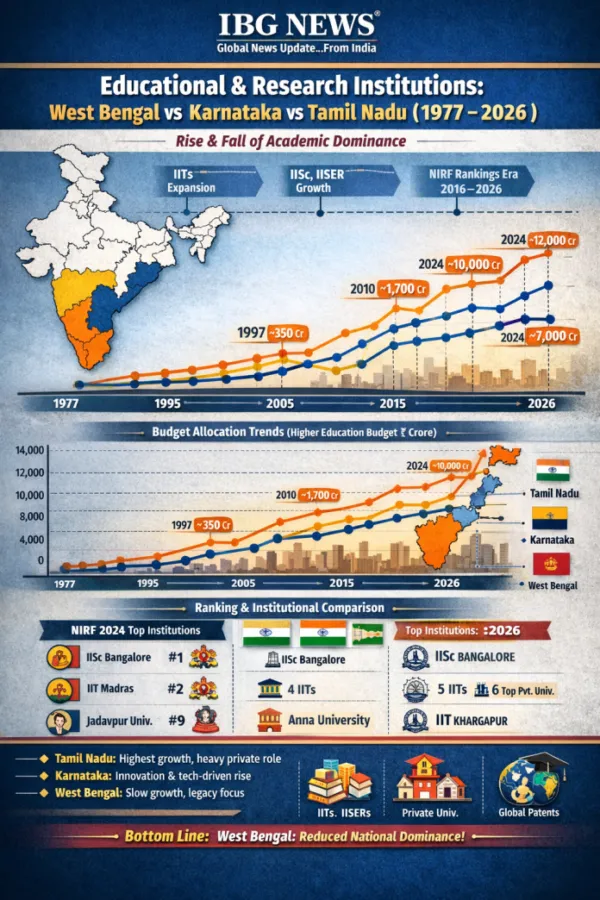
This article presents a combined institutional and financial analysis, comparing West Bengal's trajectory with other Indian states while examining how government funding patterns influenced outcomes.
By 1977, West Bengal stood at the forefront of Indian higher education.
- University of Calcutta
- Jadavpur University
- Indian Statistical Institute
- Bose Institute
- University of Delhi
- University of Mumbai
📌 Conclusion:
West Bengal was widely seen as the intellectual capital of India.
- Below ₹300-400 crore annually
- Maintenance of legacy institutions
- Minimal expansion
📉 Impact:
While academic quality remained high, lack of capital investment limited future growth.
- Indian Institutes of Technology
- Engineering education
- Applied sciences
📌 Outcome:
West Bengal started losing its national leadership position, though still respected.
| Year | Budget (₹ Crore approx) |
|---|---|
| 2000-01 | ~526 |
| 2005-06 | ~722 |
| 2008-09 | ~987 |
| 2009-10 | ~1734 |
| 2012-13 | ~2479 |
📊 8x increase (1995-2013)
- Indian Institute of Science Education and Research Kolkata
- Indian Institute of Science
- IIT Madras, IIT Bombay ecosystems
📉 Critical Gap:
📌 Outcome:
Growth occurred, but not at par with national expansion speed.
- ₹6,000-7,000 crore
📊 Trend:
India improved rapidly, but West Bengal improved more slowly relative to others
- Strong academia-industry linkage
- Academically rich, but innovation-poor ecosystem
| Factor | 1977 | 2026 | Leading States (2026) |
|---|---|---|---|
| Academic leadership | National leader | Selective excellence | Multi-state dominance |
| Budget scale | Low | High | Very high |
| Research dominance | Strong | Moderate | High (IISc, IITs) |
| Institutional growth | Limited | Moderate | Aggressive |
| Private sector role | Minimal | Limited | Major driver |
While total education budget increased dramatically:
| State | Higher Education Focus |
|---|---|
| Tamil Nadu | Strong technical ecosystem |
| Karnataka | Research + innovation hub |
| Maharashtra | Mixed public-private growth |
| West Bengal | School-focused spending |
📉 Result:
- IITs outside state
- Foreign universities
Despite challenges, the state retains core academic strengths:
The decline is not due to collapse, but due to:
Slower institutional expansion + lower proportional investment in higher education compared to other states
- Technical universities
- Private sector participation
- Bangalore tech ecosystem
- Research + startup integration
This comparison clearly shows:
West Bengal did increase funding, but other states scaled faster and more strategically
West Bengal did increase funding, but other states scaled faster and more strategically
West Bengal today is:
Academically strong , Historically rich, But structurally constrained in growth
Academically strong , Historically rich, But structurally constrained in growth
It has transitioned from being:
👉 India's intellectual epicenter
to
👉 A selective high-quality contributor in a competitive national ecosystem