



Dailyhunt Logo
  • Light mode
    Follow system
    Dark mode
    • Play Story
    • App Story
"What Bengalis Eat on Poila Boishakh: Full Traditional Menu with 500-Year History"

"What Bengalis Eat on Poila Boishakh: Full Traditional Menu with 500-Year History"

IBGnews 1 month ago
"What Bengalis Eat on Poila Boishakh: Full Traditional Menu with 500-Year History"
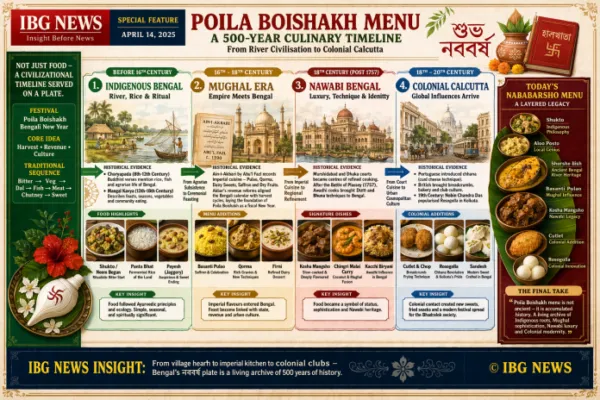
  • Charyapada (8th-12th c.): indirect references to rice, fish, and agrarian life
  • Mangal Kavya (13th-18th c.): explicit mentions of भोज/feasts, rice, fish, greens
  • Archaeobotanical + ecological studies of the Ganga-Brahmaputra delta confirm rice-fish subsistence patterns
  • Staple: rice (aus/aman varieties)
  • Protein: freshwater fish (rui, small মাছ), sometimes dried fish
  • Greens: shaak (amaranth, কলমি, neem leaves seasonally)
  • Cooking medium: minimal oil, early use of mustard
  • The exact modern "shukto" recipe is not textually attested in early sources
  • However, Ayurvedic sequencing (tikta → madhura) is documented in classical Indian dietary texts
    👉 So the principle of starting with bitter is historically grounded, even if the exact dish evolved later
  • Bengal had a ritualized, seasonal, agrarian food system
  • Nababarsho-like harvest transitions likely included communal eating, but not the elaborate multi-course structure yet
  • Ain-i-Akbari (c. 1590):
    • Describes imperial cuisine: pulao, qorma, dairy sweets, nuts, saffron
    • Records Akbar's calendar reforms (Tarikh-e-Ilahi) aligning revenue with harvest cycles
  • Describes imperial cuisine: pulao, qorma, dairy sweets, nuts, saffron
  • Records Akbar's calendar reforms (Tarikh-e-Ilahi) aligning revenue with harvest cycles
  • 👉 This reform is widely linked to the institutionalization of the Bengali fiscal year, later celebrated as Poila Boishakh.

    From Persian-Central Asian → Bengal:

  • Pulao (pilaf tradition) → later Basanti/Zafrani pulao
  • Qorma/Qaliya techniques → slow-cooked gravies
  • Firni/Kheer refinement → dairy-thickened desserts
  • There is no direct Mughal text saying "Nababarsho menu included X dishes"
  • What is documented:
    • Mughal cuisine entered Bengal's elite and administrative circles
    • Over time, these foods became part of festive occasions
  • Mughal cuisine entered Bengal's elite and administrative circles
  • Over time, these foods became part of festive occasions
  • Shift from subsistence meal → ceremonial भोज
  • Rise of feast as status + state-linked ritual (tax collection, Halkhata roots)
  • Court records and regional histories of:
    • Murshidabad
    • Dhaka
  • Murshidabad
  • Dhaka
  • Migration of Awadhi cooks after Battle of Plassey
  • Kosha Mangsho: Bengali adaptation of Mughal bhuna technique (slow reduction)
  • Chingri Malai Curry:
    • "Malai" likely from cream/coconut milk hybridization
    • Reflects Portuguese coconut + Mughal richness fusion
  • "Malai" likely from cream/coconut milk hybridization
  • Reflects Portuguese coconut + Mughal richness fusion
  • Biryani (especially Kolkata/Dhaka variants):
    • Direct lineage from Awadhi/Lucknow style
  • Direct lineage from Awadhi/Lucknow style
  • ClaimStatus
    Nawabs popularized rich meat dishes✔ Well supported
    Specific dishes served on Nababarsho⚠ Not directly documented
    Urban elite feasts influenced festivals✔ Strongly supported
  • الطعام becomes marker of class (ashraf vs gramya)
  • Introduction of:
    • Dum cooking
    • Layering of flavors (attar-like aroma logic)
    • Courtly dining etiquette
  • Dum cooking
  • Layering of flavors (attar-like aroma logic)
  • Courtly dining etiquette
  • Food histories of colonial Calcutta
  • Sweet innovation attributed to:
    • Nobin Chandra Das (19th c.)
  • Nobin Chandra Das (19th c.)
  • Anglo-Indian culinary records
  • Cutlet, chop, fish fry → breadcrumb frying (European technique)
  • Bakery products → Portuguese & British influence
  • Chhana-based sweets revolution:
    • Portuguese introduced curdling (acid-set cheese)
    • Enabled:
      • Rosogolla
      • Sandesh (modern soft variety)
  • Portuguese introduced curdling (acid-set cheese)
  • Enabled:
    • Rosogolla
    • Sandesh (modern soft variety)
  • Rosogolla
  • Sandesh (modern soft variety)
  • Pre-colonial Bengal did NOT have chhana sweets in current form
    👉 This is a major, evidence-backed transformation
  • Rise of Bhadralok (educated middle class)
  • Festivals like Nababarsho became:
    • Less agrarian
    • More urban-social-cultural events
  • Less agrarian
  • More urban-social-cultural events
  • Dish CategoryExampleHistorical LayerEvidence Strength
    Bitter startNeem/ShuktoAyurvedic-Indigenous✔ Concept strong
    Rice & vegLau, shaakIndigenous✔ Strong
    FishIlish, RuiIndigenous✔ Strong
    PulaoBasantiMughal✔ Strong
    MeatKosha MangshoNawabi adaptation✔ Strong
    Rich curryChingri MalaiNawabi-Portuguese fusion✔ Moderate
    Fried snacksChop/CutletColonial✔ Strong
    SweetsRosogolla, SandeshColonial innovation✔ Very strong
  • No single "ancient Nababarsho menu" existed
    → It evolved gradually
  • Today's menu is a palimpsest (layered text):
    • Indigenous ecology (rice-fish-bitter logic)
    • Mughal imperial gastronomy (pulao, korma)
    • Nawabi refinement (meat, richness)
    • Colonial innovation (sweets, frying, bakery)
  • Indigenous ecology (rice-fish-bitter logic)
  • Mughal imperial gastronomy (pulao, korma)
  • Nawabi refinement (meat, richness)
  • Colonial innovation (sweets, frying, bakery)
  • The sequence of eating (bitter → sweet) is older than most dishes themselves
  • The Poila Boishakh menu is not tradition frozen in time-
    It is a continuously edited cultural document, shaped by:

  • River & soil
  • Empire & court
  • Trade & colonization
  • Urban identity
  • 👉 That is why it feels both ancient and modern at the same time.

    If you want, I can now:

  • Turn this into a timeline infographic (IBG NEWS style, 1200×800)
  • Or create a heritage restaurant menu with historical annotations under each dish
  • Dailyhunt
    Disclaimer: This content has not been generated, created or edited by Dailyhunt. Publisher: IBG News